Blogger Themes

Showing posts with label Communications. Show all posts

Tuesday, 10 July 2012

New chip captures power from multiple sources

Engineerblogger
July 10, 2012


Graphic: Christine Daniloff

Researchers at MIT have taken a significant step toward battery-free monitoring systems — which could ultimately be used in biomedical devices, environmental sensors in remote locations and gauges in hard-to-reach spots, among other applications.

Previous work from the lab of MIT professor Anantha Chandrakasan has focused on the development of computer and wireless-communication chips that can operate at extremely low power levels, and on a variety of devices that can harness power from natural light, heat and vibrations in the environment. The latest development, carried out with doctoral student Saurav Bandyopadhyay, is a chip that could harness all three of these ambient power sources at once, optimizing power delivery.

The energy-combining circuit is described in a paper being published this summer in the IEEE Journal of Solid-State Circuits.

“Energy harvesting is becoming a reality,” says Chandrakasan, the Keithley Professor of Electrical Engineering and head of MIT’s Department of Electrical Engineering and Computer Science. Low-power chips that can collect data and relay it to a central facility are under development, as are systems to harness power from environmental sources. But the new design achieves efficient use of multiple power sources in a single device, a big advantage since many of these sources are intermittent and unpredictable.

“The key here is the circuit that efficiently combines many sources of energy into one,” Chandrakasan says. The individual devices needed to harness these tiny sources of energy — such as the difference between body temperature and outside air, or the motions and vibrations of anything from a person walking to a bridge vibrating as traffic passes over it — have already been developed, many of them in Chandrakasan’s lab.

Combining the power from these variable sources requires a sophisticated control system, Bandyopadhyay explains: Typically each energy source requires its own control circuit to meet its specific requirements. For example, circuits to harvest thermal differences typically produce only 0.02 to 0.15 volts, while low-power photovoltaic cells can generate 0.2 to 0.7 volts and vibration-harvesting systems can produce up to 5 volts. Coordinating these disparate sources of energy in real time to produce a constant output is a tricky process.

So far, most efforts to harness multiple energy sources have simply switched among them, taking advantage of whichever one is generating the most energy at a given moment, Bandyopadhyay says, but that can waste the energy being delivered by the other sources. “Instead of that, we extract power from all the sources,” he says. The approach combines energy from multiple sources by switching rapidly between them.

Another challenge for the researchers was to minimize the power consumed by the control circuit itself, to leave as much as possible for the actual devices it’s powering — such as sensors to monitor heartbeat, blood sugar, or the stresses on a bridge or a pipeline. The control circuits optimize the amount of energy extracted from each source.

The system uses an innovative dual-path architecture. Typically, power sources would be used to charge up a storage device, such as a battery or a supercapacitor, which would then power an actual sensor or other circuit. But in this control system, the sensor can either be powered from a storage device or directly from the source, bypassing the storage system altogether. “That makes it more efficient,” Bandyopadhyay says. The chip uses a single time-shared inductor, a crucial component to support the multiple converters needed in this design, rather than separate ones for each source.

David Freeman, chief technologist for power-supply solutions at Texas Instruments, who was not involved in this work, says, “The work being done at MIT is very important to enabling energy harvesting in various environments. The ability to extract energy from multiple different sources helps maximize the power for more functionality from systems like wireless sensor nodes.”

Only recently, Freeman says, have companies such as Texas Instruments developed very low-power micro-controllers and wireless transceivers that could be powered by such sources. “With innovations like these that combine multiple sources of energy, these systems can now start to increase functionality,” he says. “The benefits from operating from multiple sources not only include maximizing peak energy, but also help when only one source of energy may be available.”

The work has been funded by the Interconnect Focus Center, a combined program of the Defense Advanced Research Projects Agency and companies in the defense and semiconductor industries.

Source: MIT

Additional Information:

Friday, 27 April 2012

The Intersection of Information and Energy Technologies

Engineerblogger
April 27, 2012


Smart energy: Entrepreneur Bill Gross amid the solar-thermal concentrators of eSolar’s Sierra SunTower in 2009. Credit: Andres Castañeda

Two talks at the TED conference this year formed, back to back, a sort of debate about the future of our planet. First, Paul Gilding gave a talk entitled "The Earth Is Full," about how we are using up all Earth's resources, with possibly devastating consequences. Next, X Prize creator Peter Diamandis gave a presentation entitled "Abundance," about how we will invent innovative ways to solve the challenges that loom before us.

I believe that we will need great ingenuity to enable our planet to provide successfully for more than seven billion human beings, let alone the nine billion that will probably inhabit it by 2050, and I believe that information technology will make this ingenuity possible. Because of fluid marketplaces and an ever more globalized economy, nearly every important resource is becoming scarcer and more costly. Evidence of this is seen in the price not only of oil but also of aluminum, concrete, wood, water, rare-earth elements, and even common elements like copper. Everything is getting more expensive because billions of people are trying creatively to repackage and consume these materials. But there is one resource whose price has consistently has gone down: computation.

The power, cost, and energy use involved in one unit of computation is declining at a more consistent, dependable rate than we have seen with any other commodity in human history. That declining cost curve must be tapped to lower energy prices—and I believe it will be. This will happen as people ask: To achieve my purpose (in designing whatever device or system), can I use more "atoms" or more "bits" (computation power)? The choice will have to be bits, because atoms are going up in price while bits are going down.

Here are a few examples. When designing a car, one can put a bit more effort into stronger, lighter-weight materials, which will increase energy efficiency but possibly drive up cost; or one can put a lot more effort into using computational power to run simulations that optimize the use of materials. Today, computational fluid dynamics allow a designer to accurately design a new shape of car, put it in a computer wind tunnel instead of a physical one, and test 1,000,000 body designs to improve fuel mileage by significant amounts. This was never before possible for those constructing vehicles.

In solar energy, large fields of mirrors or photovoltaic panels can be optimized to be lighter, more reliable, and more power-efficient by putting a $2 microprocessor in every panel. An onboard computer that lets each panel track the sun independently replaces previous systems that used more steel, bigger gears, and bigger gearboxes—basically, more materials. As little as 10 years ago, the computing power and sensors needed to build a closed-loop, sun-tracking solar panel might have cost $2,000, or more than the panel itself, and thus the system would not have been cost effective. But with computing costs coming down by a factor of 1,000 every 15 years, all kinds of new opportunities arise to improve system design.

At eSolar, one of our companies, we designed and built a utility-scale solar-thermal power plant with a huge amount of computation embedded into the field of mirrors. We reduced the size of the components, cut the installation expense, and drove the cost of the system down to nearly half what had been achieved before. This experience proved to me the feasibility of replacing atoms with bits.

The price reduction curve for computing is not over—it's continuing, and each year will open up further avenues for ingenuity. That is important because our current energy resources are not at all easy to compete with. Fuels that we dig out of the ground and burn are extremely cheap. They are, in effect, the concentrated storage of millions of years of sunlight falling on Earth. Ironically, the biggest component of energy costs is the expense of moving the fuel to consumers from where it's obtained—and transportation costs are mostly fuel, too. So we are in a kind of vicious cycle. The way to break free of fossil fuels is to introduce something new to our energy equation that isn't fuel.

I believe ingenuity in the form of information technology is the only variable that offers sufficient leverage. We need to replace a cheap, unsustainable form of energy with sustainable forms of energy that are equally cheap. The only way to compete with cheap fuels is to be more clever with computation; that is, to use as little of anything else as possible.

Source: Technology Review

Friday, 2 March 2012

Graphene-Based Optical Modulators Poised to Break Speed Limits in Digital Communications

Engineerblogger
March 2, 2012


In yet another astounding application of the “wonder material” graphene, scientists at the University of California, Berkeley discovered that it makes an excellent active media for optical modulators. Graphene-based modulators are expected to significantly enhance ultrafast optical communication and computing. The team will report on their findings at the Optical Fiber Communication Conference and Exhibition/National Fiber Optic Engineers Conference (OFC/NFOEC) taking place next week in Los Angeles.

Modulators play a vital role in communications due to their switching ability, because this is what controls the speed that data packets can travel through networks. As the speed of data pulses sent out increases, it means that greater volumes of information can be transmitted.

“We demonstrated a graphene-based optical modulator with a broad optical bandwidth (1.35-1.6 µm), a small device footprint (25 µm2), and high operational speed (1.2 GHz at 3dB) under ambient conditions—all of which are essential for optical interconnects for future integrated optoelectronic systems,” says Ming Liu, a post-doctoral researcher working at UC Berkeley’s NSF Nanoscale Science and Engineering Center. “The modulation efficiency of a single layer of a hexagonal carbon atom is already comparable to, if not better than, traditional semiconductor materials, which are orders of magnitude larger in active volume.”

Looking into future applications, graphene-based modulators could be very compact and potentially perform at speeds up to 10 times faster than today’s technology allows. They may someday enable consumers to stream full-length, high-definition, 3-D movies onto their smartphones within mere seconds.

Liu’s talk, “Graphene-based optical modulators,” takes place Tuesday, March 6 at 3:30 p.m. in the Los Angeles Convention Center.

About OFC/NFOEC

For more than 35 years, the Optical Fiber Communication Conference and Exposition/ National Fiber Optic Engineers Conference (OFC/NFOEC) has been the premier destination for converging breakthrough research and innovation in telecommunications, optical networking and, recently, datacom and computing. Uniting service providers, systems companies, enterprise customers, IT businesses and component manufacturers, along with researchers, engineers and development teams, OFC/NFOEC combines dynamic business programming, an exposition of more than 500 companies and cutting-edge peer-reviewed research into one event that showcases the trends and pulse of the entire optical communications industry. OFC/NFOEC is managed by the Optical Society (OSA) and co-sponsored by OSA, the Institute of Electrical and Electronics Engineers/Communications Society (IEEE/ComSoc) and the IEEE Photonics Society. Acting as a non-financial technical co-sponsor is Telcordia Technologies

Source:  Optical Society of America (OSA)

Thursday, 1 March 2012

Material Flow and Logistics technology: Swarming and transporting

Engineerblogger
March 1, 2012


The autonomous transporters perform their work in a swarm.  Source:  Fraunhofer IML

On its own, an ant is not particularly clever. But in a community, the insects can solve complicated tasks. Researchers intend to put this „swarm intelligence“ to use in the logistics field. Lots of autonomous transport shuttles would provide an alternative to traditional materials-handling technology.

The orange-colored vehicle begins moving with a quiet whirr. Soon afterwards the next shuttles begin to move, and before long there are dozens of mini-transporters rolling around in the hall. As if by magic, they head for the high-rack storage shelves or spin around their own axis. But the Multishuttle Moves® – is the name given to these driverless transport vehicles – are not performing some robots‘ ballet. They are moving around in the service of science. At the Fraunhofer Institute for Material Flow and Logistics IML in Dortmund, Germany, researchers are working to harness swarm intelligence as a means of improving the flow of materials and goods in the warehouse environment. In a research hall 1000 square meters in size, the scientists have replicated a small-scale distribution warehouse with storage shelves for 600 small-part carriers and eight picking stations. The heart of the testing facility is a swarm of 50 autonomous vehicles. “In the future, transport systems should be able to perform all of these tasks autonomously, from removal from storage at the shelf to delivery to a picking station. This will provide an alternative to conventional materials-handling solutions,“ explains Prof. Dr. Michael ten Hompel, executive director at IML.

But how do the vehicles know what they should transport, and where, and which of the 50 shuttles will take on any particular order? “The driverless transport vehicles are locally controlled. The ›intelligence‹ is in the transporters themselves,“ Dipl.-Ing. Thomas Albrecht, head of the Autonomous Transport Systems department explains the researchers‘ solution approach. “We rely on agent-based software and use ant algorithms based on the work of Marco Dorigo. These are methods of combinational optimization based on the model behavior of real ants in their search for food.“ When an order is received, the shuttles are informed of this through a software agent. They then coordinate with one another via WLAN to determine which shuttle can take over the load. The job goes to whichever free transport system is closest.

The shuttles are completely unimpeded as they navigate throughout the space – with no guidelines. Their integrated localization and navigation technology make this possible. The vehicles have a newly developed, hybrid sensor concept with signal-based location capability, distance and acceleration sensors and laser scanners. This way, the vehicles can compute the shortest route to any destination. The sensors also help prevent collisions.

The vehicles are based on the components of the shelf-bound Multishuttle already successfully in use for several years. The researchers at IML have worked with colleagues at Dematic to develop the system further. The special feature about the Multishuttle Move®: the transporters can navigate in the storage area and in the hall. To accomplish this, the shuttles are fitted with an additional floor running gear. But what benefits do these autonomous transporters offer compared with conventional steady materials-handling technology with roller tracks? “The system is considerably more flexible and scalable,“ Albrecht points out. It can grow or contract depending on the needs at hand. This is how system performance can be adapted to seasonal and daily fluctuation. Another benefit: It considerably shortens transportation paths. In conventional storage facilities, materials-handling equipment obstructs the area between high-rack storage and picking stations. Packages must travel two to three times farther than the direct route. “It also makes shelf-control units and steady materials-handling technology,“ Albrecht adds. Researchers are now trying to determine how these autonomous transporters can improve intralogistics. “We want to demonstrate that cellular materials-handling technology makes sense not only technically but also economically as an alternative to classic materials-handling technology and shelf-control units,“ institute executive director ten Hompel observes. If this succeeds, the autonomous vehicles could soon be going into service in warehouses.

Source: Fraunhofer-Gesellschaft

Thursday, 23 February 2012

Smaller antennas for smaller wireless devices and still smaller micro-air vehicles

Engineerblogger
Feb 23, 2012


In most cases the size of the antenna within a wireless device is actually the limiting factor in the minimum achievable size of the device itself. As such, manufacturers must "build up" to the required antenna size. Dr. Grbic's team provides a way for manufacturers to either "build down" to a much smaller size, or with a smaller antenna, to allow additional room for more capabilities with built-in options.

Supported by a Presidential Early Career Award for Scientists and Engineers through the Air Force Office of Scientific Research, Dr. Anthony Grbic utilizes an innovative fabrication process to produce small, efficient antennas.

When you thought our hand held electronic devices could not get any smaller or more efficient, along comes Dr. Anthony Grbic and his research team from the Department of Electrical Engineering and Computer Science at the University of Michigan, with an antenna the size of an quarter.

You may ask: why is this significant? Dr. Grbic, and his colleague Dr. Stephen Forrest, point out that in most cases the size of the antenna within a wireless device is actually the limiting factor in the minimum achievable size of the device itself. As such, manufacturers must "build up" to the required antenna size. Dr. Grbic's team provides a way for manufacturers to either "build down" to a much smaller size, or with a smaller antenna, to allow additional room for more capabilities with built-in options.

The key to this new design is the hemispherical shape of the antenna which takes advantage of volume—just imagine the top half of a sphere with a descending spiral antenna winding down to the base—instant miniaturization. Dr. Grbic notes that this hemispherical antenna concept had been around for several years, but there was no practical way to mass produce the spiral antenna pattern. The Grbic and Forrest teams overcame this obstacle with a simple metallic stamping process which is very quick, efficient and potentially inexpensive, while maintaining the same bandwidth as their larger counterparts.

Currently this antenna design operates in only one frequency band, so the next step is to make the antenna operate in multiple frequency bands for use in multiple applications. Talks are also underway with Bluetooth and WiFi communications manufacturers to utilize this new technology. Of particular interest to the Air Force is the integration of these small and highly efficient antennas on autonomous micro-air vehicles, and taking this process one step further, the technique could be applied to the manufacture of conformal antennas that could be integrated onto the surface of an air vehicle—conforming to their low profile stealth design.


Source: Air Force Office of Scientific Research

Tuesday, 21 February 2012

“Duet of one” possible with hand-controlled voice synthesizer

Engineerblogger
Feb 21, 2012


New technology at the University of British Columbia makes it possible for a person to speak or sing just by using their hands to control a speech synthesizer.

UBC researcher Sidney Fels says the gesture-to-voice-synthesizer technology mirrors processes that human use when they control their own vocal apparatus.

“It’s like playing a musical instrument that plays voice. Applications could include new forms of musical expression and aids for people with speaking disabilities,” says Fels, professor of electrical and computer engineering at the Faculty of Applied Science and director of the Media and Graphics Interdisciplinary Centre (MAGIC).

Fels presented the technology today at the annual meeting of the American Association for the Advancement of Science in Vancouver.

Fels and his team used special gloves equipped with 3-D position sensors that locate the hand in space. Certain glove postures are associated with certain areas in the audio spectrum.

The right-hand glove has sensors to detect bending so when a user closes her hand, it creates consonant sounds. Opening the right hand produces vowel sounds in the same fashion as a vocal tract does when the tongue moves. The left glove controls stop sounds – like the consonant “B”.

The researchers developed a set collection of gestures that are mapped to consonant sounds. The right glove controls vowels by its location in space horizontally and also controls pitch by its location in space vertically.

“Other possible applications for this discovery are interfaces to make certain tasks easier such as controlling cranes or other heavy machinery,” says Fels, whose research interests include human-computer interaction, biomechanical modeling of the upper airway, speech synthesis, and neural networks.

Co-investigators for this project are UBC School of Music Asst. Prof. Robert Pritchard and Johnty Wang, a UBC electrical and computer engineering masters student and concert pianist.

To date, there have been seven international performances with musicians playing a set of pieces written specifically for the expressive capacities of this particular instrument. “It takes about 100 hours for a performer to learn how to speak and use the system,” says Fels.

Source: University of British Columbia.

Wednesday, 15 February 2012

GM IntelliLink Helps Drivers Get Connected

Engineerblogger
Feb 15, 2012


The IntelLink system lets you organize icons according to your preferences.  Credit: GM

The 2012 GMC Terrain smaller SUV’s standard Color Touch Radio is now available with IntelliLink, which provides smartphone connectivity and voice activated control of the audio system. Simple commands initiate a phone call, change a station, stream internet radio, and even control an iPod.

IntelliLink’s interface is designed to be used with two hands on the wheel as often as possible, and its layout was created with specific emphasis on minimizing distractions. Here are some other important things to know about the system:
  • Like most smartphones, the IntelliLink homescreen is configurable. An array of icons for phone, radio, and other functions mimics the displays of popular mobile devices, and each icon can be shifted or removed, based on the driver’s needs and wants.
  • IntelliLink has icons for popular internet radio providers Pandora and Stitcher for Bluetooth streaming through a smartphone, Pandora listeners can give a song a “thumbs-up” or “thumbs-down” through Terrain’s seven-inch touchscreen.
  • Most of IntelliLink’s features can be controlled through a hands-free voice control system powered by Nuance. Drivers can place a phone call, play an artist, or tune to a radio station without their eyes leaving the road.
  • An MP3 player isn’t required to play music through Intellilink. Owners can bring their music collections into the car by plugging a USB flash drive into a port in the center console.
  • Album art and artist information for songs playing from a device are displayed on Terrain’s color touch screen. The Gracenote data that allows this also makes voice activation more conversational, identifying nicknames like “The Boss” or “The Stones.”

GMC’s implementation of the Gracenote media database includes a piece of exclusive, patent-pending technology, according to General Motors lead engineer Tony Kraatz.

“Gracenote is typically limited to devices plugged in to the USB port,” he said. “With IntelliLink, we are the first company to run Bluetooth streaming audio through the Gracenote database to display album art for music players connected wirelessly.”

“About 70 percent of all new car buyers want some form of connectivity,” said Micky Bly, executive director leading GM’s infotainment engineering efforts, citing GM research. “Whether it’s because they want to listen to their favorite music or hear movie times on the way to the theater, today’s car buyer expects so much more out of their time in a car.”

The GMC Terrain talks with smartphones in other ways than just IntelliLink. With the OnStar RemoteLink app available for iPhone and Android, drivers can use their phones to lock and unlock doors or check fuel and tire pressure levels. On models equipped with remote start, the app can also start the engine from anywhere a cell phone signal is present.

IntelliLink is available now for the 2012 GMC Terrain SLT-2 V-6 and is coming soon to all SLT models. Last week, GMC debuted IntelliLink connectivity for the redesigned 2013 Acadia and Acadia Denali, on sale in late 2012.

About GMC  

GMC has manufactured trucks since 1902, and is one of the industry's healthiest brands. Innovation and engineering excellence is built into all GMC vehicles and the brand is evolving to offer more fuel-efficient trucks and crossovers, including the Terrain smaller SUV and Acadia crossover. GMC is the only manufacturer to offer three full-size hybrid trucks with the Yukon, Yukon Denali SUVs and the Sierra pickup. The new Sierra Heavy Duty pickups are the most capable and powerful trucks in the market.

Source: General Motors

Wednesday, 8 February 2012

Allen-Vanguard to co-develop world’s first Wireless Underground Robots for First Responders (WURFR)

Engineerblogger
Feb 8, 2012


A new robot that can communicate wirelessly from underground could be used to rescue people trapped in inaccessible places. Credit: The Engineer


Allen-Vanguard, trusted global leader in providing solutions for defeating terrorist/extremist threats, announced today its collaboration with WFS Defense, leading supplier of through-ground and through-water wireless communications technology, to develop and demonstrate the industry’s first Wireless Underground Robots for First Responders (WURFR) robotic vehicle. The announcement was made on the opening day of the Security & Policing Exhibition 2012, in Farnborough, UK, where Allen-Vanguard is displaying its latest Counter-Threat solutions.

During emergency incidents, First Responders deploy Remotely Operated Vehicles (ROVs) to avoid exposing themselves to unnecessary risks in hostile or challenging environments, such as clandestine tunnels, subway systems and underground structures. The WURFR project, co-funded by the United Kingdom Technology Strategy Board, will alleviate the logistics currently posed by hardwire tethers or multiple repeaters needed to control a robot in these situations. This will be achieved through the seamless integration of WFS’s through-ground wireless communications into Allen-Vanguard’s Digital Vanguard robot.

Allen-Vanguard President & CEO, Dennis Morris, commented, “Our WURFR-generation robot will improve First Responder safety by enabling operators to remain above ground while reliably communicating with their ROV as it conducts visual reconnaissance, detects hazardous substances and mitigates threats.” He continued, “This unprecedented capability will greatly simplify on site operations and reduce costs for
inspecting and clearing high risk underground locations.”

The WURFR-enabled ROV will use WFS’ wireless modems to provide 2-way communications, track its
location, stream video and convey data from sensors. The Digital Vanguard is the ideal platform for this project based on its outstanding operational capabilities and widespread user base of First Responders and
security agencies.

About Allen-Vanguard
Allen-Vanguard is a trusted global leader in providing solutions for defeating terrorist and extremist threats. With an unrivaled expertise in counter-threat solutions, systems, and technologies, we deliver battle-proven equipment for defeating IEDs and other terrorist incidents at the technical, operational, and national policy levels.

About the UK Technology Strategy Board
The UK Technology Strategy Board is a business-led government body which works to create economic growth by ensuring that the UK is a global leader in innovation. Sponsored by the UK government’s Department for Business, Innovation and Skills (BIS), the Technology Strategy Board brings together business, research and the public sector, supporting and accelerating the development of innovative products and services to meet market needs, tackle major societal challenges and help build the future economy.

About WFS Defense
WFS Defense is the world's leading supplier of through-water and through-ground wireless technology for
communication, navigation and power transfer. Utilizing radio, acoustic and inductive power transfer technologies, our field proven expertise in wireless connectivity is delivering cost savings and new capabilities to the Homeland Security and Defense industries.

Source: Allen-Vanguard

Friday, 6 January 2012

Deciphering communication: learning from robots

Engineerblogger
Jan 6, 2012


An experiment led by Laurent Keller at the University of Lausanne (UNIL) and by Steffen Wischmann and Dario Floreano at EPFL shows that communication systems can evolve differently within the same species and even the same environment. Performed using robots, this research can enable a better understanding of communication within the animal kingdom.

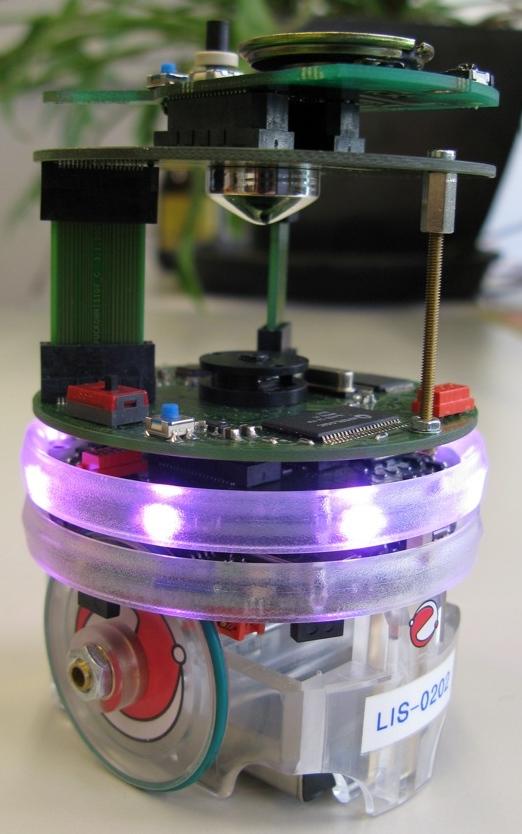
A joint research project conducted at UNIL and EPFL enabled the scientists to follow the evolution of communication in 100 groups of 20 robots over the course of 1000 generations. The robots were equipped with a camera that detected the environment, and also with wheels and a ring enabling them to emit luminous signals of different colors. Positioned in arenas, they had to locate a source of virtual food that was only visible when they came upon it. Their behavior was guided by a “neural network”, which was also controlled by genes that could evolve through mutation and selection in the course of successive generations.

An initial experiment showed that the robots rapidly acquire a communication system that enables them to transmit information about the location of the food to their peers. In fact, two really distinct communication systems evolved, according to the given populations. The simplest mechanism, using a single color to indicate the location of the food, proved more effective that the system using two colors – one pointing towards the food and the other towards the remaining part of the arena.

It also became evident that a population that has evolved towards a relatively effective type of communication doesn’t subsequently change it, as it would then be necessary to simultaneously modify the way the information is transmitted, and also the way of responding. In other words, a communication system, just like a language, cannot change rapidly through generations. In addition, this research underlines the importance of random factors in evolutionary processes. The experiment performed in twenty homogenous groups (with robots of the same type) actually shows that half of them choose the simpler – one color – strategy, whereas the other half opt for the two color system.

Competition requests more complex talking
Finally, a second experiment demonstrated that, even with robots, nothing is perfect. Within a competition context, when groups of robots were confronted with robots of other populations, it was the more complex (two-color) strategy that won the day, in spite of the proven effectiveness of the single-color strategy.

Supported by the Swiss National Science Foundation, this research has been published in the magazine PNAS (Proceedings of the National Academy of Sciences of the United States). It shows that communication strategies can evolve in different ways through generations within an identical environment.

“We know that in the animal kingdom communication systems are very complex”, concludes Laurent Keller, “and this diversity evolved over a very long period of time. Our experiment shows how it occurs, and reveals that environmental factors are not the only ones involved, as one might believe. The robots shed new light on these evolutionary processes.”


Source: École polytechnique fédérale de Lausanne (EPFL)

Additional Information:

Monday, 19 September 2011

Yale Engineers Invent a Magnetic Fluid Pump with No Moving Parts

Engineerblogger
Sept 19, 2011

Used in Hollywood and the advertising industry to create exotic special effects, ferrofluids are seemingly magical materials that are both liquid and magnetic at once. In a study published today in Physical Review B, Yale electrical engineering professor Hur Koser and colleagues from the University of Georgia and Massachusetts Institute of Technology demonstrate for the first time an approach that allows ferrofluids to be pumped by magnetic fields alone. The invention could lead to new applications for this mysterious material.

Developed in the 1960s by NASA scientists seeking a non-mechanical method for moving liquid fuels in outer space, ferrofluids are made up of magnetic nanoparticles suspended in liquids such as oil, water, or alcohol. Though numerous industrial, commercial, and biomedical applications for ferrofluids have since been created, the original goal-to pump liquids with no machinery-remained elusive, until now.

"We have shown that ferrofluids may be pumped at controllable speeds in closed-loop geometries without any mechanically moving parts," says Koser. The discovery, based on work funded in part by the National Science Foundation, is a culmination of many years of research, and is based on a theory Koser proposed in 2005 to suggest that travelling magnetic fields could enable very fast pumping of ferrofluids.

Following on successful computational simulations, the so-called "ferrohydrodynamic pumping mechanism" that Koser and colleagues have now validated could be used in systems as tiny as microfluidic devices, or as large as industrial-scale pumps, he says. It could also be used to cool computers more efficiently.

The ferrohydrodynamic pump method works when electrodes wound around a pipe force magnetic nanoparticles within the ferrofluids to rotate at varying speeds. Those particles closest to the electrodes spin faster, and it is this spatial variation in rotation speed that propels the ferrofluid forward. "We don't rely on any other material; no magnets, nothing moving but the ferrofluid that we're pumping," Koser says.

Koser and colleagues demonstrated the simplicity of this "hands-free" pumping scheme using a stereo amplifier, ordinary plumbing materials from the local hardware store, and a commercially available mineral oil/magnetite ferrofluid that is easy to make and safe to handle. "Pumping systems can be much cheaper and easier to manufacture when liquid can be moved without machinery," Koser notes.

"The ferrofluid pumping scheme we demonstrated is simple, robust, and very inexpensive," says co-author Leidong Mao, a former graduate student in Koser's lab, currently with the Faculty of Engineering at the University of Georgia. Their approach, Mao notes, could lead to highly compact, integrated, quiet, and efficient liquid cooling schemes for portable, high-performance consumer electronics. For instance, ferrofluid cooling would eliminate the need for fans and heat plumbing inside computers, enabling further miniaturization. "Your laptop could be twice as thin and a third lighter and faster with more efficient cooling," Koser says. Novel medical applications, such as cell sorting, might also be enabled by biocompatible ferrofluids, he adds.

Other co-authors include Shihab Elborai, Xiaowei He, and Markus Zahn from MIT's Laboratory for Electromagnetic and Electronic Systems. To read the paper, Direct observation of closed-loop ferrohydrodynamic pumping under traveling magnetic fields, see the current issue of Physical Review B (http://prb.aps.org/abstract/PRB/v84/i10/e104431).

Source: Yale University

Wednesday, 17 August 2011

Amazon's Bezos envisions airbag phone, files patent

Physorg.com
Aug 11, 2011

A U.S. patent application was filed in February 11, 2010 bearing the names of Amazon founder Jeff Bezos and Amazon VP Greg Hart but was discovered this week by Geekwire. According to their patent application titled "Protecting Devices From Impact Damage," smartphones will get airbags as a safety precaution in case their users drop the phones or they fall accidentally. The two patent-seekers are proposing the system and method not just for the smartphone but for a range of mobile devices that nobody likes to drop, such as audio players, cameras and pagers. Bezos and Hart’s patent filing has Illustrations and flowcharts to further explain their "removably attachable damage avoidance system."

As one smartphone scenario goes, the user drops the phone. Whoops, says the safety monitoring system, this device is no longer in contact with the user. The approaching surface is measured and the velocity is determined. Does the risk of damage exceed the threshold? If so, here comes the airbag to be deployed, and it’s the airbag, not the poor device, that makes first contact with the surface.

When the news hit that Bezos had filed a patent for phones with airbags, a number of responses from writers in the blogosphere admitted disbelief, perhaps not unrelated to bearing witness to the sting of discovering that the ‘Internet Explorer users are more stupid’ report was a hoax.

The application states conditions that make such a proposal appear practical considering the heavy use of mobile devices and the need to protect them from damage. “These portable devices are sometimes vitally important to the user as they often contain data that is related to the user's work and personal life,” says the application. That data might include private data difficult or nearly impossible to replace.

Bezos studied electrical engineering and computing science at Princeton, and also worked as a financial analyst. That, leave alone his ascent as leader of click-and-buy Amazon, suggests a scientist who knows how to market ideas. His business case in the application is as interesting as his technical description.

“With the number of cellular phones in use exceeding several billion and repairs typically exceeding $25, the costs of damage and loss of cellular phones amounts to billions of dollars per year,” says Bezos. He also notes in the application, “At least one report claims 1 out of 3 cellular phones are damaged or lost in the first year of ownership.”

Whatever direction the patent application takes, or whoever compares Bezos more to Don Quixote than Thomas Edison, Bezos is not likely to feel demolished. As he once told new students at Princeton, “Failure is an essential component of innovation.”

More information: http://appft.uspto … /20110194230
© 2011 PhysOrg.com

Wednesday, 27 April 2011

Collecting Your Data

Engineerblogger
April 25, 2011

The latest controversy covers the privacy and the trade of personal data from your mobile phone more so, your smart device.  Apple is collecting iPhone and iPad users data.  However, it has also came out that Apple is not the only company collecting data.  Google has been doing the same thing with its Android operating systems.  Google came under fire when they were caught collecting similar Wi-Fi data from its street view cars.  As a smart phone user,  I was very stunned.  I did not sign up for this but, I am sure this is all covered in the fine print which no person ever reads.  After doing more research about the topic, I was more surprised of what I have learned.  This is far from being a recent issue, tracking of individuals via their cellphones has been going on for almost ten years at least.

The movements of Apple users were tracked and stored in a hidden iOS file which gets synced to their PC every time they connect the phone. The secret file was discovered by computer experts and made public at the recent Web 2.0 conference in San Francisco. Apple confirms that "it "intermittently" collects location data, including GPS coordinates, of many iPhone users and nearby Wi-Fi networks and transmits that data to itself every 12 hours, according to a letter the company sent to U.S. Reps. Edward Markey (D-Mass.) and Joe Barton (R-Texas) last year."

According to security analyst Samy Kamkar, an HTC Android phone collected its location every few seconds and transmitted the data to Google at least several times an hour. It also transmitted the name, location and signal strength of any nearby Wi-Fi networks, as well as a unique phone identifier." These results were reviewed and confirmed by another independent consultant. Google said it uses some of the data to build accurate traffic maps. A cellphone's location data can provide details about, for instance, how fast traffic is moving along a stretch of highway. They goes on to say that the Wi-Fi data it collects is anonymous and that it deletes the start and end points of every trip that it uses in its traffic maps. However, the data by provided Samy Kamkar, contained a unique identifier tied to an individual's phone.

The Wall Street Journal reported on April 22, 2010, "Google and Apple are gathering location information as part of their race to build massive databases capable of pinpointing people's locations via their cellphones. These databases could help them tap the $2.9 billion market for location-based services expected to rise to $8.3 billion in 2014, according to research firm Gartner Inc." Hence by buying a smart phone or a tablet PC, you are automatically consented to have Apple or Google to collect your data and target personal advertisement based on your activities. This will only help them to generate more revenue from users of there products.

More shocking is that under the 1996 Telecommunications Act, the FCC mandated that by October 1, 2001 a quarter of all new cellphones be equipped with GPS functionality that would allow authorities to track the location of users. By the end of 2002, this became a mandatory requirement of all new cellphones. Mobile phone companies have been tracking their users, in line with government mandates. Even though, there are many positive aspects with these smart devices. It could also allows your personal data to be used for commercial marketing(OS, third parties apps and mobile carriers) and government matters(police). US lawmakers have invited Apple and Google to attend a hearing on privacy next month following claims the iPhone and Android devices regularly track a user's location and stores the data. This is a step in the right direction and hopefully this is will result in giving users the option to be tracked.
 

Additional Information:

Monday, 14 March 2011

The Reliability of Tsunami Detection Buoys

Technology Review
March 11, 2011

The ocean-based tsunami detection system, known as the deep-ocean assessment and reporting of tsunamis (DART), which today sent warnings to residents on the west coast of the United States and Hawaii (as well as more than 50 other countries) is an unreliable system, according to 2010 report. Of the 39 stations deployed in 2008 only an estimated 60 percent were operational by 2009 (click here to see current active and inactive stations). The report, issued by the National Research Council of the National Academy of Sciences, concluded that the buoy stations, despite their technological achievements, may not be a feasible long term solutions for providing improved early warning and real-time reporting of tsunamis.
To read more click here...

Monday, 14 February 2011

Laser-Quick Data Transfer

Technologyreview.com
Feb 14, 2011


Researchers learn how to make lasers directly on microchips the result could be computers that download large files much more quickly.

A Cell Phone Tower for Your Pocket

Technologyreview.com
Feb 9, 2011


Small USB devices that offer service to nearby cell phones provide faster Web access and an alternative to expensive international roaming. 

Thursday, 3 February 2011

Mlitary Communication Liquid Radio

Economist.com
Jan 27, 2011


The Economist says, "America’s navy is developing an antenna made of seawater."  A warship bristles with more than 100 large copper antennae that send and receive signals for its weapons, its radar and its voice and data communications. A lot of aerials, then, but still not enough. The navy wants its ships to carry even more of them. Fulfilling that desire has, however, stymied experts for decades. If placed too close together, antennae interfere with each other’s signals. They also get in the way of aircraft and weapons. And, crucially, naval antennae many of them more than 20 metres tall make warships more easily visible to enemy radar. 
To read more click here...