Blogger Themes

Wednesday, 22 February 2012

Researcher Brings Seven Adult-Sized Humanoid Robots Together For First Time in the U.S.

Engineerblogger
Feb 22, 2012


Seven adult-sized humanoid robots took the stage during Drexel University's celebration of National Engineers Week in a first-of-its-kind assembly of robotic technology. Their presence -together in one place- is a unique event that serves as a milestone for a nationwide, collaborative research effort funded by the National Science Foundation.

Seven adult-sized humanoid robots will take the stage during Drexel University’s celebration of National Engineers Week, in a first-of-its-kind assembly of robotic technology. A showcase event on Feb. 20 will introduce all seven of the Korean HUBO robots to the community. Their presence -together in one place- is a unique event that serves as a key milestone for a nationwide, collaborative robotics research effort funded by the National Science Foundation.

Each robot is 1.3 meters, or about 4-feet, 3-inches, tall. They are fully actuated, which means that they have similar joints and movement capabilities to that of a human, including arms, legs and hands with fully functional fingers and an opposable thumb.

“This is an historic event,” said Dr. Youngmoo Kim, an associate professor and assistant dean of media technologies in the College of Engineering and the director of the Music and Entertainment Technology (MET) Lab. “Never before have seven adult-sized, fully actuated humanoids appeared on stage together, so it’s truly a milestone in robotics research.”

Roots of the Robot Project
This gathering of robots is the fruition of seeds planted in 2008 when Drexel received a five-year grant from the National Science Foundation’s Partnership for International Research and Education (PIRE) Program with the goal of training engineers to work in global multi-disciplined design teams. This project, in close collaboration with the Korea Advanced Institute of Science and Technology (KAIST) HUBO Lab, enables Drexel and KAIST researchers to share training and knowledge and to work with the same world-class humanoid robot platform from different continents.

Dr. Paul Oh, the head of the Mechanical Engineering and Mechanics department, who headed the initial HUBO robot research in 2008, helped bring the first humanoid robot, named Jaemi Hubo, to Drexel in the spring of 2009 as part of the NSF PIRE grant. Oh’s students traveled to Korea to work with the HUBO robot platform and learn how to program and operate the robots.


“Humanoids provide an exciting and practical context to both motivate and train American students,” Oh said. “One can argue that humanoids are the epitome of what one perceives to be a robot. As such, they are an attractive area for engineering students to work on. Students quickly learn that Asia is the world-leader in humanoid design. Thus to become humanoid designers, students recognize that working alongside robot engineers in Asia is important.”

“The KAIST Hubo thus served as an effective platform to train students in both complex systems engineering and working in international design teams. The net effect is that humanoids have been an effective medium to make today’s American engineer more effective in a globalized work environment.”

From One to Seven
Since the arrival of Jaemi Hubo in 2009, making Drexel the only institution in the United States to have full-access to an adult-sized humanoid, engineers in Drexel’s Autonomous Systems Lab (DASL) have been accumulating experience, knowledge, and best practices as well as training others for advanced humanoids research.

Drexel engineers have also pursued projects that enable the robot to interact more naturally with humans. Students in Drexel’s Music, Entertainment, Technology Laboratory (MET-lab) introduced algorithms that direct Jaemi Hubo to dance to music, play the piano, and accompany music with a tambourine. These efforts are part of research toward making the robot musically aware, which, according to Kim, places it on the path toward autonomous human interaction.

“Our world is designed by humans for humans. To be truly useful as assistive devices, robots need to be able to deal with all of the various challenges of the real world and must have the skills and abilities to interact appropriately with humans.”

In August of 2010, the NSF awarded a $6 million grant to a group of institutions led by Drexel to further advance humanoid robotics research in the United States. This Major Research Infrastructure (MRI) grant allowed six additional HUBO units to be brought to the United States.

“To date, all adult-sized humanoids have been individual custom-made units, and advances made using one design do not necessarily translate to others,” Kim said.

Since current humanoids are not ready for unconstrained interaction with humans, having a consistent platform will facilitate rapid progress in areas needed for autonomy and natural interaction, including mobility, manipulation, vision, speech communication and cognition, and learning.

Researchers from the seven collaborating schools, MIT, Carnegie Mellon, Virginia Tech, the University of Southern California, Ohio State, Purdue and Penn will travel to Drexel to receive training on operating the robots. Eventually, each robot will be sent off to its new home institution where researchers will be able to work directly the HUBO unit, while continuing to collaborate with their counterpart teams across the country.

“Our partners represent a critical mass of humanoids research and brainpower, and this effort will, for the first time, enable researchers to work with a common instrument,” Kim said. “Building upon the unique expertise we have developed at Drexel in assembling and maintaining HUBO, this project will rapidly advance the state of the art in humanoid robotics research.”

Taking the Next Step
From leading a game of “Simon Says” to recognizing and greeting administrators, the HUBO robot has already taken big steps toward autonomous human interaction. Part of Drexel’s role in the project is to outfit each robot with high fidelity sensors for audio, visual, and tactile sensing, as well as new software to integrate this sensory input from the environment. These new capabilities and the world-class research team involved in this partnership provide an ideal foundation for taking giant steps towards the development of fully interactive humanoids.

Ultimately, this MRI project facilitates potentially transformative advances in robotics, and eventually humanoid robotic assistants may become as commonplace as the Roomba robot vacuum cleaners. But achieving that goal requires advances spanning a broad range of areas and engineering of new technologies. Having access to a state-of-the-art humanoid platform enables US researchers to focus on our national strengths in artificial intelligence and human-robot interaction to make rapid progress towards truly useful robotic assistants.

Source: Drexel University via Newswise 

The Future for Powering Electric and Hybrid Cars

Engineerblogger
Feb 2, 2012


The Tesla electric vehicle wirelessly charging at the 2012 Consumer Electronics Show. (Credit: Doug Kline)

This year’s iconic North American International Auto Show featured a wave of new hybrid and electric cars that suggest the vehicles have truly come into their own.
But what’s the future for the technology needed to power these cars? In particular, can the industry really expect in the coming years an electric car battery that is not only economical, but delivers the performance needed to make these cars a common site on the streets?

This was the topic of a recent roundtable discussion held by The Kavli Foundation with Seth Fletcher, Senior Editor at Popular Science, and two researchers in the field – Clare Grey at the University of Cambridge and Jeff Sakamoto at Michigan State University.

According to Fletcher, the dynamics for innovation are falling into place. “A few years ago there were essentially no electric cars on the road in the United States,” said Fletcher, who is also the author of “Bottled Lightning: Superbatteries, Electric Cars, and the New Lithium Economy." “Now there are several thousand that people actually own, which is completely different than in the 1990s when people were leasing EV1s. Think about it: GM leased 800 EV1s over the course of three years. Last year alone, GM sold nearly 8,000 Volts.”

Better battery technology for powering these vehicles also looks promising. “There is much good work going on,” according to Jeff Sakamoto, Assistant Professor in Michigan State University's Department of Chemical Engineering and Materials Science. “Some of it is focused on exploring new battery configurations and chemistries. One, referred to as a 'solid state' battery, uses a solid ceramic electrolyte that can replace current, flammable liquid electrolytes. Other potentially interesting though challenging areas include research on lithium-air batteries. Researchers are also exploring how different electrode materials, particularly silicon, might be used to improve battery performance.”

Another innovative direction is redox flow batteries. “Basically, these batteries pump an electrolyte solution or powder in and out of the battery,” said Clare Grey, Professor in the University of Cambridge’s Department of Chemistry. “Most batteries today are closed, sealed systems, so you’re limited to the electrons you have in a contained space. Flow batteries get rid of that limitation…And more electrons out means cars with longer ranges.”

In 2011, Grey received The Royal Society’s Kavli Medal and Lecture for work that included groundbreaking in situ studies on batteries and fuel cells. Grey recently noted that not only the technology is promising; incentives are changing in countries like the United Kingdom so the industry itself is invested in the success of these cars. “[In Europe,] emissions are regulated across each manufacturer’s fleet of vehicles. So as a result, BMW and Mercedes… are really pushing their electric and hybrid vehicle programs to reduce their fleets’ overall emissions. …And the good thing is, people are buying these cars. At the high-end of the market, it seems, people don’t mind paying a bit extra for electric or hybrid vehicles. In the most optimistic scenario that demand will eventually trickle down into the lower-end markets as well."

Source: Newswise

Additional Information:

Researchers Coax Gold Into Nanowires: Creating an inexpensive material for detecting poisonous gases found in natural gas

Engineerblogger
Feb 22, 2012


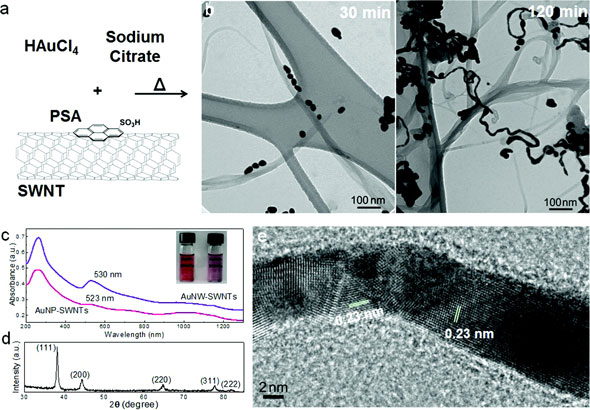
Synthesis and characterization of gold nanowires. (a) An aqueous suspension of 1-pyrenesulfonic acid (PSA)-functionalized single-walled carbon nanotubes (SWNTs) was used as a template during citrate reduction of HAuCl4. (b) TEM images showing the assembly of AuNPs on the SWNTs (after 30 min, left) and their welding into AuNWs (after 120 min, right). (c) UV–vis–NIR absorption spectra of AuNW-SWNTs and AuNP-SWNTs samples. Gold surface plasmon resonance shows a red shift with increasing size of gold nanostructures. The inset depicts a digital photo of vials containing suspensions of AuNPs and AuNWs (with SWNTs). (d) X-ray diffraction pattern of AuNWs. (e) High-resolution TEM image of AuNWs showing the polycrystalline nature of the welded AuNWs.


Researchers at the University of Pittsburgh have coaxed gold into nanowires as a way of creating an inexpensive material for detecting poisonous gases found in natural gas. Along with colleagues at the National Energy Technology Laboratory (NETL), Alexander Star, associate professor of chemistry in Pitt's Kenneth P. Dietrich School of Arts and Sciences and principal investigator of the research project, developed a self-assembly method that uses scaffolds (a structure used to hold up or support another material) to grow gold nanowires. Their findings, titled “Welding of Gold Nanoparticles on Graphitic Templates for Chemical Sensing,” were published online Jan. 22 in the Journal of the American Chemical Society.

“The most common methods to sense gases require bulky and expensive equipment,” says Star. “Chip-based sensors that rely on nanomaterials for detection would be less expensive and more portable as workers could wear them to monitor poisonous gases, such as hydrogen sulfide.”

Star and his research team determined gold nanomaterials would be ideal for detecting hydrogen sulfide owing to gold’s high affinity for sulfur and unique physical properties of nanomaterials. They experimented with carbon nanotubes and graphene—an atomic-scale chicken wire made of carbon atoms—and used computer modeling, X-ray diffraction, and transmission electron microscopy to study the self-assembly process. They also tested the resulting materials’ responses to hydrogen sulfide.

“To produce the gold nanowires, we suspended nanotubes in water with gold-containing chloroauric acid,” says Star. “As we stirred and heated the mixture, the gold reduced and formed nanoparticles on the outer walls of the tubes. The result was a highly conductive jumble of gold nanowires and carbon nanotubes.”

To test the nanowires’ ability to detect hydrogen sulfide, Star and his colleagues cast a film of the composite material onto a chip patterned with gold electrodes. The team could detect gas at levels as low as 5ppb (parts per billion)—a detection level comparable to that of existing sensing techniques. Additionally, they could detect the hydrogen sulfide in complex mixtures of gases simulating natural gas. Star says the group will now test the chips’ detection limits using real samples from gas wells.

Also involved in the study were Dan Sorescu, research physicist at NETL, who performed computational modeling of the gold nanowire formation; Mengning Ding, a Pitt graduate student in chemistry, who performed experimental work and synthesized and characterized gold nanowires and measured their sensor response; and Gregg Kotchey, a fellow Pitt graduate student in chemistry, who synthesized some of the graphene templates used in this study.

Funding for this work was provided by NETL in support of ongoing research in sensor systems and diagnostics.

Source:  University of Pittsburgh

Additional Information:

The Future of Manmade Materials: Discoveries has led to the creation of materials with extraordinary functions

Engineerblogger
Feb 22, 2012

Samuel Stupp

There’s nothing ordinary about the materials being designed in the Stupp Laboratory at Northwestern University. Many of the futuristic fibers, films, gels, coatings and putty-like substances have led to important advances in areas of research such as regenerative medicine and energy technologies.

These advances are part of an emerging field focused on using functional supramolecular polymers to unlock previously unknown functions of materials. A review article published in the Feb. 16 issue of the journal Science details this field and highlights some of the key developments made in the past decade.

“This field shows great promise for designing new materials, including highly sustainable forms of materials and highly bioactive materials, for medicine, renewable energy and sustainability,” said Northwestern’s Samuel I. Stupp, the corresponding author of the review article.

Stupp is the Board of Trustees Professor of Materials Science and Engineering, Chemistry and Medicine at Northwestern. The other two co-authors of the article are Takuzo Aida of the University of Tokyo and E.W. Meijer of Eindhoven University of Technology. These three researchers -- on three different continents -- are the pioneers in the functional supramolecular polymers field.

Some recent discoveries from Stupp’s lab include a novel nanostructure that promotes the growth of new blood vessels, an injectable gel that promotes the growth of new cartilage and gel "strings" of aligned supramolecular polymers that could be surgically placed to repair tissues such as the heart and the brain.

“Over the past decade my lab has demonstrated some of the most bioactive materials that have ever been reported by making supermolecular polymers and giving them structures that can signal cells,” Stupp said. “They have produced very highly bioactive materials for regenerative medicine.”

Polymers currently used in everyday technologies are made of very large molecules called macromolecules, which are made up of small units connected by covalent bonds. Supramolecular polymers consist of molecules connected by weaker, non-covalent bonds.

Because of their weaker bonds, researchers can create supramolecular polymers with unique combinations of order and flexibility, which allow their building blocks to interact dynamically with their environments. This could allow the spontaneous repair of defects, easy recycling of materials, signaling to cells on their complex surfaces and optimal charge transport for electronics.

The future of functional supramolecular polymers will include exploring hybrid materials with covalent polymers and or inorganic structures, the authors write. The field could also transition into 2D and even 3D complex systems to craft novel materials of interest in sustainability, electronics and health.

Source:  Northwestern University

A new twist on nanowires: Controlling the composition and structure of these tiny wires as they grow

MIT News
Feb 22, 2012

Nanowires fabricated using the new techniques developed by Gradečak and her team can have varying widths, profiles, and composition along their lengths, as illustrated here, where different colors are used to indicate compositional variations. Image courtesy of the Gradečak laboratory

Nanowires — microscopic fibers that can be “grown” in the lab — are a hot research topic today, with a variety of potential applications including light-emitting diodes (LEDs) and sensors. Now, a team of MIT researchers has found a way of precisely controlling the width and composition of these tiny strands as they grow, making it possible to grow complex structures that are optimally designed for particular applications.

The results are described in a new paper authored by MIT assistant professor of materials science and engineering Silvija Gradečak and her team, published in the journal Nano Letters.

Nanowires have been of great interest because structures with such tiny dimensions — typically just a few tens of nanometers, or billionths of a meter, in diameter — can have very different properties than the same materials have in their larger form. That’s in part because at such minuscule scales, quantum confinement effects — based on the behavior of electrons and phonons within the material — begin to play a significant role in the material’s behavior, which can affect how it conducts electricity and heat or interacts with light.

In addition, because nanowires have an especially large amount of surface area in relation to their volume, they are particularly well-suited for use as sensors, Gradečak says.

Her team was able to control and vary both the size and composition of individual wires as they grew. Nanowires are grown by using “seed” particles, metal nanoparticles that determine the size and composition of the nanowire. By adjusting the amount of gases used in growing the nanowires, Gradečak and her team were able to control the size and composition of the seed particles and, therefore, the nanowires as they grew. “We’re able to control both of these properties simultaneously,” she says. While the researchers carried out their nanowire-growth experiments with indium nitride and indium gallium nitride, they say the same technique could be applied to a variety of different materials.
To read more click here...

Tuesday, 21 February 2012

New carbon fibre polymer pipe will recover hydrocarbons from the most challenging offshore fields

Engineerblogger
Feb 21, 2012


Alumni Charles Tavner (left) and Ed Vernon-Harcourt

Deepwater production is the fastest growing source of oil and gas reserves. Cambridge engineers are currently solving many of the formidable challenges in accessing these fields. One group, at Magma Global, is leading the work to improve the reliability and operating envelope of sub-sea pipe. Magma's work is simplifying subsea architecture and lowering costs.

Magma is building on some of Professor James Gordon's pioneering work at Cambridge on composites to develop a monolithic carbon fibre polymer pipe to deliver the world's most reliable risers, jumpers, spools and flowlines for sub-sea exploration and production. Magma is working with the University of Cambridge's Department of Engineering to build their team and continue to develop their products.

Magma already employs several alumni from the Department of Engineering including Charles Tavner, their IP & Qualification Director and Ed Vernon-Harcourt, Robotic Production Manager. Magma has worked closely with the Department's Institute for Manufacturing to optimise their manufacturing processes and continues to identify individuals and research to extend their offering.

Magma's patented product, m-pipe™, exploits the benefits of carbon fibre to enable the reliable recovery of hydrocarbons from the most challenging offshore fields. m-pipe™ is lighter, stronger, more fatigue resistant, more resistant to sour service and better insulated than current solutions. Magma is backed by energy specialists Kern Partners and NES Partners.


Magma has developed a unique manufacturing process 
that produces high performance oil and gas pipes from
carbon and Victrex PEEK™ polymer. Called m-pipe™,
these pipes offer improved reliability, increased
performance, lighter weight and longer life than
conventional unbonded flexible pipe or steel solutions

Martin Jones, Magma's CEO, commented 'we are delighted to be working with the University of Cambridge's Department of Engineering. m-pipe™ will help unlock the next stages of deep water production and the University of Cambridge and its alumni are helping us address these challenges.'

Source: Cambridge University

Additional Information:

Testing a fuel cell on a ship

Engineerblogger
Feb 21, 2012


Viking Lady

The financial crisis is not putting a stop to the world’s first ship with a fuel cell. The testing of this technology, which may halve the climate emissions from shipping, starts in a couple of months.

A rather unusual offshore supply ship is being built at the Westcon shipyard in Norway. The gas-driven supply ship, which belongs to the Eidesvik shipping company, will be the test centre for the world’s first fuel cell on board a merchant vessel.

The Viking Lady will be this pioneering shipowner’s third supply ship to be run on LNG. This gas will also be the fuel for the 320 kW fuel cell. This is in principle sufficient to act as an auxiliary engine to ensure a power supply on board, but not enough for propulsion.

The first step Fuel cells in ships may lead to an environmental revolution in shipping. The Norwegian-German Fellowship project is, however, just the beginning. Following the hopefully successful demonstration will be more developments on reducing cost and physical volume and increasing lifetime and reliability. The fuel cell on the Viking Lady is being built in addition to a normal auxiliary engine, but will be connected to the systems on board so that it can provide a small contribution to the operations.

However, the most important thing will be to conduct research and gain experience so that fuel cells have a future in shipping.

"A huge amount of work remains to be done. But owing to high efficiency and clean emissions, I am convinced that fuel cells are the way of the future; onshore, offshore and onboard ships," says DNV’s project manager Tomas H. Tronstad.

Challenges at sea 
The fuel cell being tested on the Viking Lady has been developed by Germany’s MTU Onsite Energy.

More than 50 fuel cells of the same type are used as back-up power generators on shore, for instance in hospitals and universities. But it is one thing to stand firmly and quietly on land and quite another to place the sensitive technology on a ship that rolls and pitches in the waves and in a tough, salty climate.

"One of the biggest challenges is to ‘marinefy’ the technology and to integrate the fuel cell with the traditional machinery-, control- and electro systems," says Mr Tronstad.

In the German-Norwegian project, the fuel cell, all the equipment and the ship will be adapted and modified. Many companies and partners are providing technology and equipment.

Ship-design company Vik-Sandvik is designing and adapting the ship and equipment location, while Wärtsilä Norway has put together a package of electrical and control systems that are being built in a separate container. DNV has examined the safety and risk aspects and prepared classification rules.

In such a pioneering project, the importance of class is highlighted when it comes to safeguarding the interfaces between the various machinery disciplines.

Tests on shore 
The next milestone is testing parts of the equipment on shore at Wärtsilä’s facility at Stord in Norway. The fuel cell itself will be in another, larger container, which is almost finished.

The actual heart of the engine, its core, has not arrived in Norway yet, but it will do so in a few months.

"The timetable is being kept. The first equipment testing started on shore in April," states Mr Tronstad.

Eidesvik took delivery of the ship in March and will start to lift components on board later this summer.

"The goal is to start testing in the sea in September. Everything is on schedule," says project developer Kjell Sandaker of Eidesvik.

Monetary challenges This has not been the case all the time. Project manager Mr Tronstad had to go around ministries and government bodies many times to obtain the public grants for this development project in 2006.

Following a cautious start in 2003, there was a need for almost NOK 100 million to get to the next phase. That meant that around NOK 50 million was required from public funds. Not an easy amount to obtain from those sources.

In total the project budget is NOK 115 million over six years, with roughly 45% funding from the Research Council of Norway, Innovation Norway and German state funding. The remaining 55% is covered by the private partners .