Blogger Themes

Tuesday, 10 July 2012

Keeping electric vehicle batteries cool

Engineerblogger
July 10, 2012


Heat can damage the batteries of electric vehicles – even just driving fast on the freeway in summer temperatures can overheat the battery. An innovative new coolant conducts heat away from the battery three times more effectively than water, keeping the battery temperature within an acceptable range even in extreme driving situations.


Batteries provide the “fuel” that drives electric cars – in effect, the vehicles’ lifeblood. If batteries are to have a long service life, overheating must be avoided. A battery’s “comfort zone” lies between 20°C and 35°C. But even a Sunday drive in the midday heat of summer can push a battery’s temperature well beyond that range. The damage caused can be serious: operating a battery at a temperature of 45°C instead of 35°C halves its service life. And batteries are expensive – a new one can cost as much as half the price of the entire vehicle. That is why it is so important to keep them cool. Thus far, conventional cooling systems have not reached their full potential: either the batteries are not cooled at all – which is the case with ones that are simply exchanged for a fully charged battery at the “service station” – or they are air cooled. But air can absorb only very little heat and is also a poor conductor of it. What’s more, air cooling requires big spaces between the battery’s cells to allow sufficient fresh air to circulate between them. Water-cooling systems are still in their infancy. Though their thermal capacity exceeds that of air-cooling systems and they are better at conducting away heat, their downside is the limited supply of water in the system compared with the essentially limitless amount of air that can flow through a battery.
More space under the hood

In future, another option will be available for keeping batteries cool – a coolant by the name of CryoSolplus. It is a dispersion that mixes water and paraffin along with stabilizing tensides and a dash of the anti-freeze agent glycol. The advantage is that CryoSolplus can absorb three times as much heat as water, and functions better as a buffer in extreme situations such as trips on the freeway at the height of summer. This means that the holding tank for the coolant can be much smaller than those of watercooling systems – saving both weight and space under the hood. In addition, CryoSolplus is good at conducting away heat, moving it very quickly from the battery cells into the coolant. With additional costs of just 50 to 100 euros, the new cooling system is only marginally more expensive than water cooling. The coolant was developed by researchers at the Fraunhofer Institute for Environmental, Safety and Energy Technology UMSICHT in Oberhausen.

As CryoSolplus absorbs heat, the solid paraffin droplets within it melt, storing the heat in the process. When the solution cools, the droplets revert to their solid form. Scientists call such substances phase change materials or PCMs. “The main problem we had to overcome during development was to make the dispersion stable,” explains Dipl.-Ing. Tobias Kappels, a scientist at UMSICHT. The individual solid droplets of paraffin had to be prevented from agglomerating or – as they are lighter than water – collecting on the surface of the dispersion. They need to be evenly distributed throughout the water. Tensides serve to stabilize the dispersion, depositing themselves on the paraffin droplets and forming a type of protective coating. “To find out which tensides are best suited to this purpose, we examined the dispersion in three different stress situations: How long can it be stored without deteriorating? How well does it withstand mechanical stresses such as being pumped through pipes? And how stable is it when exposed to thermal stresses, for instance when the paraffin particles freeze and then thaw again?” says Kappels. Other properties of the dispersion that the researchers are optimizing include its heat capacity, its ability to transfer heat and its flow capability. The scientists’ next task will be to carry out field tests, trying out the coolant in an experimental vehicle.


Source: Fraunhofer-Gesellschaft

Graphene Repairs Holes By Knitting Itself Back Together, Say Physicists

Engineerblogger
July 10, 2012


The graphene revolution is upon us. If the visionaries are to be believed, the next generation of more or less everything is going to be based on this wonder material--sensors, actuators, transistors and information processors and so on. There seems little that graphene can't do.

But there's one fly in the ointment. Nobody has yet worked out how to make graphene in large, reliable quantities or how to carve and grow it into the shapes necessary for the next generation of devices.

That's largely because it's tricky growing anything into a layer only a single atom thick. But for carbon, it's all the more difficult because of this element's affinity to other atoms, including itself. A carbon sheet will happily curl up and form a tube or a ball or some more exotic shape. It will also react with other atoms nearby, which prevents growth and can even tear graphene apart.

So a better understanding of the way a graphene sheet interacts with itself and its environment is crucial if physicists are ever going to tame this stuff.

Enter Konstantin Novoselov at the University of Manchester and a few pals who have spent more than a few hours staring at graphene sheets through an electron microscope to see how it behaves.

Today, these guys say they've discovered why graphene appears so unpredictable. It turns out that if you make a hole in graphene, the material automatically knits itself back together again.

Novoselov and co made their discovery by etching tiny holes into a graphene sheet using an electron beam and watching what happens next using an electron microscope. They also added a few atoms of palladium or nickel, which catalyse the dissociation of carbon bonds and bind to the edges of the holes making them stable.

They found that the size of the holes depended on the number of metal atoms they added--more metal atoms can stabilise bigger holes.

But here's the curious thing. If they also added extra carbon atoms to the mix, these displaced the the metal atoms and reknitted the holes back together again.

Novoselov and co say the structure of the repaired area depends on the form in which the carbon is available. So when available as a hydrocarbon, the repairs tend to contain non-hexagonal defects where foreign atoms have entered the structure.

But when the carbon is available in pure form, the repairs are perfect and form pristine graphene.

That's important because it immediately suggests a way to grow graphene into almost any shape using the careful injection of metal and carbon atoms.

But there are significant challenges ahead. One important question is how quickly these processes occur and whether they can be controlled with the precision and reliability necessary for device manufacture.

Novoselov is a world leader in this area and the joint recipient of the Nobel Prize for physics in 2010 for his early work on graphene. He and his team are well set up to solve this and various related questions.

But with the future of computing (and almost everything else) at stake, there's bound to be plenty of competitors snapping at their heels.

Source: Technology Review


Additional Information:

Smart Headlight System Will Have Drivers Seeing Through the Rain: Shining Light Between Drops Makes Thunderstorm Seem Like a Drizzle

Engineerblogger
July 10, 2012


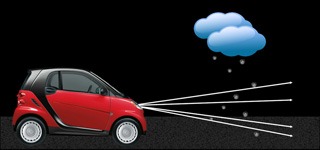
Drivers can struggle to see when driving at night in a rainstorm or snowstorm, but a smart headlight system invented by researchers at Carnegie Mellon University's Robotics Institute can improve visibility by constantly redirecting light to shine between particles of precipitation.

The system, demonstrated in laboratory tests, prevents the distracting and sometimes dangerous glare that occurs when headlight beams are reflected by precipitation back toward the driver.

"If you're driving in a thunderstorm, the smart headlights will make it seem like it's a drizzle," said Srinivasa Narasimhan, associate professor of robotics.

The system uses a camera to track the motion of raindrops and snowflakes and then applies a computer algorithm to predict where those particles will be just a few milliseconds later. The light projection system then adjusts to deactivate light beams that would otherwise illuminate the particles in their predicted positions.

"A human eye will not be able to see that flicker of the headlights," Narasimhan said. "And because the precipitation particles aren't being illuminated, the driver won't see the rain or snow either."

To people, rain can appear as elongated streaks that seem to fill the air. To high-speed cameras, however, rain consists of sparsely spaced, discrete drops. That leaves plenty of space between the drops where light can be effectively distributed if the system can respond rapidly, Narasimhan said.

In their lab tests, Narasimhan and his research team demonstrated that their system could detect raindrops, predict their movement and adjust a light projector accordingly in 13 milliseconds. At low speeds, such a system could eliminate 70 to 80 percent of visible rain during a heavy storm, while losing only 5 or 6 percent of the light from the headlamp.

To operate at highway speeds and to work effectively in snow and hail, the system's response will need to be reduced to just a few milliseconds, Narasimhan said. The lab tests have demonstrated the feasibility of the system, however, and the researchers are confident that the speed of the system can be boosted.

The test apparatus, for instance, couples a camera with an off-the-shelf DLP projector. Road-worthy systems likely would be based on arrays of light-emitting diode (LED) light sources in which individual elements could be turned on or off, depending on the location of raindrops. New LED technology could make it possible to combine LED light sources with image sensors on a single chip, enabling high-speed operation at low cost.

Narasimhan's team is now engineering a more compact version of the smart headlight that in coming years could be installed in a car for road testing.

Though a smart headlight system will never be able to eliminate all precipitation from the driver's field of view, simply reducing the amount of reflection and distortion caused by precipitation can substantially improve visibility and reduce driver distraction. Another benefit is that the system also can detect oncoming cars and direct the headlight beams away from the eyes of those drivers, eliminating the need to shift from high to low beams.

"One good thing is that the system will not fail in a catastrophic way," Narasimhan said. "If it fails, it is just a normal headlight."

This research was sponsored by the Office of Naval Research, the National Science Foundation, the Samsung Advanced Institute of Technology and Intel Corp. Collaborators include Takeo Kanade, professor of computer science and robotics; Anthony Rowe, assistant research professor of electrical and computer engineering; Robert Tamburo, Robotics Institute project scientist; Peter Barnum, a former robotics Ph.D. student now with Texas Instruments; and Raoul de Charette, a visiting Ph.D. student from Mines ParisTech, France.

Source: Carnegie Mellon University

Nanodevice builds electricity from tiny pieces

Engineerblogger
July 10, 2012

Scanning electron microscope image of the electron pump.
The arrow shows the direction of electron pumping. The hole
in the middle of the electrical control gates where the
electrons are trapped is ~0.0001 mm across
.

A team of scientists at the National Physical Laboratory (NPL) and University of Cambridge has made a significant advance in using nano-devices to create accurate electrical currents. Electrical current is composed of billions and billions of tiny particles called electrons. They have developed an electron pump - a nano-device - which picks these electrons up one at a time and moves them across a barrier, creating a very well-defined electrical current.

The device drives electrical current by manipulating individual electrons, one-by-one at very high speed. This technique could replace the traditional definition of electrical current, the ampere, which relies on measurements of mechanical forces on current-carrying wires.

The key breakthrough came when scientists experimented with the exact shape of the voltage pulses that control the trapping and ejection of electrons. By changing the voltage slowly while trapping electrons, and then much more rapidly when ejecting them, it was possible to massively speed up the overall rate of pumping without compromising the accuracy.

By employing this technique, the team were able to pump almost a billion electrons per second, 300 times faster than the previous record for an accurate electron pump set at the National Institute of Standards and Technology (NIST) in the USA in 1996.

Although the resulting current of 150 picoamperes is small (ten billion times smaller than the current used when boiling a kettle), the team were able to measure the current with an accuracy of one part-per-million, confirming that the electron pump was accurate at this level. This result is a milestone in the precise, fast, manipulation of single electrons and an important step towards a re-definition of the unit ampere.

As reported in Nature Communications, the team used a nano-scale semiconductor device called a 'quantum dot' to pump electrons through a circuit. The quantum dot is a tiny electrostatic trap less than 0.0001 mm wide. The shape of the quantum dot is controlled by voltages applied to nearby electrodes.

The dot can be filled with electrons and then raised in energy. By a process known as 'back-tunneling', all but one of the electrons fall out of the quantum dot back into the source lead. Ideally, just one electron remains trapped in the dot, which is ejected into the output lead by tilting the trap. When this is repeated rapidly this gives a current determined solely by the repetition rate and the charge on each electron - a universal constant of nature and the same for all electrons.

The research makes significant steps towards redefining the ampere by developing the application of an electron pump which improves accuracy rates in primary electrical measurement.

Masaya Kataoka of the Quantum Detection Group at NPL explains:

"Our device is like a water pump in that it produces a flow by a cyclical action. The tricky part is making sure that exactly the same number of electronic charge is transported in each cycle.

The way that the electrons in our device behave is quite similar to water; if you try and scoop up a fixed volume of water, say in a cup or spoon, you have to move slowly otherwise you'll spill some. This is exactly what used to happen to our electrons if we went too fast."

Stephen Giblin also part of the Quantum Detection Group, added:

"For the last few years, we have worked on optimising the design of our device, but we made a huge leap forward when we fine-tuned the timing sequence. We've basically smashed the record for the largest accurate single-electron current by a factor of 300.

Although moving electrons one at a time is not new, we can do it much faster, and with very high reliability - a billion electrons per second, with an accuracy of less than one error in a million operations.

Using mechanical forces to define the ampere has made a lot of sense for the last 60 or so years, but now that we have the nanotechnology to control single electrons we can move on.

The technology might seem more complicated, but actually a quantum system of measurement is more elegant, because you are basing your system on fundamental constants of nature, rather than things which we know aren't really constant, like the mass of the standard kilogram."

Source:  National Physical Laboratory

Additional Information:

How do you turn 10 minutes of power into 200? Efficiency, efficiency, efficiency.

Engineerbloggger
July 10, 2012


DARPA seeks revolutionary advances in the efficiency of robotic actuation; fundamental research into biology, physics and electrical engineering could benefit all engineered, actuated systems

A robot that drives into an industrial disaster area and shuts off a valve leaking toxic steam might save lives. A robot that applies supervised autonomy to dexterously disarm a roadside bomb would keep humans out of harm’s way. A robot that carries hundreds of pounds of equipment over rocky or wooded terrain would increase the range warfighters can travel and the speed at which they move. But a robot that runs out of power after ten to twenty minutes of operation is limited in its utility. In fact, use of robots in defense missions is currently constrained in part by power supply issues. DARPA has created the M3 Actuation program, with the goal of achieving a 2,000 percent increase in the efficiency of power transmission and application in robots, to improve performance potential.

Humans and animals have evolved to consume energy very efficiently for movement. Bones, muscles and tendons work together for propulsion using as little energy as possible. If robotic actuation can be made to approach the efficiency of human and animal actuation, the range of practical robotic applications will greatly increase and robot design will be less limited by power plant considerations.

M3 Actuation is an effort within DARPA’s Maximum Mobility and Manipulation (M3) robotics program, and adds a new dimension to DARPA’s suite of robotics research and development work.

“By exploring multiple aspects of robot design, capabilities, control and production, we hope to converge on an adaptable core of robot technologies that can be applied across mission areas,” said Gill Pratt, DARPA program manager. “Success in the M3 Actuation effort would benefit not just robotics programs, but all engineered, actuated systems, including advanced prosthetic limbs.”

Proposals are sought in response to a Broad Agency Announcement (BAA). DARPA expects that solutions will require input from a broad array of scientific and engineering specialties to understand, develop and apply actuation mechanisms inspired in part by humans and animals. Technical areas of interest include, but are not limited to: low-loss power modulation, variable recruitment of parallel transducer elements, high-bandwidth variable impedance matching, adaptive inertial and gravitational load cancellation, and high-efficiency power transmission between joints.

Research and development will cover two tracks of work:
  • Track 1 asks performer teams to develop and demonstrate high-efficiency actuation technology that will allow robots similar to the DARPA Robotics Challenge (DRC) Government Furnished Equipment (GFE) platform to have twenty times longer endurance than the DRC GFE when running on untethered battery power (currently only 10-20 minutes). Using Government Furnished Information about the GFE, M3 Actuation performers will have to build a robot that incorporates the new actuation technology. These robots will be demonstrated at, but not compete in, the second DRC live competition scheduled for December 2014.
  • Track 2 will be tailored to performers who want to explore ways of improving the efficiency of actuators, but at scales both larger and smaller than applicable to the DRC GFE platform, and at technical readiness levels insufficient for incorporation into a platform during this program. Essentially, Track 2 seeks to advance the science and engineering behind actuation without the requirement to apply it at this point.

While separate efforts, M3 Actuation will run in parallel with the DRC. In both programs DARPA seeks to develop the enabling technologies required for expanded practical use of robots in defense missions. Thus, performers on M3 Actuation will share their design approaches at the first DRC live competition scheduled for December 2013, and demonstrate their final systems at the second DRC live competition scheduled for December 2014.

Source: DARPA

Hypersonic - The new stealth

Engineerblogger
July 10, 2012


Credit: DARPA


DARPA’s research and development in stealth technology during the 1970s and 1980s led to the world’s most advanced radar-evading aircraft, providing strategic national security advantage to the United States. Today, that strategic advantage is threatened as other nations’ abilities in stealth and counter-stealth improve. Restoring that battle space advantage requires advanced speed, reach and range. Hypersonic technologies have the potential to provide the dominance once afforded by stealth to support a range of varied future national security missions.

Extreme hypersonic flight at Mach 20 (i.e., 20 times the speed of sound)—which would enable DoD to get anywhere in the world in under an hour—is an area of research where significant scientific advancements have eluded researchers for decades. Thanks to programs by DARPA, the Army, and the Air Force in recent years, however, more information has been obtained about this challenging subject.

“DoD’s hypersonic technology efforts have made significant advancements in our technical understanding of several critical areas including aerodynamics; aerothermal effects; and guidance, navigation and control,” said Acting DARPA Director, Kaigham J. Gabriel. “but additional unknowns exist.”

Tackling remaining unknowns for DoD hypersonics efforts is the focus of the new DARPA Integrated Hypersonics (IH) program. “History is rife with examples of different designs for ‘flying vehicles’ and approaches to the traditional commercial flight we all take for granted today,” explained Gabriel. “For an entirely new type of flight—extreme hypersonic—diverse solutions, approaches and perspectives informed by the knowledge gained from DoD’s previous efforts are critical to achieving our goals.”

To encourage this diversity, DARPA will host a Proposers’ Day on August 14, 2012, to detail the technical areas for which proposals are sought through an upcoming competitive broad agency announcement.

“We do not yet have a complete hypersonic system solution,” said Gregory Hulcher, director of Strategic Warfare, Office of the Under Secretary of Defense for Acquisition, Technology and Logistics. “Programs like Integrated Hypersonics will leverage previous investments in this field and continue to reduce risk, inform development, and advance capabilities.”

The IH program expands hypersonic technology research to include five primary technical areas: thermal protection system and hot structures; aerodynamics; guidance, navigation, and control (GNC); range/instrumentation; and propulsion.

At Mach 20, vehicles flying inside the atmosphere experience intense heat, exceeding 3,500 degrees Fahrenheit, which is hotter than a blast furnace capable of melting steel, as well as extreme pressure on the aeroshell. The thermal protection materials and hot structures technology area aims to advance understanding of high-temperature material characteristics to withstand both high thermal and structural loads. Another goal is to optimize structural designs and manufacturing processes to enable faster production of high-mach aeroshells.

The aerodynamics technology area focuses on future vehicle designs for different missions and addresses the effects of adding vertical and horizontal stabilizers or other control surfaces for enhanced aero-control of the vehicle. Aerodynamics seeks technology solutions to ensure the vehicle effectively manages energy to be able to glide to its destination. Desired technical advances in the GNC technology area include advances in software to enable the vehicle to make real-time, in-flight adjustments to changing parameters, such as high-altitude wind gusts, to stay on an optimal flight trajectory.

The range/instrumentation area seeks advanced technologies to embed data measurement sensors into the structure that can withstand the thermal and structural loads to provide real-time thermal and structural parameters, such as temperature, heat transfer, and how the aeroshell skin recedes due to heat. Embedding instrumentation that can provide real-time air data measurements on the vehicle during flight is also desired. Unlike subsonic aircraft that have external probes measuring air density, temperature and pressure of surrounding air, vehicles traveling Mach 20 can’t take external probe measurements. Vehicle concepts that make use of new collection and measurement assets are also being sought.

The propulsion technology area is developing a single, integrated launch vehicle designed to precisely insert a hypersonic glide vehicle into its desired trajectory, rather than adapting a booster designed for space missions. The propulsion area also addresses integrated rocket propulsion technology onboard vehicles to enable a vehicle to give itself an in-flight rocket boost to extend its glide range.

“By broadening the scope of research and engaging a larger community in our efforts, we have the opportunity to usher in a new area of flight more rapidly and, in doing so, develop a new national security capability far beyond previous initiatives,” explained Air Force Maj. Christopher Schulz, DARPA program manager, who holds a doctorate in aerospace engineering.

The IH program is designed to address technical challenges and improve understanding of long-range hypersonic flight through an initial full-scale baseline test of an existing hypersonic test vehicle, followed by a series of subscale flight tests, innovative ground-based testing, expanded modeling and simulation, and advanced analytic methods, culminating in a test flight of a full-scale hypersonic X-plane (HX) in 2016. HX is envisioned as a recoverable next-generation configuration augmented with a rocket-based propulsion capability that will enable and reduce risk for highly maneuverable, long-range hypersonic platforms.

More information regarding the August 14 Proposers’ Day is available here.

New chip captures power from multiple sources

Engineerblogger
July 10, 2012


Graphic: Christine Daniloff

Researchers at MIT have taken a significant step toward battery-free monitoring systems — which could ultimately be used in biomedical devices, environmental sensors in remote locations and gauges in hard-to-reach spots, among other applications.

Previous work from the lab of MIT professor Anantha Chandrakasan has focused on the development of computer and wireless-communication chips that can operate at extremely low power levels, and on a variety of devices that can harness power from natural light, heat and vibrations in the environment. The latest development, carried out with doctoral student Saurav Bandyopadhyay, is a chip that could harness all three of these ambient power sources at once, optimizing power delivery.

The energy-combining circuit is described in a paper being published this summer in the IEEE Journal of Solid-State Circuits.

“Energy harvesting is becoming a reality,” says Chandrakasan, the Keithley Professor of Electrical Engineering and head of MIT’s Department of Electrical Engineering and Computer Science. Low-power chips that can collect data and relay it to a central facility are under development, as are systems to harness power from environmental sources. But the new design achieves efficient use of multiple power sources in a single device, a big advantage since many of these sources are intermittent and unpredictable.

“The key here is the circuit that efficiently combines many sources of energy into one,” Chandrakasan says. The individual devices needed to harness these tiny sources of energy — such as the difference between body temperature and outside air, or the motions and vibrations of anything from a person walking to a bridge vibrating as traffic passes over it — have already been developed, many of them in Chandrakasan’s lab.

Combining the power from these variable sources requires a sophisticated control system, Bandyopadhyay explains: Typically each energy source requires its own control circuit to meet its specific requirements. For example, circuits to harvest thermal differences typically produce only 0.02 to 0.15 volts, while low-power photovoltaic cells can generate 0.2 to 0.7 volts and vibration-harvesting systems can produce up to 5 volts. Coordinating these disparate sources of energy in real time to produce a constant output is a tricky process.

So far, most efforts to harness multiple energy sources have simply switched among them, taking advantage of whichever one is generating the most energy at a given moment, Bandyopadhyay says, but that can waste the energy being delivered by the other sources. “Instead of that, we extract power from all the sources,” he says. The approach combines energy from multiple sources by switching rapidly between them.

Another challenge for the researchers was to minimize the power consumed by the control circuit itself, to leave as much as possible for the actual devices it’s powering — such as sensors to monitor heartbeat, blood sugar, or the stresses on a bridge or a pipeline. The control circuits optimize the amount of energy extracted from each source.

The system uses an innovative dual-path architecture. Typically, power sources would be used to charge up a storage device, such as a battery or a supercapacitor, which would then power an actual sensor or other circuit. But in this control system, the sensor can either be powered from a storage device or directly from the source, bypassing the storage system altogether. “That makes it more efficient,” Bandyopadhyay says. The chip uses a single time-shared inductor, a crucial component to support the multiple converters needed in this design, rather than separate ones for each source.

David Freeman, chief technologist for power-supply solutions at Texas Instruments, who was not involved in this work, says, “The work being done at MIT is very important to enabling energy harvesting in various environments. The ability to extract energy from multiple different sources helps maximize the power for more functionality from systems like wireless sensor nodes.”

Only recently, Freeman says, have companies such as Texas Instruments developed very low-power micro-controllers and wireless transceivers that could be powered by such sources. “With innovations like these that combine multiple sources of energy, these systems can now start to increase functionality,” he says. “The benefits from operating from multiple sources not only include maximizing peak energy, but also help when only one source of energy may be available.”

The work has been funded by the Interconnect Focus Center, a combined program of the Defense Advanced Research Projects Agency and companies in the defense and semiconductor industries.

Source: MIT

Additional Information: