Blogger Themes

Saturday, 19 May 2012

Magnetoresistance effect on perpendicular graphene stacks

Engineerblogger
May 18, 2012

(left) Schematic of graphene device structure; (right) magneto resistance effects of multi-layered graphene showing the anisotropic resistance response with magnetic field direction.

Graphene, a perfect two-dimensional crystal of carbon atoms, has attracted intense interest in research due to its unique physical properties. Previous studies have focused on the quantum transport properties of massless Dirac fermions of graphene supported on planar substrates, and demonstrated its half-integer quantum hall effect, klein tunnelling and so on.

Recently, collaborating with Dr. Wu Hanchun in trinity college Dublin of Ireland, Peking University (PKU) young scientist Liao Zhimin in Professor Yu Dapeng’s group reported the study on fabrication of hybrid metal/multi-layered graphene/metal structure that is perpendicular to the substrate.

The transport studies showed that both temperature and magnetic field are capable of modulating the current perpendicular to graphene plane. The resistance of graphene device is about several tens of ohms. At a magnetic field of 14T, magneto resistance effects reach 100%. Moreover, the magnitude of magneto resistance is strongly dependent on magnetic field direction. This study is published on Advanced Materials, and is expected to have potential applications of graphene in magnetic electronics.

This work was supported by the National Natural Science Foundation of China, the National Basic Research Program of China (973 Program) and State Key Laboratory for Mesoscopic Physics.

Source: Peking University

Additional Information:

Thursday, 17 May 2012

Engine Could Boost Fuel Economy by Half

Engineerblogger
May 17, 2012


Trial run: Delphi researchers tested a new combustion strategy in this single-cylinder test engine. Credit: Mark Sellnau, Delphi

Delphi, a major parts supplier to automakers, is developing an engine technology that could improve the fuel economy of gas-powered cars by 50 percent, potentially rivaling the performance of hybrid vehicles while costing less. A test engine based on the technology is similar in some ways to a highly efficient diesel engine, but runs on gasoline.

The company has demonstrated the technology in a single-piston test engine under a wide range of operating conditions. It is beginning tests on a multicylinder engine that will more closely approximate a production engine. Its fuel economy estimates suggest that engines based on the technology could be far more efficient than even diesel engines. Those estimates are based on simulations of how a midsized vehicle would perform with a multicylinder version of the new engine.

The Delphi technology is the latest attempt by researchers to combine the best qualities of diesel and gasoline engines. Diesel engines are 40 to 45 percent efficient in using the energy in fuel to propel a vehicle, compared to roughly 30 percent efficiency for gasoline engines. But diesel engines are dirty and require expensive exhaust-treatment technology to meet emissions regulations.

For decades, researchers have attempted to run diesel-like engines on gasoline to achieve high efficiency with low emissions. Such engines might be cheaper than hybrid technology, since they don't require a large battery and electric motor.

In conventional gasoline-powered engines, a spark ignites a mixture of fuel and air. Diesel engines don't use a spark. Instead, they compress air until it's so hot that fuel injected into the combustion chamber soon ignites. Several researchers have attempted to use compression ignition with gasoline, but it's proved challenging to control such engines, especially under the wide range of loads put on them as a car idles, accelerates, and cruises at various speeds.

Delphi's approach, which is called gasoline-direct-injection compression ignition, aims to overcome the problem by combining a collection of engine-operating strategies that make use of advanced fuel injection and air intake and exhaust controls, many of which are available on advanced engines today.

For example, the researchers found that if they injected the gasoline in three precisely timed bursts, they could avoid the too-rapid combustion that's made some previous experimental engines too noisy. At the same time, they could burn the fuel faster than in conventional gasoline engines, which is necessary for getting the most out of the fuel.

They used other strategies to help the engine perform well at extreme loads. For example, when the engine has just been started or is running at very low speeds, the temperatures in the combustion chamber can be too low to achieve combustion ignition. Under these conditions, the researchers directed exhaust gases into the combustion chamber to warm it up and facilitate combustion.

Mark Sellnau, engineering manager of advanced powertrain technology at Delphi Powertrain, says the engine could be paired with a battery pack and electric motor, as in hybrid cars, to improve efficiency still more, although he notes that it's not clear whether doing that would be worth the added cost.

Source: Technology Review

Using Graphene, Scientists Develop a Less Toxic Way to Rust-Proof Steel

Engineerblogger
May 17, 2012


A graphene-based coating under development at UB keeps a piece of steel rust-free (foreground), in stark comparison with a rusted sheet of steel (background).

University at Buffalo researchers are making significant progress on rust-proofing steel using a graphene-based composite that could serve as a nontoxic alternative to coatings that contain hexavalent chromium, a probable carcinogen.

In the scientists' first experiments, pieces of steel coated with the high-tech varnish remained rust-free for only a few days when immersed continuously in saltwater, an environment that accelerates corrosion.

By adjusting the concentration and dispersion of graphene within the composite, the researchers increased to about a month the amount of time the treated steel can survive in brine. (Because brine is an extremely harsh environment, the coated steel's survival time in the real-world would be many times longer.)

The UB chemists leading the project are Sarbajit Banerjee, PhD, an assistant professor, and Robert Dennis, a PhD student. Their next step is to use a $50,000 grant from the New York State Pollution Prevention Institute to enhance the graphene composite's lasting power, as well as the quality of its finish.

See a video interview with Dennis


Tata Steel, an international company that has provided past funding for Banerjee's projects, has been helping the scientists test larger sample sizes, Banerjee said.

Bringing the coating to the market could not only benefit public health, but also save jobs, said Dennis and Banerjee.

"Our product can be made to work with the existing hardware of many factories that specialize in chrome electroplating, including job shops in Western New York that grew around Bethlehem Steel," Banerjee said. "This could give factories a chance to reinvent themselves in a healthy way in a regulatory environment that is growing increasingly harsh when it comes to chromium pollution."

Graphene, the thinnest and strongest material known to man, consists of a single layer of carbon atoms linked in a honeycomb-like arrangement.

The material's hydrophobic and conductive properties may help prevent corrosion, repelling water and stunting electro-chemical reactions that transform iron into iron oxide, or rust, Banerjee said.

UB's Office of Science, Technology Transfer and Economic Outreach (STOR) has submitted a provisional patent application to protect the coating Banerjee and Dennis are refining. As sponsors of the research and due to inventive contribution by Tata employees, Tata Steel also has certain rights to the technology.

"Tata Steel has always displayed leadership in motivating innovative research and product development by leveraging partnerships with universities. UB has been one of our choices for cutting-edge coatings technology development on steel substrate," said Debashish Bhattacharjee, PhD, Tata Steel's group director for Research, Development and Technology.

"The development of an environmentally friendly alternative to hexavalent chromium would truly revolutionize this sector," said Anahita Williamson, PhD, director of the New York State Pollution Prevention Institute (NYSP2I), a research and technology transfer center funded by the New York State Department of Environmental Conservation. "The metals plating industry identified this as a high-priority research project and NYSP2I is excited to support UB researchers in their efforts to develop solutions."

The New York State Pollution Prevention Institute, headquartered at Rochester Institute of Technology (RIT), is a partnership between RIT, Clarkson University, Rensselaer Polytechnic Institute, UB and the state's network of Regional Technology Development Centers.

Banerjee, a materials chemist, has worked closely with industry and STOR to commercialize his research since joining UB in 2007.

In addition to his work on graphene, Banerjee has spoken to companies in the building materials industry about his research on vanadium oxide, a synthetic compound that could be used in "smart" windows that reflect heat from the sun only on hot days.

"UB 2020, our university's long-range plan, asks faculty to take an active role in translational research, and our rust-proofing project is an example of research that benefits communities on both a global and local scale," Banerjee said.

Source: University at Buffalo

Scientist attempts to grow nanocomposites faster using novel approach

Engineerblogger
May 17, 2012


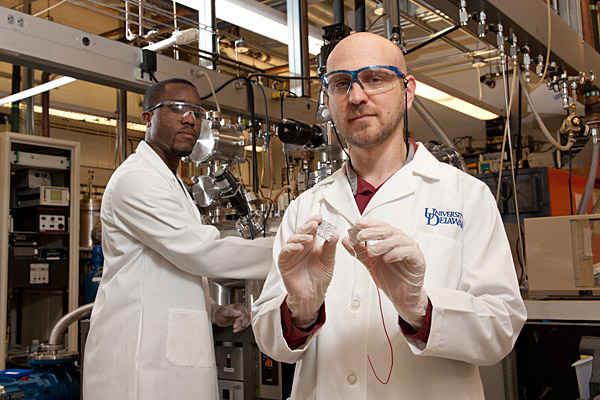
Joshua Zide (right), assistant professor of materials science and engineering, at work in the laboratory with Pernell Dongmo, a doctoral candidate in the College of Engineering.

Joshua Zide, assistant professor of materials science and engineering at the University of Delaware, has spent nearly a decade engineering nanomaterials using a technique called molecular beam epitaxy (MBE).

In his research, Zide makes a class of materials called nanocomposites that consist of metallic nanoparticles within a semi-conductor. These nanocomposites can be used in electronic devices such as transistors or in energy conversion devices such as solar cells or thermoelectrics. Typically, these devices are made of semiconductors like silicon or gallium arsenide.

While MBE produces nanoscale materials with exquisite control, the technique is slow and expensive. It also doesn’t scale well for industrial applications and it isn’t flexible in allowing the addition of new materials.

Zide will attempt to grow nanoscale materials in a new way through a 2012 Department of Energy Early Career Research grant from the Office of Basic Energy Sciences. One of only 68 individuals selected from a pool of nearly 850 applicants, the award will provide Zide $750,000 in research funding over five years.

Under the grant, Zide will explore the use of liquid phase epitaxy (LPE) to make nanocomposites for thermoelectrics, which are devices for generating electrical energy from heat. The work shows potential for transitioning these promising materials from the laboratory to the factory, allowing production of innovative electronic, optoelectronic and energy conversion devices.

“People have used LPE many times to make semiconductors. What we’re doing is making the same kinds of nanocomposites using a hybrid approach that also employs inert gas condensation,” he said.

The research team will first make the metal nanoparticles in the laboratory via inert gas condensation and then use the nanoparticles to grow materials by LPE. According to Zide, combining these two well-established, inexpensive techniques in a new way opens the door to making this class of materials in a commercially viable and scalable way.

“Instead of growing nanomaterials at one micron per hour, which is much slower than grass grows, LPE will enable us to grow nanomaterials at one micron per minute,” Zide said.

“We think this could lead to a faster, better, cheaper way of making a class of nanocomposite materials with pretty exciting applications,” he added.

Separating the production of the nanoparticles from the production of the film also increases the materials flexibility and enables it to be changed in ways not possible by MBE. In principle, Zide said the technique could also be applied to other materials systems, enabling researchers to combine more dissimilar materials in electronic nanocomposites.

During the project, he will collaborate and share equipment with materials science and engineering colleagues Ismat Shah, whose expertise lies in making nanoparticles via inert gas condensation, and Robert Opila, whose expertise lies in LPE.

Two graduate students will also participate in the project. One student will focus on creating the nanoparticles and the other will incorporate the nanoparticles into the films designed in Zide’s laboratory and to study the materials’ characterization and properties.

“This long-term funding will enable me to lead my research in an entirely new direction,” Zide said.

About the award

The U.S. Department of Energy Early Career Research Program aims to strengthen the nation’s scientific workforce. The five-year awards are designed to support exceptional researchers during their early career years, when many scientists do their most seminal work.

Now in its third year, the program also aims to providing incentives for scientists to focus on research areas important to the Department of Energy including advanced scientific computing research, biological and environmental research, basic energy sciences, fusion energy sciences, high-energy physics and nuclear physics.

About the professor

Joshua Zide joined UD in 2007 as an assistant professor in electrical engineering with a joint appointment in mechanical engineering. He joined the materials science and engineering faculty in 2009.

Zide earned his doctoral degree in materials from the University of California Santa Barbara in 2007 and his bachelor’s degree with distinction in materials science and engineering from Stanford University in 2002.

Source: University of Delaware

Tuesday, 15 May 2012

Getting in Tune: Researchers Solve Tuning Problem For Wireless Power Transfer Systems

Engineerblogger
May 15, 2012


Researchers from North Carolina State University have developed a new way to fine-tune wireless power transfer (WPT) receivers, making the systems more efficient and functional. WPT systems hold promise for charging electric vehicles, electronic devices and other technologies.

Researchers have shown that it is possible to transmit power wirelessly by using magnetic resonance. Even minor changes in how the transmitter or receiver is tuned, however, can result in faulty power transmission.

A new prototype developed at NC State addresses the problem by automatically – and precisely – re-tuning the receivers in WPT systems. The researchers focused on receivers because methods already exist that allow researchers to use electronics to precisely tune the transmitters.

“We’re optimistic that this technology moves us one step closer to realizing functional WPT systems that can be used in real-world circumstances,” says Dr. Srdjan Lukic, an assistant professor of electrical and computer engineering at NC State and co-author of a paper on the research.

WPT systems work by transmitting magnetic waves on a specific frequency from a transmitter to a receiver. These magnetic waves interact with a coil in the receiver to induce an electric current. If the coil is tuned so that its resonant frequency matches the frequency of the magnetic waves, the current it produces is amplified. However, if the receiver and the transmitter are out of tune, the system becomes inefficient and doesn’t transfer a significant amount of power. The receiver coil still picks up a trace amount of current, but it is not amplified.

This is a problem because many factors can affect the tuning of a receiver or transmitter, such as temperature or proximity to other magnetic objects. In other words, a hot summer day could wreak havoc on the tuning of a receiver.

Lukic and NC State Ph.D. student Zeljko Pantic developed an electronic prototype that incorporates additional circuitry into the receiver that does two things: it injects small amounts of reactive power into the receiver coil as needed to maintain its original resonant frequency; and, if the transmitter’s tuning changes, the prototype can read the trace amount of current being transmitted and adjust the receiver’s tuning accordingly.

“Because we are using electronics to inject reactive power into the receiver coil, we can be extremely precise when tuning the receiver,” Lukic says. “This degree of fine-tuning maximizes the efficiency of the WPT system.

“The next step is to try incorporating this work into technology that can be used to wirelessly charge electric vehicles.”

Source: North Carolina State University

Additional Information:

"Dip Chip" Technology Tests Toxicity On-the-Go

Engineerblogger
May 15, 2012


Biosensor warns of toxicity in real time, says TAU researcher

From man-made toxic chemicals such as industrial by-products to poisons that occur naturally, a water or food supply can be easily contaminated. And for every level of toxic material ingested, there is some level of bodily response, ranging from minor illness to painful certain death.

Biosensors have long been used to safeguard against exposure to toxic chemicals. Food tasters employed by the ancients acted as early versions of biosensors, determining if a meal had been poisoned. More modern examples include the use of fish, which may alter their swimming characteristics if a toxic material is introduced into to the water. But although current warning systems are more sophisticated, they require equipment and time that a soldier in the field or an adventurer in the wilderness do not have.

Now Prof. Yosi Shacham-Diamand, Vice Dean of Tel Aviv University's Faculty of Engineering, along with Prof. Shimshon Belkin of the Institute of Life Sciences at the Hebrew University of Jerusalem, has married biology and engineering to produce a biosensor device called the "Dip Chip," which detects toxicity quickly and accurately, generating low false positive and false negative readings. The Dip Chip contains microbes designed to exhibit a biological reaction to toxic chemicals, emulating the biological responses of humans or animals.

Converting biological response to electricity

The biological reaction is converted into an electronic signal that can be read by the user. When perfected for commercial applications, the chip might be easily plugged into a mobile device to determine toxicity, says Prof. Shacham-Diamand.

The new chips are based on genetically modified microbes developed in Prof. Belkin's lab. When the modified microbes are exposed to toxic or poisonous materials, they produce a measurable biochemical reaction — and this is where Prof. Shacham-Diamand's work begins.

"In my lab, we developed a method for communicating with the microbes, converting this biological response to electrical signals," he explains. The device, which looks like a dip stick, immobilizes these specially-produced microbes next to the sensing electrodes. Once the microbes come into contact with a questionable substance they produce a chemical signal that is converted to an electrical current by an device that can interpret the signals, producing a binary "toxic" or "not toxic" diagnosis.

In the future, Prof. Shacham-Diamand hopes that smaller versions of the Dip Chips might be plugged into existing mobile electronic devices, such as cell phones or tablets, to give the user a toxicity reading. This would make it an economically feasible and easy-to-use technology for people such as campers or for military purposes.

Reading any toxic material

One of the chip's advantages is its ability to identify toxicity as a biological quality instead of specific toxic chemicals. There are already excellent detectors to identify specific toxic materials, says Prof. Shacham-Diamand. The Dip Chip, however, is designed to alert the user to overall toxicity. And because the chip measures general toxicity, it will pick up on any and all toxic materials — even those that have not been discovered or invented yet.

Beyond their ability to find toxic chemicals in the field, these chips can also be put to use in the cosmetics or pharmaceuticals industries, says Prof. Shacham-Diamand. They could be used to detect the toxicity of new compounds, minimizing the controversial use of lab animals. Using the same technology, the researchers have also developed a larger-scale device which allows water to flow continuously over the sensor, making it appropriate for online, real-time monitoring of water supplies.


Source: American Friends of Tel Aviv University


Additional Information:
  • The results of their research have been published in a number of journals, including Electrochimica Acta and Sensors and Actuators B: Chemical.

Engineers tackle challenges of hypersonic flight

Engineerblogger
May 15, 2012


A multiyear collaboration among Stanford engineering departments uses some of the world's fastest supercomputers to model the complexities of hypersonic flight. Someday, their work may lead to planes that fly at many times the speed of sound.


Aeronautical engineers believe hypersonic planes flying at seven to 15 times the speed of sound will someday change the face of air and space travel. That is, if they can master such flight's known unknowns.

Hypersonic flight is a particularly intense engineering challenge both in the mechanical forces placed on the structure of the plane and in the physics of the sophisticated engines that must operate in the extremes of the upper atmosphere where the planes would fly.

Real-world laboratories can only go so far in reproducing such conditions, and test vehicles are rendered extraordinarily vulnerable. Of the U.S. government's three most recent tests, two ended in vehicle failure.

But now, thanks to a five-year, $20 million U.S. Department of Energy grant, an interdepartmental, multiyear research effort is under way at Stanford to use some of the world's fastest supercomputers to tackle these challenges virtually.

The Stanford Predictive Science Academic Alliance Program (PSAAP) is using computers to model the physical complexities of the hypersonic environment –specifically, how fuel and air flow through a hypersonic aircraft engine, known as a scramjet engine.

PSAAP is a collaboration of the departments of mechanical engineering, aeronautics and astronautics, computer science and mathematics, plus Stanford's Institute for Computational and Mathematical Engineering.

PSAAP focuses on what is known as the scramjet's unstart problem, said Professor Parviz Moin, founding director of Stanford's Center for Turbulence Research and faculty director of the program.

"If you put too much fuel in the engine when you try to start it, you get a phenomenon called 'thermal choking,' where shock waves propagate back through the engine," he explained. "Essentially, the engine doesn't get enough oxygen and it dies. It's like trying to light a match in a hurricane."

Modeling the unstart phenomenon requires a clear understanding of the physics and then reproducing mathematically the immensely complex interactions that occur at hypersonic speeds.

It is impossible to model the physical world exactly, said Juan Alonso, an associate professor of aeronautics and astronautics.

"When you base decisions on computations that are in some way imperfect, you make errors," he said. "Not only that, but these hypersonic vehicles are themselves subject to uncertainties in how they behave in the air."

As a result, PSAAP's principal goal is to try to quantify those uncertainties – the known unknowns – so that scramjet engineers can build the appropriate tolerances into their designs to allow the engines to function in extraordinary environments.

Measuring what the engineers call epistemic uncertainty is common in real-world experimental work, where researchers typically note uncertainties in their measurements in the form of bars that have upper and lower limits. But hard numbers generated by computer models do not have uncertainty bars and therefore can take on an unwarranted, potentially dangerous air of certainty.

"We have asked experimentalists for a long time to give us uncertainty bars on their measurements," said Moin. "But I think the time is right to ask the computationalists to do the same."

Quantification of uncertainties in numerical predictions is at the core of PSAAP. Gianluca Iaccarino, assistant professor of mechanical engineering, is leading this effort.
Innovations in computing

One reason computational uncertainty quantification is a relatively new science is that, until recently, the necessary computer resources simply didn't exist.

"Some of our latest calculations run on 163,000 processors simultaneously," Moin said. "I think they're some of the largest calculations ever undertaken."

Thanks to its close relationship with the Department of Energy, however, the Stanford PSAAP team enjoys access to the massive computer facilities at the Lawrence Livermore, Los Alamos and Sandia national laboratories, where their largest and most complex simulations can be run.

It takes specialized knowledge to get computers of this scale to perform effectively, however.

"And that's not something scientists and engineers should be worrying about," said Alonso, which is why the collaboration between departments is critical.

"Mechanical engineers and those of us in aeronautics and astronautics understand the flow and combustion physics of scramjet engines and the predictive tools. We need the computer scientists to help us figure out how to run these tests on these large computers," he said.

That need will only increase over the next decade as supercomputers move toward the exascale – computers with a million or more processors able to execute a quintillion calculations in a single second.

Thinking ahead to that day, the PSAAP team, led by computer science Professor Pat Hanrahan, has created LISZT, an entirely new computer language for running complex simulations on massive processor sets.

The great virtue of LISZT is its ability to directly express problems in engineering and science through code designed specifically for exascale architectures. That makes it equally accessible to experts working in fluid physics, combustion, turbulence and other mathematically intense applications while at the same time remaining highly computationally efficient.

LISZT seems to be one of the most viable methods – and some say only method – for doing real scientific modeling at the exascale, a distinction that has it attracting widespread international interest.

"It's something you could never have created unless you put computer scientists, mathematicians, mechanical engineers and aerospace engineers together in the same room," said Alonso. "Do it, though, and you can produce some really magical results."
Advances in several dimensions

Beyond progress in the treatment of epistemic uncertainty in computer modeling and the creation of LISZT, the Stanford PSAAP team has made key advances in the specific disciplines that underpin scramjet engineering: combustion, turbulence and fluid flow in general.

And while the challenges of running an actual scramjet engine in a wind tunnel working at hypersonic speeds remain daunting, the Stanford PSAAP project is unique in that it has supported advances in physical experimentation.

"We've had strong validation of our computational work against experiments," said Moin. "In particular, in the High Temperature Gasdynamics Lab and the Flow Physics group, we've developed a number of new techniques to validate how we build physical models into our computer code."

Collectively, these insights will enable the design of safer, more reliable hypersonic engines. But PSAAP's advances in quantifying uncertainty have other, far broader implications, said Alonso.

"These same technologies can be used to quantify flow of air around wind farms, for example, or for complex global climate models," he said. "I was in Los Alamos talking with people who are interested in global climate, and guess what? Just like the models for the scramjet, right now their climate models are far from perfect, but it doesn't stop them from pushing ahead."

Source: Stanford University