Blogger Themes

Showing posts with label Australia. Show all posts

Saturday, 5 January 2013

New 2D material for next generation high-speed electronics

Engineerblogger
Jan 4, 2013

Artist impression of high carrier mobility through layered molybdenum oxide crystal lattice. Credit: Dr Daniel J White, ScienceFX

Scientists at CSIRO and RMIT University have produced a new two-dimensional material that could revolutionise the electronics market, making “nano” more than just a marketing term.

The material – made up of layers of crystal known as molybdenum oxides – has unique properties that encourage the free flow of electrons at ultra-high speeds.

In a paper published in the January issue of materials science journal Advanced Materials, the researchers explain how they adapted a revolutionary material known as graphene to create a new conductive nano-material.

Graphene was created in 2004 by scientists in the UK and won its inventors a Nobel Prize in 2010. While graphene supports high speed electrons, its physical properties prevent it from being used for high-speed electronics.

The CSIRO's Dr Serge Zhuiykov said the new nano-material was made up of layered sheets – similar to graphite layers that make up a pencil's core.

"Within these layers, electrons are able to zip through at high speeds with minimal scattering," Dr Zhuiykov said.

"The importance of our breakthrough is how quickly and fluently electrons – which conduct electricity – are able to flow through the new material."

RMIT's Professor Kourosh Kalantar-zadeh said the researchers were able to remove "road blocks" that could obstruct the electrons, an essential step for the development of high-speed electronics.

"Instead of scattering when they hit road blocks, as they would in conventional materials, they can simply pass through this new material and get through the structure faster," Professor Kalantar-zadeh said.

"Quite simply, if electrons can pass through a structure quicker, we can build devices that are smaller and transfer data at much higher speeds.

"While more work needs to be done before we can develop actual gadgets using this new 2D nano-material, this breakthrough lays the foundation for a new electronics revolution and we look forward to exploring its potential."

In the paper titled 'Enhanced Charge Carrier Mobility in Two-Dimensional High Dielectric Molybdenum Oxide,' the researchers describe how they used a process known as "exfoliation" to create layers of the material ~11nm thick.

The material was manipulated to convert it into a semiconductor and nanoscale transistors were then created using molybdenum oxide.

The result was electron mobility values of  >1,100 cm2/Vs – exceeding the current industry standard for low dimensional silicon.

The work, with RMIT doctoral researcher Sivacarendran Balendhran as the lead author, was supported by the CSIRO Sensors and Sensor Networks Transformational Capability Platform and the CSIRO Materials Science and Engineering Division.

It was also a result of collaboration between researchers from Monash University, University of California – Los Angeles (UCLA), CSIRO, Massachusetts Institute of Technology (MIT) and RMIT.

Source:  CSIRO
Wednesday, 18 April 2012

Breakthrough in solar cell efficiency

Engineerblogger
April 18, 2012


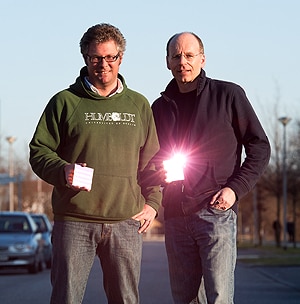
(L-R) Professor Tim Schmidt and his research partner Dr Klaus Lips at the Helmholtz Centre for Materials and Energy have made a breakthrough in solar cell technology.

Low cost solar cells suitable for rooftop panels could reach a record-breaking 40 percent efficiency following an early stage breakthrough by a University of Sydney researcher and his German partners.

With Australian Solar Institute support, Professor Tim Schmidt from the University's School of Chemistry, together with the Helmholtz Centre for Materials and Energy, has developed a "turbo for solar cells", called photochemical upconversion that allows energy, normally lost in solar cells, to be turned into electricity.

The finding has been published in the Energy & Environmental Science journal.

Professor Tim Schmidt said using the upconversion technique, a process which harvests the part of the solar spectrum currently unused by solar cells, eliminates the need for costly redevelopment of solar cells.

"We are able to boost efficiency by forcing two energy-poor red photons in the cell to join and make one energy-rich yellow photon that can capture light, which is then turned into electricity," Professor Schmidt said.

"We now have a benchmark for the performance of an upconverting solar cell. We need to improve this several times, but the pathway is now clear."

Australian Solar Institute Executive Director Mark Twidell said this is a great example of successful collaboration between leading Australian and German solar researchers.

"Together, Australia and Germany can accelerate the pace of commercialisation of solar technologies and drive down the cost of solar electricity," Mr Twidell said.

"That's why the Australian Solar Institute is supporting collaboration between the two countries through the Australia-Germany Collaborative Solar Research and Development Program."

The Australian Solar Institute is a $150 million commitment by the Australian government to support the development of photovoltaic and concentrating solar power technologies in Australia.

Source: University of Sydney

Additional Information:

In the paper "Improving the light-harvesting of amorphous silicon solar cells with photochemical upconversion" in the Energy & Environmental Science journal.

Wednesday, 21 March 2012

Solar cell turns windows into generators

Engineerblogger
March 21, 2012


Mark Bissett. Photo: Flinders University

Imagine a world where the windows of high-rise office buildings are powerful energy producers, offering its inhabitants much more than some fresh air, light and a view.

For the past four years a team of researchers from Flinders University has been working to make this dream a reality – and now the notion of solar-powered windows could be coming to a not too distant future near you.

As part of his just-completed PhD, Dr Mark Bissett (pictured) from the School of Chemical and Physical Sciences has developed a revolutionary solar cell using carbon nanotubes.

A promising alternative to traditional silicon-based solar cells, carbon nanotubes are cheaper to make and more efficient to use than their energy-sapping, silicon counterparts.

“Solar power is actually the most expensive type of renewable energy – in fact the silicon solar cells we see on peoples’ roofs are very expensive to produce and they also use a lot of electricity to purify,” Dr Bissett said.

“The overall efficiency of silicon solar cells are about 10 per cent and even when they’re operating at optimal efficiency it could take eight to 15 years to make back the energy that it took to produce them in the first place because they’re produced using fossil fuels,” he said.

Dr Bissett said the new, low-cost carbon nanotubes are transparent, meaning they can be “sprayed” onto windows without blocking light, and they are also flexible so they can be weaved into a range of materials including fabric – a concept that is already being explored by advertising companies.

While the amount of power generated by solar windows would not be enough to completely offset the energy consumption of a standard office building, Dr Bissett said they still had many financial and environmental advantages.

“In a new building, or one where the windows are being replaced anyway, adding transparent solar cells to the glass would be a relatively small cost since the cost of the glass, frames and installation would be the same with or without the solar component,” Dr Bissett said.

“It’s basically like tinting the windows except they’re able to produce electricity, and considering office buildings don’t have a lot of roof space for solar panels it makes sense to utilise the many windows they do have instead.”

Dr Bissett said the technology mimics photosynthesis, the process whereby plants obtain energy from the sun.

“A solar cell is created by taking two sheets of electrically conductive glass and sandwiching a layer of functionalised single-walled carbon nanotubes between the glass sheets,” he said.

“When light shines on the cell, electrons are generated within the carbon nanotubes and these can be used to power electrical devices.”

Although small prototypes have been developed in the lab, he said the next step would be to test the carbon cells on an “industrial stage”.

If all goes to plan, the material could be on the market within 10 years.

“When we first started the research we had no idea if it would work because we were the first in the world to try it so it’s pretty exciting that we’ve proved the concept, and hopefully it will be commercially available in a few year’s time,” Dr Bissett said.

Dr Bissett is a winner of Flinders inaugural Best Student Paper Award, a now annual program which aims to recognise excellence in student research across the University.

Source: Flinders University

Wednesday, 15 February 2012

Innovators in solar world's first: Developing efficient nanoplasmonic solar cells

Engineerblogger
Feb 15, 2012


Professor Min Gu. Credit: Swinburne University of Technology

In a boon for the local solar industry, a team of researchers from Swinburne University of Technology and Suntech Power Holdings have developed the world's most efficient broadband nanoplasmonic solar cells.

In a paper published in Nano Letters, the researchers describe how they have manufactured thin film solar cells with an absolute efficiency of 8.1 per cent.

The research was conducted under the auspices of the Victoria-Suntech Advanced Solar Facility (VSASF) at Swinburne, a $12 million program jointly funded by the Victorian Government, Swinburne and Suntech. The group is working to dramatically increase the efficiency of thin film solar technology.

According to Swinburne Professor Min Gu, Director of the VSASF, thin film cells have attracted enormous research interest as a cheap alternative to bulk crystalline silicon cells. However, the significantly reduced thickness of their silicon layer makes it more difficult for them to absorb sunlight.

"Light trapping technology is of paramount importance to increase the performance of thin film solar cells and make them competitive with silicon cells," Professor Gu said. "One of the main potential applications of the technology will be to cover conventional glass, enabling buildings and skyscrapers to be powered entirely by sunlight."

The VSASF group has been improving thin film cell efficiency by embedding gold and silver nanoparticles into the cells. This increases the wavelength range of the absorbed light, improving the conversion of photons into electrons.

In their most efficient cells yet, the researchers went one step further, using what are known as nucleated or ‘bumpy' nanoparticles.

Senior Research Fellow at Swinburne Dr Baohua Jia said: "The broadband plasmonic effect is an exciting discovery of the team. It is truly a collaborative outcome between Swinburne and Suntech over the last 12 months."

Dr Jia believes that this new technology will have an important impact on the solar industry. "What we have found is that nanoparticles that have an uneven surface scatter light even further into a broadband wavelength range. This leads to greater absorption, and therefore improves the cell's overall efficiency.

Professor Gu applauded the quick timeframe in which the research group has been able to achieve 8.1 per cent total efficiency, however he believes there is still considerable scope to improve the cells and transform the way the world sources energy.

"We are on a rapid upwards trajectory with our research and development. With our current rate of progress we expect to achieve 10 per cent efficiency by mid 2012," he said. "We are well on track to reach the VSASF's target to develop solar cells that are twice as efficient and run at half the cost of those currently available."

Professor Gu said that another advantage of the group's approach is that nanoparticle integration is inexpensive and easy to upscale and therefore can easily be transferred to the production line.

"We have been using Suntech solar cells from the outset, so it should be very straightforward to integrate the technology into mass manufacturing. We expect these cells to be commercially available by 2017."

Suntech CEO Dr Zhengrong Shi said: "Our team has achieved an impressive milestone with the world record for the most efficient broadband nanoplasmonic thin-film cell. This is an important step in demonstrating the potential of nanotechnology in leading the next generation of solar cells."

The Nano Letters paper was authored by Dr Xi Chen, Dr Baohua Jia, Dr Jhantu Saha, Mr Boyuan Cai, Dr Nicholas Stokes, and Professor Min Gu from Swinburne and Dr Qi Qiao, Dr Yongqian Wang and Dr Zhengrong Shi from Suntech.

Source:  Swinburne University of Technology

Additional Information:

Monday, 9 January 2012

Wires shrink to atomic scale

Engineerblogger
Jan 9, 2012


Michelle Simmons and Bent Weber from UNSW  Credit: UNSW

The narrowest conducting wires in silicon ever made – just four atoms wide and one atom tall – have been shown to have the same electrical current carrying capability of copper, according to a new study published today in the journal Science.

Despite their astonishingly tiny diameter – 10,000 times thinner than a human hair – these wires have exceptionally good electrical properties, raising hopes they will serve to connect atomic-scale components in the quantum computers of tomorrow.

“Interconnecting wiring of this scale will be vital for the development of future atomic-scale electronic circuits,” says the lead author of the study, Bent Weber, a PhD student in the ARC Centre of Excellence for Quantum Computation and Communication Technology at the University of New South Wales, in Sydney, Australia.

The wires were made by precisely placing chains of phosphorus atoms within a silicon crystal, according to the study, which includes researchers from the University of Melbourne and Purdue University in the US.

The researchers discovered that the electrical resistivity of their wires – a measure of the ease with which electrical current can flow – does not depend on the wire width. Their behaviour is described by Ohm’s law, which is a fundamental law of physics taught to every high school student.

“It is extraordinary to show that such a basic law still holds even when constructing a wire from the fundamental building blocks of nature – atoms,” says Weber.

The discovery demonstrates that electrical interconnects in silicon can shrink to atomic dimensions without loss of functionality, says the Centre’s Director and leader of the research, Professor Michelle Simmons.

“Driven by the semiconductor industry, computer chip components continuously shrink in size allowing ever smaller and more powerful computers,” Simmons says.

“Over the past 50 years this paradigm has established the microelectronics industry as one of the key drivers for global economic growth. A major focus of the Centre of Excellence at UNSW is to push this technology to the next level to develop a silicon-based quantum computer, where single atoms serve as the individual units of computation,” she says.

“It will come down to the wire. We are on the threshold of making transistors out of individual atoms. But to build a practical quantum computer we have recognised that the interconnecting wiring and circuitry also needs to shrink to the atomic scale.”

Creating such tiny components has been made possible using a technique called scanning tunnelling microscopy. “This technique not only allows us to image individual atoms but also to manipulate them and place them in position,” says Weber.

The video below explains the discovery and features interviews with Professor Michelle Simmons and PhD student Bent Weber.


Source:The University of New South Wales

Thursday, 15 December 2011

An Unmanned Aerial Vehicle (UAV) that uses wind power like a bird

Engineerblogger
Dec 15, 2011


Wesam Al Sabban was awarded a Genius Prize for his Green Falcon 11, a wind and solar powered unmanned aerial vehicle (UAV).

Queensland University of Technology PhD student Wesam Al Sabban is a genius and has the medal to prove it!

The engineering student received the accolade for his work on the design of an unmanned aerial vehicle (UAV) that would be powered by the sun and wind.

"While all aeroplanes mimic the shape of birds, the Green Falcon II will literally use the wind to power its movement, just as a bird would," Mr Al Sabban said.

"As part of my PhD topic we are studying the way birds make use of wind energy to fly with minimum power, the way they glide and use all types of wind to move and change their flight path.

"We're developing a UAV with artificial intelligence to forecast solar intensity and use wind patterns for path planning and to power the UAV.

"Quite frankly, we expect it to fly like the wind and because it will run on solar and wind power it'll be cheaper to operate than similar sized UAVs on the market."

While a final design is about eighteen months away, Mr Al Sabban was presented with a trio of awards at the recent 63rd iENA International Trade Fair, a mega inventors' showcase held each year in Nuremberg, Germany.

He was awarded an independent inventor iENA Gold Medal, a certificate from the International Federation of Inventors Association (IFIA) for outstanding achievement in a world competition for green inventions and was awarded an honorary Genius Prize from the Association of Hungarian Inventors (MAFE) - the only Genius Prize awarded this year.

At the trade fair, Mr Al Sabban's invention competed with more than 750 others from 30 countries.

Other notable products to come out of previous trade fairs include the skateboard, suitcase on wheels and a folding bicycle.

"We're very interested in green technology and for a number of years we have been working on a UAV to mimic the way birds fly so Wesam's success is a fabulous result," said his PhD supervisor at QUT Dr Felipe Gonzalez.

Dr Gonzalez, a QUT Aerospace Avionics lecturer based at the Australian Research Centre for Aerospace Automation (ARCAA) said the awards illustrated the world-class research of QUT in artificial intelligence, unmanned systems for civilian applications and aerospace avionics.

"The Green Falcon II will be a zero-emissions UAV capable of round-the-clock service," he said.

"It could potentially assist with powerlines inspection, disaster relief, 3D mine mapping and similar scanning uses."

"The iENA awards prove there is a market for efficient UAV development and we'll be looking for partners to turn this unique UAV design into a commercial reality by 2013."

Mr Al Sabban, a Saudi Arabian engineer, moved to Queensland in 2007 to further his engineering education. He was sponsored by the Government of Saudi Arabia as well as ARCAA to present his Green Falcon II at the iENA trade fair.

Source:  Queensland University of Technology

Wednesday, 7 December 2011

BioPower Systems Power Module Grid-Tested And Ready For Sea Trials

Engineerblogger
Dec 07, 2011


bioWAVE is a wave power system, inspired by the swaying motions of kelp plants

Ocean energy company, BioPower Systems, announced that it has completed extensive tests of its full-scale O-Drive power conversion module, successfully delivering stable power to the grid over extended periods with a high level of efficiency.

The O-Drive 250kW module is designed to plug into wave and tidal energy systems, such as the company’s bioWAVE  and bioSTREAM. It is driven in an oscillating fashion to convert the ocean energy harnessed by such systems into grid-ready AC power.


The bioSTREAM technology has been extensively tested at 1:15 scale in state-of-the-art towing tank facilities. Click below to watch a video of a bioSTREAM model in operation.

Work commenced on the O-Drive in 2008 under a project partly funded by an Australian
Commonwealth Government REDI grant. The O-Drive combines a hydraulic circuit, an electric generator, and complex control algorithms to convert the characteristically large forces, and slow motions, inherent to ocean waves into a steady flow of electricity. A test rig was built to reproduce ocean forces and apply these to the O-Drive in order to perform tests.

“Ocean energy devices typically oscillate slowly in response to huge forces, and this presents a significant challenge in terms of harnessing the energy to produce electricity. The O-Drive solves this problem outright, as it not only gears up the motion, but also rectifies it and smooths it, so that we can produce grid-ready electricity using a standard electric generator” the CEO of BioPower Systems, Dr Timothy Finnigan, said. “We are very pleased with the efficiency of this system, and with the quality of power that is produced.”

The O-Drive is designed to be detached from a moored ocean energy system, which enables easy and cost-effective maintenance. It produces high-voltage power, which allows ocean energy systems to be installed even at substantial distances from shore, as the losses during transmission are minimal.
BioPower Systems will use the O-Drive module in a bioWAVE pilot demonstration off the coast of Victoria, Australia. The company also intends to produce a 1MW commercial version of bioWAVE, which would utilise four 250kW O-Drive TM modules.

“BioPower Systems has invested substantial capital and expertise to ensure that the O-Drive performs optimally and reliably before deployment” said Dr Finnigan.

The company is planning to offer turnkey ocean energy solutions to project developers. Ocean energy equipment, services and support will be provided to the companies that currently develop wind farms.

“We intend to adopt a similar business model to those used in the wind energy sector. It is well-proven,
and serves as a good precedent for ocean energy,” Dr Finnigan added.


Source: BioPower Systems
 

Related Information:


Wednesday, 16 November 2011

Researchers assess additive manufacturing for JSF parts

Engineerblogger
Nov 16, 2011

Australian researchers are assessing the feasibility of using additive manufacturing to produce small titanium components for the Joint Strike Fighter (JSF).

The research project is a collaboration between RMIT, the Defence Materials Technology Centre (DMTC), Lockheed Martin, 3D Systems, the University of Wollongong and the Defence Science and Technology Organisation (DSTO).

‘Initially we want to find out the effects of various parameters on the microstructure of the built titanium structures and the difference in mechanical properties between vertical and horizontal builds,’ said project lead Prof Milan Brandt from the school of aerospace, mechanical and manufacturing engineering at RMIT. ‘This will then be used to redesign and manufacture the components based on bionic principles.’

An important aspect of the JSF programme is reducing the cost of manufacturing titanium components, which are attractive because of their high strength-to-weight ratio, the ability to retain that strength at high temperatures and high corrosion resistance compared to other alloys.

Prof Brandt said a major problem of manufacturing components from titanium alloys was the high rate of wastage. Technologies that cut waste would significantly impact the cost of manufactured titanium components.

RMIT University academics are looking at the use of selective laser melting (SLM) equipment to make small but expensive titanium-based components.

This method spreads a fine metallic powder in a thin layer typically 50 micrometres thick. A laser beam scans along a path based on the shape of the part to be manufactured, melting the powder and fusing it to the layer below and producing a metallurgical bond between them.

‘At the end of the day it is all leading to manufacturing small-scale JSF titanium components more efficiently and effectively while maintaining their quality and integrity,’ said Brandt.

‘On the fundamental scientific level our objective is to increase the understanding of the SLM process and translate that into practical information for uptake by industry.’


Additional Information:

Thursday, 3 November 2011

Is that a robot in your suitcase?

Engineerblogger
Nov 3, 2011


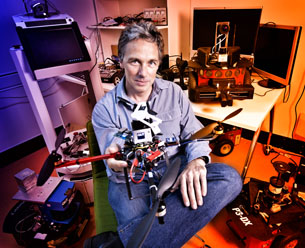
A flying robot as small as a dinner plate that can zoom to hard-to-reach places and a fleet of eco-friendly robotic farm-hands are just two of the exciting projects the robotics team at the Queensland University of Technology (QUT) is working on.

The pint-sized propellor-powered robots can be packed away into a suitcase. They have multiple cameras which enable them to 'see' the world around them as they navigate their way through buildings, carrying out tasks like deliveries or inspections.

"You'll be able to put your suitcase on the ground, open it up and send the flying robot off to do its job," said Professor Peter Corke, from the Faculty of Built Environment and Engineering.

"These robots could fly around and deliver objects to people inside buildings and inspect things that are too high or difficult for a human to reach easily.

"Instead of having to lower someone down on a rope to a window on the seventh floor, or raise them up on a cherrypicker, you could send up the flying robot instead."

The QUT researchers are using cost-effective technology so the robots are affordable. Within the next year, it may be possible to attach arms to the device so it can also fix things.

Professor Corke said his team were busy working out the technical challenges.

"We need to keep it safe when it's up near solid things like power poles, or the edge of a building. It also needs to be able to keep its position when the wind is blowing," he said.

Professor Corke and his team, including fellow researcher Dr Ben Upcroft, are also researching ways to create lightweight agricultural robots, equipped with cameras, that have advanced navigation capability, cooperate in teams to cover large areas and resupply themselves - all while causing less soil damage and applying herbicide more intelligently.

"Farmers are currently using machines which indiscriminately spray herbicide across the crop, which is expensive and not very environmentally friendly," Dr Upcroft said.

"The (robot's) camera can look at the area surrounding the robot and the image recognition software will pick out features of the weed which make it different to the rest of the crop."

The three-year project, which was recently awarded nearly $400,000 in funding from the Australian Research Council, is being conducted with the University of Sydney and Queensland farmer Andrew Bate, who runs Advanced Agricultural Systems.

Source:  Queensland University of Technology (QUT)

Thursday, 22 September 2011

New energy in search for future wind

CSIRO
Sept 21, 2011

Scientists are taking the first steps to improve estimates of long-term wind speed changes for the fast-growing wind energy sector, intended to reduce the risks for generators in a changing climate.

Some recent international studies have shown a decrease in wind speeds in several parts of the globe, including across Australia. However, more recent results by CSIRO show that Australia's average wind speed is actually increasing.

Scientists at CSIRO Marine and Atmospheric Research have analysed wind speed observations to understand the causes of variations in near-surface wind and explore long-term wind speed trends over Australia.

"We have a good picture of wind energy availability across Australia from previous CSIRO wind mapping and, with the growth of wind farms, there is an emerging need to understand how climate change can affect the wind resource," says Dr Alberto Troccoli, lead author of the paper published in the Journal of Climate.

"Wind power production is expected to increase greatly over the coming years and the associated electricity system will be subject to variations of several hundred megawatts – depending on wind availability.

"The ability to quantify with accuracy these long-term variations is essential to the sector from an economic point of view," he said.
To read more click here...

Tuesday, 16 August 2011

Solar soldiers power up at ANU

Australian National University (ANU)
Aug 11, 2011

Solar technology set to revolutionise combat has been developed by The Australian National University.

Wearable light-weight solar panels have been developed by the ANU Centre for Sustainable Energy Systems as part of a $2.3 million Capability and Technology Demonstrator (CTD) contract with the Department of Defence.

Dr Igor Skryabin, Development Manager for the project, said that as part of the Australian Defence Force soldier modernisation program, infantry soldiers are being equipped with electronic devices to enhance their close combat tactical awareness and survivability.

“Currently soldiers are dependant on electrical power provided by a conventional battery to power these devices,” said Dr Skryabin. “Each battery has a different endurance and reliability level and each rechargeable type requires its own kit, compounding the bulk and weight that needs to be carried.

“While battery technology research has delivered considerable improvements, the goal of a small, lightweight power storage system, capable of sustaining all electronic equipment for the whole time a soldier is in the field, is not yet available.

“The development of these wearable solar cells will now allow soldiers to generate power in the field and reduce the need for batteries for their electronic devices. They will also establish a power supply that keeps electronic devices operational throughout the duration of missions,” he said.
To read more click here...

Monday, 18 July 2011

AUSTRALIA TO DEVELOP WORLD'S FIRST ONE-PIECE CARBON FIBRE AUTOMOTIVE WHEEL

FEN
July 18, 2011

The world’s first one-piece carbon fibre automotive wheel will be developed in Australia, thanks to a $6.2 million grant that has been given to four local automotive manufacturers to develop ‘lightweight’ components.

CFusion, Toyoda Gosei Australia, Composite Materials Engineering and Hirotec will each receive a share of the $6.2 million grant, to develop components that will help consumers reduce their greenhouse gas emissions.

The new developments will open-up opportunities for jobs, skills and new technologies in Australia.

“The components being developed to retool our automotive industry will help cars that are friendlier on the environment and the pocket — in this case, we expect the four projects will reduce greenhouse gas emissions by around 133,000 tonnes and significantly reduce fuel consumption,” said Innovation Minister, Senator Kim Carr.

CFusion is using $1.4 million to commercialise the world’s first one-piece carbon fibre automotive wheel, at about half the weight of aluminium wheels.

Toyoda Gosei is using funding of over $2.3 million to introduce and refine technologies for manufacturing lighter components, namely body sealing products and safety system products, such as air bag modules and plastic interior trim products.

CME is using funding of $797,399 to develop a high strength, lightweight sandwich panel to be used in the load floor of Australian vehicles. This product will significantly reduce the weight of the load floor whilst meeting all of the performance requirements for this component.

Hirotec is using funding of over $1.6 million to produce lighter automotive components including aluminium hoods and deck lids using innovative product design to significantly reduce the overall weight of passenger motor vehicles.

The grants are part of the government’s $5.4 billion New Car Plan.

Holden Australia executive director manufacturing operations, Martyn Cray, announced at the Endeavour Awards ceremony in Melbourne recently that government grants are instrumental to Australia's manufacturing future.

"Manufacturing needs support from the government. I've worked around the world, and governments all around the world support manufacturing - don't let this government tell you anything different," he said.

Thursday, 7 July 2011

Double solar world record

University of New South Wales(UNSW)
July 7, 2011

A world record double by UNSW solar cell researchers promises to make solar power more affordable, with world-beating new technology delivering substantial efficiency gains at minimal extra cost.

Using a patented laser process, researchers from UNSW’s Photovoltaics Technology Transfer Team, working with solar technology firm Centrotherm, achieved a new world benchmark of 19.3 percent efficiency in May for a mass-produced, crystalline silicon solar cell. They improved that result in June to advance the record to 19.4 per cent.

The previous record for cells created with this process was 18.9 per cent.

The new cells compare favourably with the 18 per cent-efficient cells commonly used in rooftop solar panels.

Dr Matt Edwards, Program Manager of the Photovoltaics Technology Transfer Team in the UNSW School of Photovoltaic and Renewable Energy Engineering, said the records were achieved without exotic materials or equipment.

"The exciting aspect of these records is that we achieved these results in a short time, using an industry-standard silicon wafer and modified industry-standard equipment," he said.

"It’s another step closer to solar power costing the same as coal-fired electricity."

Revolutionary ANU ‘plasma thruster’ set for blast off

Australian National University (ANU)
July 7, 2011

ANU has won a $3.1 million grant from the Federal Government to help propel Australian satellite technology and exploratory missions into the furthest reaches of deep space.

The University will partner with national and international bodies to make a revolutionary plasma thruster engine, invented and developed at ANU, ready for spaceflight. If successful, the engine could be used in satellites and deep space missions as soon as 2013.

Project leader Professor Rod Boswell, from the Plasma Research Laboratory, said the engine will be based on his colleague Professor Christine Charles’ Helicon Double Layer Thruster (HDLT).

“The HDLT is the first thruster of its kind in the world and can be used to keep satellites in their desired orbit as well as in interplanetary travel,” he said. “It is an elegant, almost fuel-independent as well as energy and cost effective, propulsion system.

“Plasma thruster engines are set to be the future of all space exploration and satellite activities. They have characteristics that will eventually lead to their wide deployment as space propulsion systems.

“They are much less powerful than conventional chemical rocket engines, but in principle are more efficient, for long periods of time, making them ideal for deep space missions.

“In the long term, the development of plasma thruster technology will extend the range of human as well as robotic exploration into the solar system and beyond.”

The grant won by Professor Boswell and his colleagues in the Plasma Research Laboratory will also help build a space simulation facility at ANU. Based at Mt Stromlo Observatory in Canberra, the Space Simulation Facility will incorporate a thermal/vacuum device which will enable testing of the HDLT and other satellites in space-like conditions.

The facility will also be made available to other scientists, astronomers and industry bodies seeking to develop space equipment.

The grant to ANU forms part of a $6.1 million investment in space research and education announced last month by Innovation Minister, Senator the Hon Kim Carr.


Additional Information:

Saturday, 2 July 2011

Printable nanotech solar cells developed

University of Melbourne
July 1, 2011

Printable, flexible solar cells that could dramatically decrease the cost of renewable energy have been developed by University of Melbourne PhD student Brandon MacDonald in collaboration with his colleagues from University of Melbourne’s Bio21 Institute and the CSIRO’s Future Manufacturing Flagship.

Their patented technology is based on inks containing tiny, semiconducting nanocrystals, which can be printed directly onto a variety of surfaces.

By choosing the right combination of ink and surface it is possible to make efficient solar cells using very little material or energy. The solar cells can be used much like current solar panels to provide power to things like lighting on bus shelters.

“The problem with traditional solar cells,” Brandon says, “is that making them requires many complex and energy intensive steps.”

“Using nanocrystal inks, they can be manufactured in a continuous manner, which increases production rate and should make the cells much cheaper to produce.”

Nanocrystals, also known as quantum dots, are semiconducting particles with a diameter of a few millionths of a millimetre. Because of their extremely small size they can remain suspended in a solution.
To read more click here...

Wednesday, 22 June 2011

Direct geothermal energy could be key to our clean energy future

The Conversion
June 22, 2011

While direct geothermal energy is extensively used in other countries, it is rarely encountered in Australia.

This might be because we have cheap sources of energy (although, regrettably, not the cleanest). We also haven’t had to worry too much about alternatives yet.

Our climate is also less demanding than the much colder, heavily populated areas of the northern hemisphere.

But it’s highly likely that this is going to change dramatically soon. A carbon price will push up the price of conventional power and greenhouse gas emissions will have to be seriously reduced.

Clean energy has to come to the rescue.

While all forms of renewable energy will play a part, the geothermal alternative must become a major player. It is abundant, totally renewable (it is recharged over enormous areas by the sun), it involves well established and reliable technology, and, unlike most others, it is available 24/7.

Energy use in buildings accounts for 26% of Australia’s greenhouse gas emissions. Heating and cooling accounts for over half of this.

Cheaper energy, lower emissions

The introduction of direct geothermal heating and cooling to Australia – even on a moderate scale – would have a significant impact on power requirements. There would be enormous economic and environmental benefits.

As virtually every building in Australia requires some form of heating or cooling, direct geothermal energy could influence every Australian and their carbon footprint.

For each kilowatt of electrical energy put into a direct geothermal system, about 4 kilowatts of energy is developed for the purposes of heating and cooling.

This means that outside of the capital costs of the installation, 75% of the power is free.

A significant amount of electrical power in Australia is generated with brown coal. Replacing 75% of this with a totally clean renewable energy source would reduce greenhouse gas emissions to as little as 25% of what occurs with current practice.

Clearly, this is a crude assessment of what is possible and other fuel sources are not taken into account.

But the figures do indicate some of the significant economic and environmental benefits that can be achieved directly and indirectly.

Wednesday, 15 June 2011

EDWARD - Electric Diwheel With Active Rotation Damping

The University of Adelaide
June 14, 2011


This honours project involved the construction of a human operated diwheel. Many diwheels in the past have been human powered or powered by IC engines. This one is purely electric. It has additional functionality lacking in other models, including inbuilt dynamic lateral stability and slosh control to prevent "gerbiling" or tumbling in aggressive braking or acceleration maneuvers. The diwheel also incorporates a unique feature that allows the rider to drive the vehicle when "upside down" - keeping the vehicle in its unstable state is achieved using a combined swingup and inversion controller. The mechanical design and some of the electronics was completed in 2009, with the majority of the electronics and control systems developed in 2010.

Wednesday, 8 June 2011

Waste heat slashes fuel consumption

Fresh Science
June 7, 2011

A minor modification to your car could reduce fuel consumption by over seven per cent.

The Deakin University invention uses waste heat to reduce friction by warming the engine oil. A prototype has been built and tested and the inventors are now talking to the car manufacturers and developing an aftermarket conversion kit.

The system, which can be retrofitted, works by diverting waste heat to bring engine oil up to its optimal operating temperature. It was developed by researchers at Deakin University led by Mr Frank Will of the School of Engineering during his PhD project.

“Preliminary testing of our system has demonstrated fuel savings of over seven per cent as well as significant reductions in exhaust emissions,” Frank says.

The work is being presented through Fresh Science, a communication boot camp for early career scientists held at the Melbourne Museum. Frank was one of 16 winners from across Australia.
To read more click here...

Monday, 16 May 2011

SCRAMSPACE – the next frontier

The University of Queensland
May 13, 2011

A talented new team of young scientists and engineers at The University of Queensland (UQ) is building a hypersonic scramjet which will fly at 8600 km/h in South Australia next year.

The research is the first phase of SCRAMSPACE - the development of a high-tech Australian capability set to revolutionise the way the world launches satellites into space.

“A scramjet is an airbreathing engine for hypersonic craft that travel at many times the speed of sound, for high speed transport in Earth's atmosphere or along trajectories to space, Professor Russell Boyce said.

"They improve the efficiency and reliability and reduce the cost of inserting satellites into orbit."

Professor Boyce is the SCRAMSPACE director and DSTO Chair for Hypersonics at UQ.

“Australia is a world leader in scramjet development," he said.

"We now have an opportunity to build a scramjet-based industry in this country, in international partnership.

Thursday, 5 May 2011

Australia expects to have first delivery of commercial geothermal power in 2012

Xinhua News Agency
May 4, 2011

Australia can expect its first delivery of commercial geothermal power by the end of 2012 from Petratherm's Paralana project in northern South Australia, local media reported on Wednesday.

In January, Petratherm successfully completed an initial test at its Paralana-2 well, where an injection of a small volume of water detected micro-seismic event as far as 300 metres out from the well hole.

A more major test is now scheduled for June, using higher volumes of water at higher pressure.

The test will be critical, and by achieving it will help determine the company's ability to get a commercial flow rate going between the injector and the eventual Paralana-3 production well.

According to the company's managing director Terry Kallis, the June test was achievable provided it continued to meet its targets.

"This is not a race and the sector has had its detractors but we are now within a very real and measurable 18-month horizon of achieving maiden production," Kallis told Australia Associated Press during the the South Australian Resources and Energy Investment Conference in Adelaide.

Petratherm plans to drill the deep Paralana-3 production well in the second half of 2011 and complete the final tests during the first half of 2012.

It said this would allow the commercial commissioning of the power plant by the end of 2012.

If so, the company will commission a 3.75 megawatt power plant.