
Engineerblogger
Feb 18, 2013
Paved roads are nice to look at, but they’re easily damaged and costly to repair. Erik Schlangen demos a new type of porous asphalt made of simple materials with an astonishing feature: When cracked, it can be “healed” by induction heating.
Source: TED
Additional Information:
Showing posts with label Science. Show all posts
Showing posts with label Science. Show all posts
Monday, 18 February 2013
Miguel Nicolelis: A monkey that controls a robot with its thoughts. No, really.
Engineerblogger
Feb 18, 2013
Can we use our brains to directly control machines -- without requiring a body as the middleman? Miguel Nicolelis talks through an astonishing experiment, in which a clever monkey in the US learns to control a monkey avatar, and then a robot arm in Japan, purely with its thoughts. The research has big implications for quadraplegic people -- and maybe for all of us.
Source: TED
Additional Information:
Feb 18, 2013
Can we use our brains to directly control machines -- without requiring a body as the middleman? Miguel Nicolelis talks through an astonishing experiment, in which a clever monkey in the US learns to control a monkey avatar, and then a robot arm in Japan, purely with its thoughts. The research has big implications for quadraplegic people -- and maybe for all of us.
Source: TED
Additional Information:
Saturday, 12 January 2013
How to treat heat like light: Using nanoparticle alloys allows heat to be focused or reflected just like electromagnetic waves
Engineerblogger
Jan 12, 2012
An MIT researcher has developed a technique that provides a new way of manipulating heat, allowing it to be controlled much as light waves can be manipulated by lenses and mirrors.
The approach relies on engineered materials consisting of nanostructured semiconductor alloy crystals. Heat is a vibration of matter — technically, a vibration of the atomic lattice of a material — just as sound is. Such vibrations can also be thought of as a stream of phonons — a kind of “virtual particle” that is analogous to the photons that carry light. The new approach is similar to recently developed photonic crystals that can control the passage of light, and phononic crystals that can do the same for sound.
The spacing of tiny gaps in these materials is tuned to match the wavelength of the heat phonons, explains Martin Maldovan, a research scientist in MIT’s Department of Materials Science and Engineering and author of a paper on the new findings published Jan. 11 in the journal Physical Review Letters.
“It’s a completely new way to manipulate heat,” Maldovan says. Heat differs from sound, he explains, in the frequency of its vibrations: Sound waves consist of lower frequencies (up to the kilohertz range, or thousands of vibrations per second), while heat arises from higher frequencies (in the terahertz range, or trillions of vibrations per second).
In order to apply the techniques already developed to manipulate sound, Maldovan’s first step was to reduce the frequency of the heat phonons, bringing it closer to the sound range. He describes this as “hypersonic heat.”
“Phonons for sound can travel for kilometers,” Maldovan says — which is why it’s possible to hear noises from very far away. “But phonons of heat only travel for nanometers [billionths of a meter]. That’s why you couldn’t hear heat even with ears responding to terahertz frequencies.”
Heat also spans a wide range of frequencies, he says, while sound spans a single frequency. So, to address that, Maldovan says, “the first thing we did is reduce the number of frequencies of heat, and we made them lower,” bringing these frequencies down into the boundary zone between heat and sound. Making alloys of silicon that incorporate nanoparticles of germanium in a particular size range accomplished this lowering of frequency, he says.
Reducing the range of frequencies was also accomplished by making a series of thin films of the material, so that scattering of phonons would take place at the boundaries. This ends up concentrating most of the heat phonons within a relatively narrow “window” of frequencies.
Following the application of these techniques, more than 40 percent of the total heat flow is concentrated within a hypersonic range of 100 to 300 gigahertz, and most of the phonons align in a narrow beam, instead of moving in every direction.
As a result, this beam of narrow-frequency phonons can be manipulated using phononic crystals similar to those developed to control sound phonons. Because these crystals are now being used to control heat instead, Maldovan refers to them as “thermocrystals,” a new category of materials.
These thermocrystals might have a wide range of applications, he suggests, including in improved thermoelectric devices, which convert differences of temperature into electricity. Such devices transmit electricity freely while strictly controlling the flow of heat — tasks that the thermocrystals could accomplish very effectively, Maldovan says.
Most conventional materials allow heat to travel in all directions, like ripples expanding outward from a pebble dropped in a pond; thermocrystals could instead produce the equivalent of those ripples only moving out in a single direction, Maldovan says. The crystals could also be used to create thermal diodes: materials in which heat can pass in one direction, but not in the reverse direction. Such a one-way heat flow could be useful in energy-efficient buildings in hot and cold climates.
Other variations of the material could be used to focus heat — much like focusing light with a lens — to concentrate it in a small area. Another intriguing possibility is thermal cloaking, Maldovan says: materials that prevent detection of heat, just as recently developed metamaterials can create “invisibility cloaks” to shield objects from detection by visible light or microwaves.
Rama Venkatasubramanian, senior research director at the Center for Solid State Energetics at RTI International in North Carolina, says this is “an interesting approach to control the various frequencies of the phonon spectra that conduct heat in a solid-state material.”
The modeling used to develop this new system “needs to be further developed,” Venkatasubramanian adds. “The theory of what wavelengths of phonons, and at what temperatures, contribute to how much heat transport is a complex problem even in simpler materials, let alone nanostructured materials, and these will have to be factored in — so this paper will trigger more interest and study in that direction.”
Source: MIT
Jan 12, 2012
 |
| Thermal lattices, shown here, are one possible application of the newly developed thermocrystals. In these structures, where precisely spaced air gaps (dark circles) control the flow of heat, thermal energy can be "pinned" in place by defects introduced into the structure (colored areas). Illustration courtesy of Martin Maldovan |
An MIT researcher has developed a technique that provides a new way of manipulating heat, allowing it to be controlled much as light waves can be manipulated by lenses and mirrors.
The approach relies on engineered materials consisting of nanostructured semiconductor alloy crystals. Heat is a vibration of matter — technically, a vibration of the atomic lattice of a material — just as sound is. Such vibrations can also be thought of as a stream of phonons — a kind of “virtual particle” that is analogous to the photons that carry light. The new approach is similar to recently developed photonic crystals that can control the passage of light, and phononic crystals that can do the same for sound.
The spacing of tiny gaps in these materials is tuned to match the wavelength of the heat phonons, explains Martin Maldovan, a research scientist in MIT’s Department of Materials Science and Engineering and author of a paper on the new findings published Jan. 11 in the journal Physical Review Letters.
“It’s a completely new way to manipulate heat,” Maldovan says. Heat differs from sound, he explains, in the frequency of its vibrations: Sound waves consist of lower frequencies (up to the kilohertz range, or thousands of vibrations per second), while heat arises from higher frequencies (in the terahertz range, or trillions of vibrations per second).
In order to apply the techniques already developed to manipulate sound, Maldovan’s first step was to reduce the frequency of the heat phonons, bringing it closer to the sound range. He describes this as “hypersonic heat.”
“Phonons for sound can travel for kilometers,” Maldovan says — which is why it’s possible to hear noises from very far away. “But phonons of heat only travel for nanometers [billionths of a meter]. That’s why you couldn’t hear heat even with ears responding to terahertz frequencies.”
Heat also spans a wide range of frequencies, he says, while sound spans a single frequency. So, to address that, Maldovan says, “the first thing we did is reduce the number of frequencies of heat, and we made them lower,” bringing these frequencies down into the boundary zone between heat and sound. Making alloys of silicon that incorporate nanoparticles of germanium in a particular size range accomplished this lowering of frequency, he says.
Reducing the range of frequencies was also accomplished by making a series of thin films of the material, so that scattering of phonons would take place at the boundaries. This ends up concentrating most of the heat phonons within a relatively narrow “window” of frequencies.
Following the application of these techniques, more than 40 percent of the total heat flow is concentrated within a hypersonic range of 100 to 300 gigahertz, and most of the phonons align in a narrow beam, instead of moving in every direction.
As a result, this beam of narrow-frequency phonons can be manipulated using phononic crystals similar to those developed to control sound phonons. Because these crystals are now being used to control heat instead, Maldovan refers to them as “thermocrystals,” a new category of materials.
These thermocrystals might have a wide range of applications, he suggests, including in improved thermoelectric devices, which convert differences of temperature into electricity. Such devices transmit electricity freely while strictly controlling the flow of heat — tasks that the thermocrystals could accomplish very effectively, Maldovan says.
Most conventional materials allow heat to travel in all directions, like ripples expanding outward from a pebble dropped in a pond; thermocrystals could instead produce the equivalent of those ripples only moving out in a single direction, Maldovan says. The crystals could also be used to create thermal diodes: materials in which heat can pass in one direction, but not in the reverse direction. Such a one-way heat flow could be useful in energy-efficient buildings in hot and cold climates.
Other variations of the material could be used to focus heat — much like focusing light with a lens — to concentrate it in a small area. Another intriguing possibility is thermal cloaking, Maldovan says: materials that prevent detection of heat, just as recently developed metamaterials can create “invisibility cloaks” to shield objects from detection by visible light or microwaves.
Rama Venkatasubramanian, senior research director at the Center for Solid State Energetics at RTI International in North Carolina, says this is “an interesting approach to control the various frequencies of the phonon spectra that conduct heat in a solid-state material.”
The modeling used to develop this new system “needs to be further developed,” Venkatasubramanian adds. “The theory of what wavelengths of phonons, and at what temperatures, contribute to how much heat transport is a complex problem even in simpler materials, let alone nanostructured materials, and these will have to be factored in — so this paper will trigger more interest and study in that direction.”
Source: MIT
Friday, 26 October 2012
Electron 'sniper' targets graphene
Engineerblogger
Oct 26, 2012
Because of its intriguing properties graphene could be the ideal material for building new kinds of electronic devices such as sensors, screens, or even quantum computers.
One of the keys to exploiting graphene's potential is being able to create atomic-scale defects – where carbon atoms in its flat, honeycomb-like structure are rearranged or 'knocked out' – as these influence its electrical, chemical, magnetic, and mechanical properties.
A team led by Oxford University scientists report in Nature Communications a new approach to a new approach to engineering graphene's atomic structure with unprecedented precision.
'Current approaches for producing defects in graphene are either like a 'shotgun' where the entire sample is sprayed with high energy ions or electrons to cause widespread defects, or a chemistry approach where many regions of the graphene are chemically reacted,' said Jamie Warner from Oxford University's Department of Materials, a member of the team.
'Both methods lack any form of control in terms of spatial precision and also the defect type, but to date are the only reported methods known for defect creation.'
The new method replaces the 'shotgun' with something more like a sniper rifle: a minutely-controlled beam of electrons fired from an electron microscope.
'The shotgun approach is restricted to micron scale precision, which is roughly an area of 10,000,000 square nanometres, we demonstrated a precision to within 100 square nanometres, which is about four orders of magnitude better,' explains Alex Robertson of Oxford University's Department of Materials, another member of the team.
Yet it isn’t just about the accuracy of a single 'shot'; the researchers also show that by controlling the length of time graphene is exposed to their focused beam of electrons they can control the size and type of defect created.
'Our study reveals for the first time that only a few types of defects are actually stable in graphene, with several defects being quenched by surface atoms or relaxing back to pristine by bond rotations,' Jamie tells me.
The ability to create just the right kind of stable defects in graphene's crystal structure is going to be vital if its properties are to be harnessed for applications such as mobile phones and flexible displays.
'Defect sites in graphene are much more chemically reactive, so we can use defects as a site for chemical functionalisation of the graphene. So we can attach certain molecules, such as biomolecules, to the graphene to act as a sensor,' Alex tells me.
'Defects in graphene can also give rise to localized electron spin, an attribute that has important future use in quantum nanotechnology and quantum computers.'
At the moment scaling up the team's technique into a manufacturing process to create graphene-based technologies is still a way off. Currently electron microscopes are the only systems that can achieve the necessary exquisite control of an electron beam.
But, Alex says, it is always possible that a scalable electron beam lithography type technique may be developed in the future that could allow for defect patterning in graphene.And it's worth remembering that it wasn't so long ago that the technology needed to etch millions of transistors onto a tiny slice of silicon seemed like an impossible dream.
Source: Oxford University
Additional Information:
Oct 26, 2012
 |
| Credit: Oxford University |
Because of its intriguing properties graphene could be the ideal material for building new kinds of electronic devices such as sensors, screens, or even quantum computers.
One of the keys to exploiting graphene's potential is being able to create atomic-scale defects – where carbon atoms in its flat, honeycomb-like structure are rearranged or 'knocked out' – as these influence its electrical, chemical, magnetic, and mechanical properties.
A team led by Oxford University scientists report in Nature Communications a new approach to a new approach to engineering graphene's atomic structure with unprecedented precision.
'Current approaches for producing defects in graphene are either like a 'shotgun' where the entire sample is sprayed with high energy ions or electrons to cause widespread defects, or a chemistry approach where many regions of the graphene are chemically reacted,' said Jamie Warner from Oxford University's Department of Materials, a member of the team.
'Both methods lack any form of control in terms of spatial precision and also the defect type, but to date are the only reported methods known for defect creation.'
The new method replaces the 'shotgun' with something more like a sniper rifle: a minutely-controlled beam of electrons fired from an electron microscope.
'The shotgun approach is restricted to micron scale precision, which is roughly an area of 10,000,000 square nanometres, we demonstrated a precision to within 100 square nanometres, which is about four orders of magnitude better,' explains Alex Robertson of Oxford University's Department of Materials, another member of the team.
Yet it isn’t just about the accuracy of a single 'shot'; the researchers also show that by controlling the length of time graphene is exposed to their focused beam of electrons they can control the size and type of defect created.
'Our study reveals for the first time that only a few types of defects are actually stable in graphene, with several defects being quenched by surface atoms or relaxing back to pristine by bond rotations,' Jamie tells me.
The ability to create just the right kind of stable defects in graphene's crystal structure is going to be vital if its properties are to be harnessed for applications such as mobile phones and flexible displays.
'Defect sites in graphene are much more chemically reactive, so we can use defects as a site for chemical functionalisation of the graphene. So we can attach certain molecules, such as biomolecules, to the graphene to act as a sensor,' Alex tells me.
'Defects in graphene can also give rise to localized electron spin, an attribute that has important future use in quantum nanotechnology and quantum computers.'
At the moment scaling up the team's technique into a manufacturing process to create graphene-based technologies is still a way off. Currently electron microscopes are the only systems that can achieve the necessary exquisite control of an electron beam.
But, Alex says, it is always possible that a scalable electron beam lithography type technique may be developed in the future that could allow for defect patterning in graphene.And it's worth remembering that it wasn't so long ago that the technology needed to etch millions of transistors onto a tiny slice of silicon seemed like an impossible dream.
Source: Oxford University
Additional Information:
Tuesday, 3 July 2012
Researchers develop paintable battery onto most surfaces
Engineerblogger
July 2, 2012
Researchers at Rice University have developed a lithium-ion battery that can be painted on virtually any surface.
The rechargeable battery created in the lab of Rice materials scientist Pulickel Ajayan consists of spray-painted layers, each representing the components in a traditional battery. The research appears in Nature’s online, open-access journal Scientific Reports.
“This means traditional packaging for batteries has given way to a much more flexible approach that allows all kinds of new design and integration possibilities for storage devices,” said Ajayan, Rice’s Benjamin M. and Mary Greenwood Anderson Professor in Mechanical Engineering and Materials Science and of chemistry. “There has been lot of interest in recent times in creating power sources with an improved form factor, and this is a big step forward in that direction.”
Lead author Neelam Singh, a Rice graduate student, and her team spent painstaking hours formulating, mixing and testing paints for each of the five layered components – two current collectors, a cathode, an anode and a polymer separator in the middle.
The materials were airbrushed onto ceramic bathroom tiles, flexible polymers, glass, stainless steel and even a beer stein to see how well they would bond with each substrate.
In the first experiment, nine bathroom tile-based batteries were connected in parallel. One was topped with a solar cell that converted power from a white laboratory light. When fully charged by both the solar panel and house current, the batteries alone powered a set of light-emitting diodes that spelled out “RICE” for six hours; the batteries provided a steady 2.4 volts.
The researchers reported that the hand-painted batteries were remarkably consistent in their capacities, within plus or minus 10 percent of the target. They were also put through 60 charge-discharge cycles with only a very small drop in capacity, Singh said.
Each layer is an optimized stew. The first, the positive current collector, is a mixture of purified single-wall carbon nanotubes with carbon black particles dispersed in N-methylpyrrolidone. The second is the cathode, which contains lithium cobalt oxide, carbon and ultrafine graphite (UFG) powder in a binder solution. The third is the polymer separator paint of Kynar Flex resin, PMMA and silicon dioxide dispersed in a solvent mixture. The fourth, the anode, is a mixture of lithium titanium oxide and UFG in a binder, and the final layer is the negative current collector, a commercially available conductive copper paint, diluted with ethanol.
“The hardest part was achieving mechanical stability, and the separator played a critical role,” Singh said. “We found that the nanotube and the cathode layers were sticking very well, but if the separator was not mechanically stable, they would peel off the substrate. Adding PMMA gave the right adhesion to the separator.” Once painted, the tiles and other items were infused with the electrolyte and then heat-sealed and charged.
Singh said the batteries were easily charged with a small solar cell. She foresees the possibility of integrating paintable batteries with recently reported paintable solar cells to create an energy-harvesting combination that would be hard to beat. As good as the hand-painted batteries are, she said, scaling up with modern methods will improve them by leaps and bounds. “Spray painting is already an industrial process, so it would be very easy to incorporate this into industry,” Singh said.
The Rice researchers have filed for a patent on the technique, which they will continue to refine. Singh said they are actively looking for electrolytes that would make it easier to create painted batteries in the open air, and they also envision their batteries as snap-together tiles that can be configured in any number of ways.
“We really do consider this a paradigm changer,” she said.
Co-authors of the paper are graduate students Charudatta Galande and Akshay Mathkar, alumna Wei Gao, now a postdoctoral researcher at Los Alamos National Laboratory, and research scientist Arava Leela Mohana Reddy, all of Rice; Rice Quantum Institute intern Andrea Miranda; and Alexandru Vlad, a former research associate at Rice, now a postdoctoral researcher at the Université Catholique de Louvain, Belgium.
The Advanced Energy Consortium, the National Science Foundation Partnerships for International Research and Education, Army Research Laboratories and Nanoholdings Inc. supported the research.

Source: Rice University
July 2, 2012
 |
| An electron microscope image of a spray-painted lithium-ion battery developed at Rice University shows its five-layer structure. (Credit: Ajayan Lab/Rice University) |
Researchers at Rice University have developed a lithium-ion battery that can be painted on virtually any surface.
The rechargeable battery created in the lab of Rice materials scientist Pulickel Ajayan consists of spray-painted layers, each representing the components in a traditional battery. The research appears in Nature’s online, open-access journal Scientific Reports.
“This means traditional packaging for batteries has given way to a much more flexible approach that allows all kinds of new design and integration possibilities for storage devices,” said Ajayan, Rice’s Benjamin M. and Mary Greenwood Anderson Professor in Mechanical Engineering and Materials Science and of chemistry. “There has been lot of interest in recent times in creating power sources with an improved form factor, and this is a big step forward in that direction.”
Lead author Neelam Singh, a Rice graduate student, and her team spent painstaking hours formulating, mixing and testing paints for each of the five layered components – two current collectors, a cathode, an anode and a polymer separator in the middle.
The materials were airbrushed onto ceramic bathroom tiles, flexible polymers, glass, stainless steel and even a beer stein to see how well they would bond with each substrate.
In the first experiment, nine bathroom tile-based batteries were connected in parallel. One was topped with a solar cell that converted power from a white laboratory light. When fully charged by both the solar panel and house current, the batteries alone powered a set of light-emitting diodes that spelled out “RICE” for six hours; the batteries provided a steady 2.4 volts.
The researchers reported that the hand-painted batteries were remarkably consistent in their capacities, within plus or minus 10 percent of the target. They were also put through 60 charge-discharge cycles with only a very small drop in capacity, Singh said.
Each layer is an optimized stew. The first, the positive current collector, is a mixture of purified single-wall carbon nanotubes with carbon black particles dispersed in N-methylpyrrolidone. The second is the cathode, which contains lithium cobalt oxide, carbon and ultrafine graphite (UFG) powder in a binder solution. The third is the polymer separator paint of Kynar Flex resin, PMMA and silicon dioxide dispersed in a solvent mixture. The fourth, the anode, is a mixture of lithium titanium oxide and UFG in a binder, and the final layer is the negative current collector, a commercially available conductive copper paint, diluted with ethanol.
“The hardest part was achieving mechanical stability, and the separator played a critical role,” Singh said. “We found that the nanotube and the cathode layers were sticking very well, but if the separator was not mechanically stable, they would peel off the substrate. Adding PMMA gave the right adhesion to the separator.” Once painted, the tiles and other items were infused with the electrolyte and then heat-sealed and charged.
Singh said the batteries were easily charged with a small solar cell. She foresees the possibility of integrating paintable batteries with recently reported paintable solar cells to create an energy-harvesting combination that would be hard to beat. As good as the hand-painted batteries are, she said, scaling up with modern methods will improve them by leaps and bounds. “Spray painting is already an industrial process, so it would be very easy to incorporate this into industry,” Singh said.
The Rice researchers have filed for a patent on the technique, which they will continue to refine. Singh said they are actively looking for electrolytes that would make it easier to create painted batteries in the open air, and they also envision their batteries as snap-together tiles that can be configured in any number of ways.
“We really do consider this a paradigm changer,” she said.
Co-authors of the paper are graduate students Charudatta Galande and Akshay Mathkar, alumna Wei Gao, now a postdoctoral researcher at Los Alamos National Laboratory, and research scientist Arava Leela Mohana Reddy, all of Rice; Rice Quantum Institute intern Andrea Miranda; and Alexandru Vlad, a former research associate at Rice, now a postdoctoral researcher at the Université Catholique de Louvain, Belgium.
The Advanced Energy Consortium, the National Science Foundation Partnerships for International Research and Education, Army Research Laboratories and Nanoholdings Inc. supported the research.
Source: Rice University
Sunday, 24 June 2012
Science: Breaking the limits of classical physics
Engineerblogger
June 24, 2012
With simple arguments, researchers show that nature is complicated! Researchers from the Niels Bohr Institute have made a simple experiment that demonstrates that nature violates common sense – the world is different than most people believe. The experiment illustrates that light does not behave according to the principles of classical physics, but that light has quantum mechanical properties. The new method could be used to study whether other systems behave quantum mechanically. The results have been published in the scientific journal, Physical Review Letters.
In physics there are two categories: classical physics and quantum physics. In classical physics, objects, e.g. a car or a ball, have a position and a velocity. This is how we classically look at our everyday world. In the quantum world objects can also have a position and a velocity, but not at the same time. At the atomic level, quantum mechanics says that nature behaves quite differently than you might think. It is not just that we do not know the position and the velocity, rather, these two things simply do not exist simultaneously. But how do we know that they do not exist simultaneously? And where is the border of these two worlds? Researchers have found a new way to answer these questions.
Light on quantum mechanics
“Our goal is to use quantum mechanics in a new way. It is therefore important for us to know that a ‘system’ really behaves in a way that has no classical explanation. To this end, we first examined light,” explains Eran Kot, PhD-student in the research group, Quantum Optics at the Niels Bohr Institute at the University of Copenhagen.
Based on a series of experiments in the quantum optics laboratories, they examined the state of light. In classical physics, light possesses both an electric and a magnetic field.
“What our study demonstrated was that light can have both an electric and a magnetic field, but not at the same time. We thus provide a simple proof that an experiment breaks the classical principles. That is to say, we showed light possesses quantum properties, and we can expand this to other systems as well” says Eran Kot.
Classical and non-classical mechanics
The aim of the research is both to fundamentally understand the world, but there is also a practical challenge in being able to exploit quantum mechanics in larger contexts. For light it is no great surprise that it behaves quantum mechanically, but the methods that have been developed can also be used to study other systems.
“We are endeavoring to develop future quantum computers and we therefore need to understand the borders for when something behaves quantum mechanically and when it is classical mechanics,” says professor of quantum physics Anders S. Sørensen, explaining that quantum computing must necessarily be comprised of systems with non-classical properties.
Source: University of Copenhagen
June 24, 2012
 |
| In the quantum optical laboratories at the Niels Bohr Institute, researchers have conducted experiments that show that light breaks with the classical physical principles. The studies show that light can have both an electrical and a magnetic field, but not at the same time. That is to say, light has quantum mechanical properties. |
With simple arguments, researchers show that nature is complicated! Researchers from the Niels Bohr Institute have made a simple experiment that demonstrates that nature violates common sense – the world is different than most people believe. The experiment illustrates that light does not behave according to the principles of classical physics, but that light has quantum mechanical properties. The new method could be used to study whether other systems behave quantum mechanically. The results have been published in the scientific journal, Physical Review Letters.
In physics there are two categories: classical physics and quantum physics. In classical physics, objects, e.g. a car or a ball, have a position and a velocity. This is how we classically look at our everyday world. In the quantum world objects can also have a position and a velocity, but not at the same time. At the atomic level, quantum mechanics says that nature behaves quite differently than you might think. It is not just that we do not know the position and the velocity, rather, these two things simply do not exist simultaneously. But how do we know that they do not exist simultaneously? And where is the border of these two worlds? Researchers have found a new way to answer these questions.
Light on quantum mechanics
“Our goal is to use quantum mechanics in a new way. It is therefore important for us to know that a ‘system’ really behaves in a way that has no classical explanation. To this end, we first examined light,” explains Eran Kot, PhD-student in the research group, Quantum Optics at the Niels Bohr Institute at the University of Copenhagen.
Based on a series of experiments in the quantum optics laboratories, they examined the state of light. In classical physics, light possesses both an electric and a magnetic field.
“What our study demonstrated was that light can have both an electric and a magnetic field, but not at the same time. We thus provide a simple proof that an experiment breaks the classical principles. That is to say, we showed light possesses quantum properties, and we can expand this to other systems as well” says Eran Kot.
Classical and non-classical mechanics
The aim of the research is both to fundamentally understand the world, but there is also a practical challenge in being able to exploit quantum mechanics in larger contexts. For light it is no great surprise that it behaves quantum mechanically, but the methods that have been developed can also be used to study other systems.
“We are endeavoring to develop future quantum computers and we therefore need to understand the borders for when something behaves quantum mechanically and when it is classical mechanics,” says professor of quantum physics Anders S. Sørensen, explaining that quantum computing must necessarily be comprised of systems with non-classical properties.
Source: University of Copenhagen
Saturday, 23 June 2012
New technique allows simulation of noncrystalline materials
Engineerblogger
June 23, 2012
A multidisciplinary team of researchers at MIT and in Spain has found a new mathematical approach to simulating the electronic behavior of noncrystalline materials, which may eventually play an important part in new devices including solar cells, organic LED lights and printable, flexible electronic circuits.
The new method uses a mathematical technique that has not previously been applied in physics or chemistry. Even though the method uses approximations rather than exact solutions, the resulting predictions turn out to match the actual electronic properties of noncrystalline materials with great precision, the researchers say. The research is being reported in the journal Physical Review Letters, published June 29.
Jiahao Chen, a postdoc in MIT’s Department of Chemistry and lead author of the report, says that finding this novel approach to simulating the electronic properties of “disordered materials” — those that lack an orderly crystal structure — involved a team of physicists, chemists, mathematicians at MIT and a computer scientist at the Universidad Autónoma de Madrid. The work was funded by a grant from the National Science Foundation aimed specifically at fostering interdisciplinary research.
The project used a mathematical concept known as free probability applied to random matrices — previously considered an abstraction with no known real-world applications — that the team found could be used as a step toward solving difficult problems in physics and chemistry. “Random-matrix theory allows us to understand how disorder in a material affects its electrical properties,” Chen says.
Typically, figuring out the electronic properties of materials from first principles requires calculating certain properties of matrices — arrays of numbers arranged in columns and rows. The numbers in the matrix represent the energies of electrons and the interactions between electrons, which arise from the way molecules are arranged in the material.
To determine how physical changes, such as shifting temperatures or adding impurities, will affect such materials would normally require varying each number in the matrix, and then calculating how this changes the properties of the matrix. With disordered materials, where the values of the numbers in the matrix are not precisely known to begin with, this is a very difficult mathematical problem to solve. But, Chen explains, “Random-matrix theory gives a way to short-circuit all that,” using a probability distribution instead of deriving all the precise values.
The new method makes it possible to translate basic information about the amount of disorder in the molecular structure of a material — that is, just how messy its molecules are — into a prediction of its electrical properties.
“There is a lot of interest in how organic semiconductors can be used to make solar cells” as a possible lower-cost alternative to silicon solar cells, Chen says. In some types of these devices, “all the molecules, instead of being perfectly ordered, are all jumbled up.” These disordered materials are very difficult to model mathematically, but this new method could be a useful step in that direction, he says.
Essentially, what the method developed by Chen and his colleagues does is take a matrix problem that is too complex to solve easily by traditional mathematical methods and “approximates it with a combination of two matrices whose properties can be calculated easily,” thus sidestepping the complex calculations that would be required to solve the original problem, he explains.
Amazingly, the researchers found that their method, although it yields an approximation instead of the real solution, turns out to be highly accurate. When the approximation is plotted on a graph along with the exact solution, “you couldn’t tell the difference with the naked eye,” Chen says.
While mathematicians have used such methods in the abstract, “to our knowledge, this is the first application of this theory to chemistry,” Chen says. “It’s been very much in the domain of pure math, but we’re starting to find real applications. It’s exciting for the mathematicians as well.”
The incredible accuracy of the method, which uses a technique called free convolution, led the team to investigate why it was so accurate, which has led in turn to new mathematical discoveries in free probability theory. The method derived for estimating the amount of deviation between the precise calculation and the approximation is new, Chen says, “driven by our questions” for the mathematicians on the team. “It’s a happy accident that it worked out as well as it did,” he adds.
“Our results are a promising first step toward highly accurate solutions of much more sophisticated models,” Chen says. Ultimately, an extension of such methods could lead to “reducing the overall cost of computational modeling of next-generation solar materials and devices.”
David Leitner, a professor of theoretical and biophysical chemistry and chemical physics at the University of Nevada at Reno who was not involved in this work, says the potential practical impact of this research “is great, given the challenge faced in calculating the electronic structure of disordered materials and their practical importance.” He adds that the key test will be to see if this approach can be extended beyond the one-dimensional systems described in this paper to systems more applicable to actual devices. “Extension to higher dimensions is critical in assessing the work’s significance,” he says.
Such calculations “remain a big challenge,” Leitner says, and further work on this approach to the problem “could be very fruitful.”
In addition to Chen, the team included MIT associate professor of chemistry Troy Van Voorhis, chemistry graduate students Eric Hontz and Matthew Welborn and postdoc Jeremy Moix, MIT mathematics professor Alan Edelman and graduate student Ramis Movassagh, and computer scientist Alberto Suárez of the Universidad Autónoma de Madrid.
Source: MIT
June 23, 2012
 |
Disordered materials, such as this slice of amorphous silicon (a
material often used to make solar cells), have been very difficult to
model mathematically. New mathematical methods developed at MIT should
help with such modeling.
Image: Wikimedia commons/Asad856
|
A multidisciplinary team of researchers at MIT and in Spain has found a new mathematical approach to simulating the electronic behavior of noncrystalline materials, which may eventually play an important part in new devices including solar cells, organic LED lights and printable, flexible electronic circuits.
The new method uses a mathematical technique that has not previously been applied in physics or chemistry. Even though the method uses approximations rather than exact solutions, the resulting predictions turn out to match the actual electronic properties of noncrystalline materials with great precision, the researchers say. The research is being reported in the journal Physical Review Letters, published June 29.
Jiahao Chen, a postdoc in MIT’s Department of Chemistry and lead author of the report, says that finding this novel approach to simulating the electronic properties of “disordered materials” — those that lack an orderly crystal structure — involved a team of physicists, chemists, mathematicians at MIT and a computer scientist at the Universidad Autónoma de Madrid. The work was funded by a grant from the National Science Foundation aimed specifically at fostering interdisciplinary research.
The project used a mathematical concept known as free probability applied to random matrices — previously considered an abstraction with no known real-world applications — that the team found could be used as a step toward solving difficult problems in physics and chemistry. “Random-matrix theory allows us to understand how disorder in a material affects its electrical properties,” Chen says.
Typically, figuring out the electronic properties of materials from first principles requires calculating certain properties of matrices — arrays of numbers arranged in columns and rows. The numbers in the matrix represent the energies of electrons and the interactions between electrons, which arise from the way molecules are arranged in the material.
To determine how physical changes, such as shifting temperatures or adding impurities, will affect such materials would normally require varying each number in the matrix, and then calculating how this changes the properties of the matrix. With disordered materials, where the values of the numbers in the matrix are not precisely known to begin with, this is a very difficult mathematical problem to solve. But, Chen explains, “Random-matrix theory gives a way to short-circuit all that,” using a probability distribution instead of deriving all the precise values.
The new method makes it possible to translate basic information about the amount of disorder in the molecular structure of a material — that is, just how messy its molecules are — into a prediction of its electrical properties.
“There is a lot of interest in how organic semiconductors can be used to make solar cells” as a possible lower-cost alternative to silicon solar cells, Chen says. In some types of these devices, “all the molecules, instead of being perfectly ordered, are all jumbled up.” These disordered materials are very difficult to model mathematically, but this new method could be a useful step in that direction, he says.
Essentially, what the method developed by Chen and his colleagues does is take a matrix problem that is too complex to solve easily by traditional mathematical methods and “approximates it with a combination of two matrices whose properties can be calculated easily,” thus sidestepping the complex calculations that would be required to solve the original problem, he explains.
Amazingly, the researchers found that their method, although it yields an approximation instead of the real solution, turns out to be highly accurate. When the approximation is plotted on a graph along with the exact solution, “you couldn’t tell the difference with the naked eye,” Chen says.
While mathematicians have used such methods in the abstract, “to our knowledge, this is the first application of this theory to chemistry,” Chen says. “It’s been very much in the domain of pure math, but we’re starting to find real applications. It’s exciting for the mathematicians as well.”
The incredible accuracy of the method, which uses a technique called free convolution, led the team to investigate why it was so accurate, which has led in turn to new mathematical discoveries in free probability theory. The method derived for estimating the amount of deviation between the precise calculation and the approximation is new, Chen says, “driven by our questions” for the mathematicians on the team. “It’s a happy accident that it worked out as well as it did,” he adds.
“Our results are a promising first step toward highly accurate solutions of much more sophisticated models,” Chen says. Ultimately, an extension of such methods could lead to “reducing the overall cost of computational modeling of next-generation solar materials and devices.”
David Leitner, a professor of theoretical and biophysical chemistry and chemical physics at the University of Nevada at Reno who was not involved in this work, says the potential practical impact of this research “is great, given the challenge faced in calculating the electronic structure of disordered materials and their practical importance.” He adds that the key test will be to see if this approach can be extended beyond the one-dimensional systems described in this paper to systems more applicable to actual devices. “Extension to higher dimensions is critical in assessing the work’s significance,” he says.
Such calculations “remain a big challenge,” Leitner says, and further work on this approach to the problem “could be very fruitful.”
In addition to Chen, the team included MIT associate professor of chemistry Troy Van Voorhis, chemistry graduate students Eric Hontz and Matthew Welborn and postdoc Jeremy Moix, MIT mathematics professor Alan Edelman and graduate student Ramis Movassagh, and computer scientist Alberto Suárez of the Universidad Autónoma de Madrid.
Source: MIT
Sunday, 17 June 2012
Electrified graphene a shutter for light: Researchers tune material to control terahertz, infrared waves
Engineerblogger
June 16, 2012
An applied electric voltage can prompt a centimeter-square slice of graphene to change and control the transmission of electromagnetic radiation with wavelengths from the terahertz to the midinfrared.
The experiment at Rice University advances the science of manipulating particular wavelengths of light in ways that could be useful in advanced electronics and optoelectronic sensing devices.
In previous work, the Rice lab of physicist Junichiro Kono found a way to use arrays of carbon nanotubes as a near-perfect terahertz polarizer. This time, the team led by Kono is working on an even more basic level; the researchers are wiring a sheet of graphene – the one-atom-thick form of carbon – to apply an electric voltage and thus manipulate what’s known as Fermi energy. That, in turn, lets the graphene serve as a sieve or a shutter for light.
The discovery by Kono and his colleagues at Rice and the Institute of Laser Engineering at Osaka University was reported online this month in the American Chemical Society journal Nano Letters.
In graphene, “electrons move like photons, or light. It’s the fastest material for moving electrons at room temperature,” said Kono, a professor of electrical and computer engineering and of physics and astronomy. He noted many groups have investigated the exotic electrical properties of graphene at zero- or low frequencies.
“There have been theoretical predictions about the unusual terahertz and midinfrared properties of electrons in graphene in the literature, but almost nothing had been done in this range experimentally,” Kono said.
Key to the new work, he said, are the words “large area” and “gated.”
“Large because infrared and terahertz have long wavelengths and are difficult to focus on a small area,” Kono said. “Gated simply means we attached electrodes, and by applying a voltage between the electrodes and (silicon) substrate, we can tune the Fermi energy.”
Fermi energy is the energy of the highest occupied quantum state of electrons within a material. In other words, it defines a line that separates quantum states that are occupied by electrons from the empty states. “Depending on the value of the Fermi energy, graphene can be either p-type (positive) or n-type (negative),” he said.
Making fine measurements required what is considered in the nano world to be a very large sheet of graphene, even though it was a little smaller than a postage stamp. The square centimeter of atom-thick carbon was grown in the lab of Rice chemist James Tour, a co-author of the paper, and gold electrodes were attached to the corners.
Raising or lowering the applied voltage tuned the Fermi energy in the graphene sheet, which in turn changed the density of free carriers that are good absorbers of terahertz and infrared waves. This gave the graphene sheet the ability to either absorb some or all of the terahertz or infrared waves or let them pass. With a spectrometer, the team found that terahertz transmission peaked at near-zero Fermi energy, around plus-30 volts; with more or less voltage, the graphene became more opaque. For infrared, the effect was the opposite, he said, as absorption was large when the Fermi energy was near zero.
“This experiment is interesting because it lets us study the basic terahertz properties of free carriers with electrons (supplied by the gate voltage) or without,” Kono said. The research extended to analysis of the two methods by which graphene absorbs light: through interband (for infrared) and intraband (for terahertz) absorption. Kono and his team found that varying the wavelength of light containing both terahertz and infrared frequencies enabled a transition from the absorption of one to the other. “When we vary the photon energy, we can smoothly transition from the intraband terahertz regime into the interband-dominated infrared. This helps us understand the physics underlying the process,” he said.
They also found that thermal annealing – heating – of the graphene cleans it of impurities and alters its Fermi energy, he said.
Kono said his lab will begin building devices while investigating new ways to manipulate light, perhaps by combining graphene with plasmonic elements that would allow a finer degree of control.
Co-authors of the paper include former Rice graduate students Lei Ren, Jun Yao and Zhengzong Sun; Rice graduate student Qi Zhang; Rice postdoctoral researchers Zheng Yan and Sébastien Nanot; former Rice postdoctoral researcher Zhong Jin; and graduate student Ryosuke Kaneko, assistant professor Iwao Kawayama and Professor Masayoshi Tonouchi of the Institute of Laser Engineering, Osaka University.
The research was supported by the Department of Energy, the National Science Foundation, the Robert A. Welch Foundation and the Japan Society for the Promotion of Science Core-to-Core Program. Support for the Tour Group came from the Office of Naval Research and the Air Force Office of Scientific Research.
Source: Rice University
Additional Information:
June 16, 2012
 |
| Experiments at Rice University showed that voltage applied to a sheet of graphene on a silicon-based substrate can turn it into a shutter for both terahertz and infrared wavelengths of light. Changing the voltage alters the Fermi energy (Ef) of the graphene, which controls the transmission or absorption of the beam. The Fermi energy divides the conduction band (CB), which contains electrons that absorb the waves, and the valance band (VB), which contains the holes to which the electrons flow. (Credit: Lei Ren/Rice University) |
An applied electric voltage can prompt a centimeter-square slice of graphene to change and control the transmission of electromagnetic radiation with wavelengths from the terahertz to the midinfrared.
The experiment at Rice University advances the science of manipulating particular wavelengths of light in ways that could be useful in advanced electronics and optoelectronic sensing devices.
In previous work, the Rice lab of physicist Junichiro Kono found a way to use arrays of carbon nanotubes as a near-perfect terahertz polarizer. This time, the team led by Kono is working on an even more basic level; the researchers are wiring a sheet of graphene – the one-atom-thick form of carbon – to apply an electric voltage and thus manipulate what’s known as Fermi energy. That, in turn, lets the graphene serve as a sieve or a shutter for light.
The discovery by Kono and his colleagues at Rice and the Institute of Laser Engineering at Osaka University was reported online this month in the American Chemical Society journal Nano Letters.
In graphene, “electrons move like photons, or light. It’s the fastest material for moving electrons at room temperature,” said Kono, a professor of electrical and computer engineering and of physics and astronomy. He noted many groups have investigated the exotic electrical properties of graphene at zero- or low frequencies.
“There have been theoretical predictions about the unusual terahertz and midinfrared properties of electrons in graphene in the literature, but almost nothing had been done in this range experimentally,” Kono said.
Key to the new work, he said, are the words “large area” and “gated.”
“Large because infrared and terahertz have long wavelengths and are difficult to focus on a small area,” Kono said. “Gated simply means we attached electrodes, and by applying a voltage between the electrodes and (silicon) substrate, we can tune the Fermi energy.”
Fermi energy is the energy of the highest occupied quantum state of electrons within a material. In other words, it defines a line that separates quantum states that are occupied by electrons from the empty states. “Depending on the value of the Fermi energy, graphene can be either p-type (positive) or n-type (negative),” he said.
Making fine measurements required what is considered in the nano world to be a very large sheet of graphene, even though it was a little smaller than a postage stamp. The square centimeter of atom-thick carbon was grown in the lab of Rice chemist James Tour, a co-author of the paper, and gold electrodes were attached to the corners.
Raising or lowering the applied voltage tuned the Fermi energy in the graphene sheet, which in turn changed the density of free carriers that are good absorbers of terahertz and infrared waves. This gave the graphene sheet the ability to either absorb some or all of the terahertz or infrared waves or let them pass. With a spectrometer, the team found that terahertz transmission peaked at near-zero Fermi energy, around plus-30 volts; with more or less voltage, the graphene became more opaque. For infrared, the effect was the opposite, he said, as absorption was large when the Fermi energy was near zero.
“This experiment is interesting because it lets us study the basic terahertz properties of free carriers with electrons (supplied by the gate voltage) or without,” Kono said. The research extended to analysis of the two methods by which graphene absorbs light: through interband (for infrared) and intraband (for terahertz) absorption. Kono and his team found that varying the wavelength of light containing both terahertz and infrared frequencies enabled a transition from the absorption of one to the other. “When we vary the photon energy, we can smoothly transition from the intraband terahertz regime into the interband-dominated infrared. This helps us understand the physics underlying the process,” he said.
They also found that thermal annealing – heating – of the graphene cleans it of impurities and alters its Fermi energy, he said.
Kono said his lab will begin building devices while investigating new ways to manipulate light, perhaps by combining graphene with plasmonic elements that would allow a finer degree of control.
Co-authors of the paper include former Rice graduate students Lei Ren, Jun Yao and Zhengzong Sun; Rice graduate student Qi Zhang; Rice postdoctoral researchers Zheng Yan and Sébastien Nanot; former Rice postdoctoral researcher Zhong Jin; and graduate student Ryosuke Kaneko, assistant professor Iwao Kawayama and Professor Masayoshi Tonouchi of the Institute of Laser Engineering, Osaka University.
The research was supported by the Department of Energy, the National Science Foundation, the Robert A. Welch Foundation and the Japan Society for the Promotion of Science Core-to-Core Program. Support for the Tour Group came from the Office of Naval Research and the Air Force Office of Scientific Research.
Source: Rice University
Additional Information:
- American Chemical Society journal Nano Letters ("Terahertz and Infrared Spectroscopy of Gated Large-Area Graphene").
Ionic liquid improves speed and efficiency of hydrogen-producing catalyst
Engineerblogger
June 16, 2012
The design of a nature-inspired material that can make energy-storing hydrogen gas has gone holistic. Usually, tweaking the design of this particular catalyst — a work in progress for cheaper, better fuel cells — results in either faster or more energy efficient production but not both. Now, researchers have found a condition that creates hydrogen faster without a loss in efficiency.
And, holistically, it requires the entire system — the hydrogen-producing catalyst and the liquid environment in which it works — to overcome the speed-efficiency tradeoff. The results, published online June 8 in the Proceedings of the National Academy of Sciences, provide insights into making better materials for energy production.
"Our work shows that the liquid medium can improve the catalyst's performance," said chemist John Roberts of the Center for Molecular Electrocatalysis at the Department of Energy's Pacific Northwest National Laboratory. "It's an important step in the transformation of laboratory results into useable technology."
The results also provide molecular details into how the catalytic material converts electrical energy into the chemical bonds between hydrogen atoms. This information will help the researchers build better catalysts, ones that are both fast and efficient, and made with the common metal nickel instead of expensive platinum.
A Solution Solution
The work explores a type of dissolvable nickel-based catalyst, which is a material that eggs on chemical reactions. Catalysts that dissolve are easier to study than fixed catalysts, but fixed catalysts are needed for most real-world applications, such as a car's pollution-busting catalytic converter. Studying the catalyst comes first, affixing to a surface comes later.
In their search for a better catalyst to produce hydrogen to feed into fuel cells, the team of PNNL chemists modeled this dissolvable catalyst after a protein called a hydrogenase. Such a protein helps tie two hydrogen atoms together with electrons, storing energy in their chemical bond in the process. They modeled the catalytic center after the protein's important parts and built a chemical scaffold around it.
In previous versions, the catalyst was either efficient but slow, making about a thousand hydrogen molecules per second; or inefficient yet fast — clocking in at 100,000 molecules per second. (Efficiency is based on how much electricity the catalyst requires.) The previous work didn't get around this pesky relation between speed and efficiency in the catalysts — it seemed they could have one but not the other.
Hoping to uncouple the two, Roberts and colleagues put the slow catalyst in a medium called an acidic ionic liquid. Ionic liquids are liquid salts and contain molecules or atoms with negative or positive charges mixed together. They are sometimes used in batteries to allow for electrical current between the positive and negative electrodes.
The researchers mixed the catalyst, the ionic liquid, and a drop of water. The catalyst, with the help of the ionic liquid and an electrical current, produced hydrogen molecules, stuffing some of the electrons coming in from the current into the hydrogen's chemical bonds, as expected.
As they continued to add more water, they expected the catalyst to speed up briefly then slow down, as the slow catalyst in their previous solvent did. But that's not what they saw.
"The catalyst lights up like a rocket when you start adding water," said Roberts.
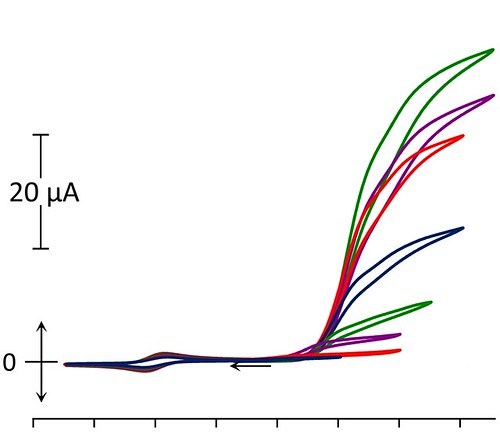
The rate continued to increase as they added more and more water. With the largest amount of water they tested, the catalyst produced up to 53,000 hydrogen molecules per second, almost as fast as their fast and inefficient version.
Importantly, the speedy catalyst stayed just as efficient when it was cranking out hydrogen as when it produced the gas more slowly. Being able to separate the speed from the efficiency means the team might be able to improve both aspects of the catalyst.
Liquid Protein
The team also wanted to understand how the catalyst worked in its liquid salt environment. The speed of hydrogen production suggested that the catalyst moved electrons around fast. But something also had to be moving protons around fast, because protons are the positively charged hydrogen ions that electrons follow around. Just like on an assembly line, protons move through the catalyst or a protein such as hydrogenase, pick up electrons, form bonds between pairs to make hydrogen, then fall off the catalyst.
Additional tests hinted how this catalyst-ionic liquid set-up works. Roberts suspects the water and the ionic liquid collaborated to mimic parts of the natural hydrogenase protein that shuffled protons through. In these proteins, the chemical scaffold holding the catalytic center also contributes to fast proton movement. The ionic liquid-water mixture may be doing the same thing.
Next, the team will explore the hints they gathered about why the catalyst works so fast in this mixture. They will also need to attach it to a surface. Lastly, this catalyst produces hydrogen gas. To create a fuel technology that converts electrical energy to chemical bonds and back again, they also plan to examine ionic liquids that will help a catalyst take the hydrogen molecule apart.
Source: Pacific Northwest National Laboratory
Additional Information:
June 16, 2012
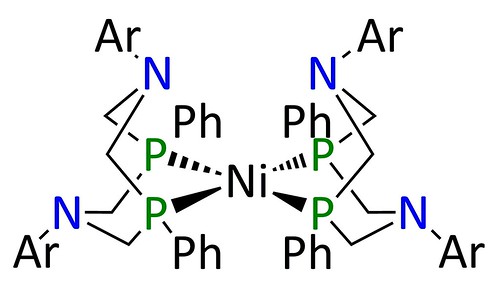 |
Combined with an acidic ionic liquid, this catalyst can make hydrogen gas fast and efficiently.
|
The design of a nature-inspired material that can make energy-storing hydrogen gas has gone holistic. Usually, tweaking the design of this particular catalyst — a work in progress for cheaper, better fuel cells — results in either faster or more energy efficient production but not both. Now, researchers have found a condition that creates hydrogen faster without a loss in efficiency.
And, holistically, it requires the entire system — the hydrogen-producing catalyst and the liquid environment in which it works — to overcome the speed-efficiency tradeoff. The results, published online June 8 in the Proceedings of the National Academy of Sciences, provide insights into making better materials for energy production.
"Our work shows that the liquid medium can improve the catalyst's performance," said chemist John Roberts of the Center for Molecular Electrocatalysis at the Department of Energy's Pacific Northwest National Laboratory. "It's an important step in the transformation of laboratory results into useable technology."
The results also provide molecular details into how the catalytic material converts electrical energy into the chemical bonds between hydrogen atoms. This information will help the researchers build better catalysts, ones that are both fast and efficient, and made with the common metal nickel instead of expensive platinum.
A Solution Solution
The work explores a type of dissolvable nickel-based catalyst, which is a material that eggs on chemical reactions. Catalysts that dissolve are easier to study than fixed catalysts, but fixed catalysts are needed for most real-world applications, such as a car's pollution-busting catalytic converter. Studying the catalyst comes first, affixing to a surface comes later.
In their search for a better catalyst to produce hydrogen to feed into fuel cells, the team of PNNL chemists modeled this dissolvable catalyst after a protein called a hydrogenase. Such a protein helps tie two hydrogen atoms together with electrons, storing energy in their chemical bond in the process. They modeled the catalytic center after the protein's important parts and built a chemical scaffold around it.
In previous versions, the catalyst was either efficient but slow, making about a thousand hydrogen molecules per second; or inefficient yet fast — clocking in at 100,000 molecules per second. (Efficiency is based on how much electricity the catalyst requires.) The previous work didn't get around this pesky relation between speed and efficiency in the catalysts — it seemed they could have one but not the other.
Hoping to uncouple the two, Roberts and colleagues put the slow catalyst in a medium called an acidic ionic liquid. Ionic liquids are liquid salts and contain molecules or atoms with negative or positive charges mixed together. They are sometimes used in batteries to allow for electrical current between the positive and negative electrodes.
The researchers mixed the catalyst, the ionic liquid, and a drop of water. The catalyst, with the help of the ionic liquid and an electrical current, produced hydrogen molecules, stuffing some of the electrons coming in from the current into the hydrogen's chemical bonds, as expected.
As they continued to add more water, they expected the catalyst to speed up briefly then slow down, as the slow catalyst in their previous solvent did. But that's not what they saw.
"The catalyst lights up like a rocket when you start adding water," said Roberts.
The rate continued to increase as they added more and more water. With the largest amount of water they tested, the catalyst produced up to 53,000 hydrogen molecules per second, almost as fast as their fast and inefficient version.
Importantly, the speedy catalyst stayed just as efficient when it was cranking out hydrogen as when it produced the gas more slowly. Being able to separate the speed from the efficiency means the team might be able to improve both aspects of the catalyst.
Liquid Protein
The team also wanted to understand how the catalyst worked in its liquid salt environment. The speed of hydrogen production suggested that the catalyst moved electrons around fast. But something also had to be moving protons around fast, because protons are the positively charged hydrogen ions that electrons follow around. Just like on an assembly line, protons move through the catalyst or a protein such as hydrogenase, pick up electrons, form bonds between pairs to make hydrogen, then fall off the catalyst.
Additional tests hinted how this catalyst-ionic liquid set-up works. Roberts suspects the water and the ionic liquid collaborated to mimic parts of the natural hydrogenase protein that shuffled protons through. In these proteins, the chemical scaffold holding the catalytic center also contributes to fast proton movement. The ionic liquid-water mixture may be doing the same thing.
Next, the team will explore the hints they gathered about why the catalyst works so fast in this mixture. They will also need to attach it to a surface. Lastly, this catalyst produces hydrogen gas. To create a fuel technology that converts electrical energy to chemical bonds and back again, they also plan to examine ionic liquids that will help a catalyst take the hydrogen molecule apart.
 |
| This graphic roostertail illustrates how the catalyst picks up speed as water is added to the ionic liquid (more water equals taller, faster current) |
Source: Pacific Northwest National Laboratory
Additional Information:
- Reference: Douglas H. Pool, Michael P. Stewart, Molly O'Hagan, Wendy J. Shaw, John A. S. Roberts, R. Morris Bullock, and Daniel L. DuBois, 2012. An Acidic Ionic Liquid/Water Solution as Both Medium and Proton Source for Electrocatalytic H2 Evolution by [Ni(P2N2)2]2+ Complexes, Proc Natl Acad Sci U S A Early Edition online the week of June 8, DOI 10.1073/pnas.1120208109. (http://www.pnas.org/content/early/2012/06/07/1120208109)
Monday, 11 June 2012
A new spin on antifreeze: Researchers create ultra slippery anti-ice and anti-frost surfaces
Engineerblogger
June 11, 2012
A team of researchers from Harvard University have invented a way to keep any metal surface free of ice and frost. The treated surfaces quickly shed even tiny, incipient condensation droplets or frost simply through gravity. The technology prevents ice sheets from developing on surfaces—and any ice that does form, slides off effortlessly.
The discovery, published online as a just-accepted-manuscript in ACS Nano on June 10, has direct implications for a wide variety of metal surfaces such as those used in refrigeration systems, wind turbines, aircraft, marine vessels, and the construction industry.
The group, led by Joanna Aizenberg, Amy Smith Berylson Professor of Materials Science at the Harvard School of Engineering and Applied Sciences (SEAS) and a Core Faculty Member at the Wyss Institute for Biologically Inspired Engineering at Harvard, previously introduced the idea that it was possible to create a surface that completely prevented ice with ice-repellent coatings, inspired by the water repellent lotus leaf. Yet this technique can fail under high humidity as the surface textures become coated with condensation and frost.
“The lack of any practical way to eliminate the intrinsic defects and inhomogeneities that contribute to liquid condensation, pinning, freezing, and strong adhesion, have raised the question of whether any solid surface (irrespective of its topography or treatment) can ever be truly ice-preventive, especially at high-humidity, frost-forming conditions,” Aizenberg said.
To combat this problem, the researchers recently invented a radically different technology that is suited for both high humidity and extreme pressure, called SLIPS (Slippery Liquid Infused Porous Surfaces). SLIPS are designed to expose a defect-free, molecularly flat liquid interface, immobilized by a hidden nanostructured solid. On these ultra smooth slippery surfaces fluids and solids alike—including water drops, condensation, frost, and even solid ice—can slide off easily.
The challenge was to apply this technology to metal surfaces, especially as these materials are ubiquitous in our modern world, from airplane wings to railings. Aizenberg and her team developed a way to coat the metal with a rough material that the lubricant can adhere to. The coating can be finely sculpted to lock in the lubricant and can be applied over a large scale, on arbitrarily shaped metal surfaces. In addition, the coating is non-toxic and anti-corrosive.
To demonstrate the robustness of the technology, the researchers successfully applied it to refrigerator cooling fins and tested it under a prolonged, deep freeze condition. Compared to existing “frost-free” cooling systems, their innovation completely prevented frost far more efficiently and for a longer time.
“Unlike lotus leaf-inspired icephobic surfaces, which fail under high humidity conditions, SLIPS-based icephobic materials, as our results suggest, can completely prevent ice formation at temperatures slightly below 0°C while dramatically reducing ice accumulation and adhesion under deep freezing, frost-forming conditions,” said Aizenberg.
In addition to allowing for the efficient removal of ice, the technology lowers the energy costs associated by several orders of magnitude. Thus, the readily scalable approach to slippery metallic surfaces holds great promise for broad application in the refrigeration and aviation industry and in other high-humidity environments where an icephobic surface is desirable.
For example, once their technology is applied to a surface, ice on roofs, wires, outdoor signs, and wind turbines could be easily removed merely by tilting, slight agitation, or even wind and vibrations.
"This new approach to icephobic materials is a truly disruptive idea that offers a way to make a transformative impact on energy and safety costs associated with ice, and we are actively working with the refrigeration and aviation industries to bring it to market," said Aizenberg.
Aizenberg is also Professor of Chemistry and Chemical Biology in the Department of Chemistry and Chemical Biology, and Susan S. and Kenneth L. Wallach Professor at the Radcliffe Institute for Advanced Study, and Director of the Kavli Institute for Bionano Science and Technology at Harvard. Her co-authors included Philseok Kim, a Technology Development Fellow at the Wyss Institute and SEAS; Tak-Sing Wong of the Wyss Institute and SEAS; Jack Alvarenga of the Wyss Institute; Michael J. Kreder of the Wyss Institute; and Wilmer E. Adorno-Martinez of University of Puerto Rico.
Source: Harvard University
Additional Information:
June 11, 2012
| Harvard researchers that keeps any metal surface free of ice and frost, freezer buildup could be a thing of the past. |
A team of researchers from Harvard University have invented a way to keep any metal surface free of ice and frost. The treated surfaces quickly shed even tiny, incipient condensation droplets or frost simply through gravity. The technology prevents ice sheets from developing on surfaces—and any ice that does form, slides off effortlessly.
The discovery, published online as a just-accepted-manuscript in ACS Nano on June 10, has direct implications for a wide variety of metal surfaces such as those used in refrigeration systems, wind turbines, aircraft, marine vessels, and the construction industry.
The group, led by Joanna Aizenberg, Amy Smith Berylson Professor of Materials Science at the Harvard School of Engineering and Applied Sciences (SEAS) and a Core Faculty Member at the Wyss Institute for Biologically Inspired Engineering at Harvard, previously introduced the idea that it was possible to create a surface that completely prevented ice with ice-repellent coatings, inspired by the water repellent lotus leaf. Yet this technique can fail under high humidity as the surface textures become coated with condensation and frost.
“The lack of any practical way to eliminate the intrinsic defects and inhomogeneities that contribute to liquid condensation, pinning, freezing, and strong adhesion, have raised the question of whether any solid surface (irrespective of its topography or treatment) can ever be truly ice-preventive, especially at high-humidity, frost-forming conditions,” Aizenberg said.
To combat this problem, the researchers recently invented a radically different technology that is suited for both high humidity and extreme pressure, called SLIPS (Slippery Liquid Infused Porous Surfaces). SLIPS are designed to expose a defect-free, molecularly flat liquid interface, immobilized by a hidden nanostructured solid. On these ultra smooth slippery surfaces fluids and solids alike—including water drops, condensation, frost, and even solid ice—can slide off easily.
The challenge was to apply this technology to metal surfaces, especially as these materials are ubiquitous in our modern world, from airplane wings to railings. Aizenberg and her team developed a way to coat the metal with a rough material that the lubricant can adhere to. The coating can be finely sculpted to lock in the lubricant and can be applied over a large scale, on arbitrarily shaped metal surfaces. In addition, the coating is non-toxic and anti-corrosive.
 |
| Figure 1: Still images extracted from the movies simulating ice formation by deep freezing (-10°C) in high humidity condition (60% RH) and subsequent deicing by heating. |
To demonstrate the robustness of the technology, the researchers successfully applied it to refrigerator cooling fins and tested it under a prolonged, deep freeze condition. Compared to existing “frost-free” cooling systems, their innovation completely prevented frost far more efficiently and for a longer time.
“Unlike lotus leaf-inspired icephobic surfaces, which fail under high humidity conditions, SLIPS-based icephobic materials, as our results suggest, can completely prevent ice formation at temperatures slightly below 0°C while dramatically reducing ice accumulation and adhesion under deep freezing, frost-forming conditions,” said Aizenberg.
In addition to allowing for the efficient removal of ice, the technology lowers the energy costs associated by several orders of magnitude. Thus, the readily scalable approach to slippery metallic surfaces holds great promise for broad application in the refrigeration and aviation industry and in other high-humidity environments where an icephobic surface is desirable.
 |
| Figure 2: A scalable method to directly coat aluminum surface with nanostructured polymer layer subsequently converted into a slippery liquid-infused porous surface (SLIPS) is demonstrated. SLIPS can effectively delay ice accumulation and facilitate removal of ice even under high humidity conditions. |
For example, once their technology is applied to a surface, ice on roofs, wires, outdoor signs, and wind turbines could be easily removed merely by tilting, slight agitation, or even wind and vibrations.
"This new approach to icephobic materials is a truly disruptive idea that offers a way to make a transformative impact on energy and safety costs associated with ice, and we are actively working with the refrigeration and aviation industries to bring it to market," said Aizenberg.
Aizenberg is also Professor of Chemistry and Chemical Biology in the Department of Chemistry and Chemical Biology, and Susan S. and Kenneth L. Wallach Professor at the Radcliffe Institute for Advanced Study, and Director of the Kavli Institute for Bionano Science and Technology at Harvard. Her co-authors included Philseok Kim, a Technology Development Fellow at the Wyss Institute and SEAS; Tak-Sing Wong of the Wyss Institute and SEAS; Jack Alvarenga of the Wyss Institute; Michael J. Kreder of the Wyss Institute; and Wilmer E. Adorno-Martinez of University of Puerto Rico.
Source: Harvard University
Additional Information:
- In ACS Nano on June 10 ("Liquid-Infused Nanostructured Surfaces with Extreme Anti-Ice and Anti-Frost Performance")
Engineers Devise New Way to Split Water: Nontoxic, noncorrosive, "low-temperature" method makes use of wasted heat
Engineerblogger
June 11, 2012

Providing a possible new route to hydrogen-gas production, researchers at the California Institute of Technology (Caltech) have devised a series of chemical reactions that allows them, for the first time, to split water in a nontoxic, noncorrosive way, at relatively low temperatures.
A research group led by Mark Davis, the Warren and Katharine Schlinger Professor of Chemical Engineering at Caltech, describes the new, four-reaction process in the early edition of the Proceedings of the National Academy of Sciences (PNAS).
Hydrogen is a coveted gas: industry uses it for everything from removing sulfur from crude oil to manufacturing vitamins. Since its combustion does not emit carbon dioxide into the atmosphere, there is some belief that it could even fuel a potential "hydrogen economy"—an energy-delivery system based entirely on this one gas. But since there is no abundant supply of hydrogen gas that can be simply tapped into, this lighter-than-air gas has to be mass-produced.
One way to make hydrogen is by using heat to split water, yielding pure hydrogen and oxygen. Known as thermochemical water splitting, this method is appealing because it can take advantage of excess heat given off by other processes. Thus far, it has been attempted in two ways: using two steps and taking advantage of high temperatures (above 1000°C) associated with solar collectors; or through multiple steps at "lower temperatures"—those below 1000°C—where, for example, the excess heat from nuclear reactors could drive the chemistry.
Davis is interested in this latter approach, which actually takes him back to his academic roots: his first paper as a graduate student dealt with a low-temperature water-splitting cycle, called the sulfur-iodine system, which has since been piloted for use around the world. Although that cycle operates at a maximum temperature of 850°C, it also produces a number of toxic and corrosive liquid intermediates that have to be dealt with. The cycle's high-temperature counterparts typically involve simpler reactions and solid intermediates—but there are very few processes that produce excess heat at such high temperatures.
"We wanted to combine the best of both worlds," Davis says. "We wanted to use solids, as they do in the high-temperature cycles, so we could avoid these toxicity and corrosion issues. But we also wanted to learn how to lower the temperature."
The first thing postdoctoral scholar and lead author Bingjun Xu and graduate student Yashodhan Bhawe did was to prove via thermodynamic arguments that a two-step, low-temperature cycle for water splitting will not be practical. "Nature's telling you 'No way,'" Davis says. "It was really a key point that told us we had to go away from looking for a two-step process, and that guidance directed us down another pathway that turned out to be quite fruitful."
The four-reaction cycle the team came up with begins with a manganese oxide and sodium carbonate, and is a completely closed system: the water that enters the system in the second step comes out completely converted into hydrogen and oxygen during each cycle. That's important because it means that none of the hydrogen or oxygen is lost, and the cycle can run over and over, splitting water into the two gases. In the current paper, the researchers ran their newly created cycle five times to show reproducibility. It will be needed to show that the cycle can run thousands of times in order to be practical. Experiments of this type are beyond the capabilities currently in the Davis lab.
"We're excited about this new cycle because the chemistry works, and it allows you to do real thermochemical water splitting with temperatures of 850°C without producing any of the halides or other types of corrosive acids that have been problems in the past," Davis says. Still, he is careful to point out that the implementation of the cycle as a functioning water-splitting system will require clever engineering. For example, for practical purposes, engineers will want some of the reactions to go faster, and they would also need to build processing reactors that have efficient-energy flows and recycling amongst the different stages of the cycle.
Going forward, the team plans to study further the chemistry of the cycle at the molecular level. They have already learned that shuttling sodium in and out of the manganese oxide is critical in lowering the operating temperature, but they want to know more about what exactly is happening during those steps. They hope that the enhanced understanding will allow them to devise cycles that could operate at even lower maximum temperatures.
Figuring out ways to decrease the operating temperatures is at the heart of Davis's interest in this project. "What we're trying to ask is, 'Where are the places around the world where people are just throwing away energy in the form of heat?'" he says. He speculates that there could be a day when water-splitting plants are able to run on the heat given off by a variety of manufacturing industries such as the steel- and aluminum-making industries and the petrochemicals industries, and by the more traditional power-generation industries. "The lower the temperature that we can use for driving these types of water-splitting processes," he says, "the more we can make use of energy that people are currently just wasting."
Source: Caltech
June 11, 2012
Providing a possible new route to hydrogen-gas production, researchers at the California Institute of Technology (Caltech) have devised a series of chemical reactions that allows them, for the first time, to split water in a nontoxic, noncorrosive way, at relatively low temperatures.
A research group led by Mark Davis, the Warren and Katharine Schlinger Professor of Chemical Engineering at Caltech, describes the new, four-reaction process in the early edition of the Proceedings of the National Academy of Sciences (PNAS).
Hydrogen is a coveted gas: industry uses it for everything from removing sulfur from crude oil to manufacturing vitamins. Since its combustion does not emit carbon dioxide into the atmosphere, there is some belief that it could even fuel a potential "hydrogen economy"—an energy-delivery system based entirely on this one gas. But since there is no abundant supply of hydrogen gas that can be simply tapped into, this lighter-than-air gas has to be mass-produced.
One way to make hydrogen is by using heat to split water, yielding pure hydrogen and oxygen. Known as thermochemical water splitting, this method is appealing because it can take advantage of excess heat given off by other processes. Thus far, it has been attempted in two ways: using two steps and taking advantage of high temperatures (above 1000°C) associated with solar collectors; or through multiple steps at "lower temperatures"—those below 1000°C—where, for example, the excess heat from nuclear reactors could drive the chemistry.
Davis is interested in this latter approach, which actually takes him back to his academic roots: his first paper as a graduate student dealt with a low-temperature water-splitting cycle, called the sulfur-iodine system, which has since been piloted for use around the world. Although that cycle operates at a maximum temperature of 850°C, it also produces a number of toxic and corrosive liquid intermediates that have to be dealt with. The cycle's high-temperature counterparts typically involve simpler reactions and solid intermediates—but there are very few processes that produce excess heat at such high temperatures.
"We wanted to combine the best of both worlds," Davis says. "We wanted to use solids, as they do in the high-temperature cycles, so we could avoid these toxicity and corrosion issues. But we also wanted to learn how to lower the temperature."
The first thing postdoctoral scholar and lead author Bingjun Xu and graduate student Yashodhan Bhawe did was to prove via thermodynamic arguments that a two-step, low-temperature cycle for water splitting will not be practical. "Nature's telling you 'No way,'" Davis says. "It was really a key point that told us we had to go away from looking for a two-step process, and that guidance directed us down another pathway that turned out to be quite fruitful."
The four-reaction cycle the team came up with begins with a manganese oxide and sodium carbonate, and is a completely closed system: the water that enters the system in the second step comes out completely converted into hydrogen and oxygen during each cycle. That's important because it means that none of the hydrogen or oxygen is lost, and the cycle can run over and over, splitting water into the two gases. In the current paper, the researchers ran their newly created cycle five times to show reproducibility. It will be needed to show that the cycle can run thousands of times in order to be practical. Experiments of this type are beyond the capabilities currently in the Davis lab.
"We're excited about this new cycle because the chemistry works, and it allows you to do real thermochemical water splitting with temperatures of 850°C without producing any of the halides or other types of corrosive acids that have been problems in the past," Davis says. Still, he is careful to point out that the implementation of the cycle as a functioning water-splitting system will require clever engineering. For example, for practical purposes, engineers will want some of the reactions to go faster, and they would also need to build processing reactors that have efficient-energy flows and recycling amongst the different stages of the cycle.
Going forward, the team plans to study further the chemistry of the cycle at the molecular level. They have already learned that shuttling sodium in and out of the manganese oxide is critical in lowering the operating temperature, but they want to know more about what exactly is happening during those steps. They hope that the enhanced understanding will allow them to devise cycles that could operate at even lower maximum temperatures.
Figuring out ways to decrease the operating temperatures is at the heart of Davis's interest in this project. "What we're trying to ask is, 'Where are the places around the world where people are just throwing away energy in the form of heat?'" he says. He speculates that there could be a day when water-splitting plants are able to run on the heat given off by a variety of manufacturing industries such as the steel- and aluminum-making industries and the petrochemicals industries, and by the more traditional power-generation industries. "The lower the temperature that we can use for driving these types of water-splitting processes," he says, "the more we can make use of energy that people are currently just wasting."
Source: Caltech
- The PNAS paper, "Low-temperature, manganese oxide-based thermochemical water splitting cycle" is now online. The work was funded by a donation from Mr. and Mrs. Lewis W. van Amerongen.
Thursday, 31 May 2012
Researchers unique approach to materials allows temperature-stable circuits
Engineerblogger
May 31, 2012
Sandia National Laboratories researcher Steve Dai jokes that his approach to creating materials whose properties won’t degenerate during temperature swings is a lot like cooking — mixing ingredients and fusing them together in an oven.
Sandia has developed a unique materials approach to multilayered, ceramic-based, 3-D microelectronics circuits, such as those used in cell phones. The approach compensates for how changes due to temperature fluctuations affect something called the temperature coefficient of resonant frequency, a critical property of materials used in radio and microwave frequency applications. Sandia filed a patent for its new approach last fall. The work was the subject of a recently completed two-year Early Career Laboratory Directed Research and Development (LDRD) project that focused on understanding why certain materials behave as they do. That knowledge could help manufacturers design and build better products.
“At this point we’re just trying to demonstrate that the technology is practical,” Dai said. “Can we design a device with it, can we design it over and over again, and can we design this reliably?”
The familiar cell phone illustrates how the development might be used. The Federal Communications Commission allocates bandwidth to various uses — aviation, the military, cell phones, and so on. Each must operate within an assigned bandwidth with finite signal-carrying capacity. But as temperatures vary, the properties of the materials inside the phone change, and that causes a shift in the resonant frequency at which a signal is sent or received.
Because of that shift, cell phones are designed to operate squarely in the middle of the bandwidth so as not to break the law by drifting outside their assigned frequency range. That necessary caution wastes potential bandwidth and sacrifices higher rates at which data could move.
Dai worked on low-temperature co-fired ceramic (LTCC), a multilayer 3-D packaging and interconnection technology that can integrate passive components — resistors, capacitors and inductors.
Most mainstream LTCC dielectrics now on the market have a temperature coefficient of resonant frequency in a range as wide as that between northern Alaska in the winter and southern Arizona in the summer. Dai’s research achieved a near-zero temperature coefficient by incorporating compensating materials into the LTCC — basically a dielectric that works against the host dielectric and in essence balances the temperature coefficient of resonant frequency. A dielectric is a material, such as glass, that does not conduct electricity but can sustain an electric field.
A graph shows the differences. Resonant frequencies used in various LTCC base dielectrics today appear as slanted lines on the graph as temperatures change. Dai’s approach to an LTCC leaves the line essentially flat — indicating radio and microwave resonator frequency functions that remain stable as temperatures change.
He presented the results of the approach in a paper published in January in the Journal of Microelectronics and Electronic Packaging.
“We can actually make adjustments in the materials property to make sure my resonance frequency doesn’t drift,” Dai said. “If this key property of your material doesn’t drift with the temperature, you can fully utilize whatever the bandwidth is.”
Another advantage: Manufacturers could cut costs by eliminating additional mechanical and electrical circuits now built into a device to compensate for temperature variations.
One challenge was choosing different materials that don’t fall apart when co-fired together, Dai said. Glass ceramic materials used in cell phone applications are both fragile and rigid, but they’re also very solid with minimal porosity. Researchers experimented with different materials, changing a parameter, adjusting the composition, and seeing which ones worked best together.
He had to consider both physical and chemical compatibility. Physical compatibility means that as materials shrink when they’re fired, they shrink in the same way so they don’t warp or buckle. Chemical compatibility means each material retains its unique properties rather than diffusing into the whole.
The LDRD project created a new set of materials to solve the problem of resonant frequency drift but also developed a better understanding of why and how the processes involved in identifying the best materials work. “Why select material A and not B, what’s the rationale? Once you have A in place, what’s the behavior when you make a formulation change, a composition change, do little things?” Dai said.
Researchers looked at variables to boost performance. For example, the functional material within the composite carries the electrical signal, and researchers experimented with placing that material in different areas within the composite until they came up with what arrangement worked best and understood why.
The team also constructed a computational model to analyze what happens when materials with different properties are placed together, and what happens when they change their order in the stacked layers or the dimensions of one material versus another.
“We study all these different facets, the placement of materials, the thickness, to try to hit the sweet spot of the commercial process,” Dai said.
Manufacturing can be done as simple screen printing, a low-cost, standard commercial process much like printing an image on a T-shirt. Dai said the idea was to avoid special requirements that would make the process more expensive or difficult.
“That’s kind of the approach you try to take: Make it simple to use with solid understanding of the fundamentals of materials science,” he said.
Source: Sandia National Laboratories
May 31, 2012
 |
| Sandia National Laboratories materials science researcher Steve Dai has come up with a unique approach to creating materials whose properties won't degenerate with temperature swings. (Photo by Randy Montoya) |
Sandia National Laboratories researcher Steve Dai jokes that his approach to creating materials whose properties won’t degenerate during temperature swings is a lot like cooking — mixing ingredients and fusing them together in an oven.
Sandia has developed a unique materials approach to multilayered, ceramic-based, 3-D microelectronics circuits, such as those used in cell phones. The approach compensates for how changes due to temperature fluctuations affect something called the temperature coefficient of resonant frequency, a critical property of materials used in radio and microwave frequency applications. Sandia filed a patent for its new approach last fall. The work was the subject of a recently completed two-year Early Career Laboratory Directed Research and Development (LDRD) project that focused on understanding why certain materials behave as they do. That knowledge could help manufacturers design and build better products.
“At this point we’re just trying to demonstrate that the technology is practical,” Dai said. “Can we design a device with it, can we design it over and over again, and can we design this reliably?”
The familiar cell phone illustrates how the development might be used. The Federal Communications Commission allocates bandwidth to various uses — aviation, the military, cell phones, and so on. Each must operate within an assigned bandwidth with finite signal-carrying capacity. But as temperatures vary, the properties of the materials inside the phone change, and that causes a shift in the resonant frequency at which a signal is sent or received.
Because of that shift, cell phones are designed to operate squarely in the middle of the bandwidth so as not to break the law by drifting outside their assigned frequency range. That necessary caution wastes potential bandwidth and sacrifices higher rates at which data could move.
Dai worked on low-temperature co-fired ceramic (LTCC), a multilayer 3-D packaging and interconnection technology that can integrate passive components — resistors, capacitors and inductors.
Most mainstream LTCC dielectrics now on the market have a temperature coefficient of resonant frequency in a range as wide as that between northern Alaska in the winter and southern Arizona in the summer. Dai’s research achieved a near-zero temperature coefficient by incorporating compensating materials into the LTCC — basically a dielectric that works against the host dielectric and in essence balances the temperature coefficient of resonant frequency. A dielectric is a material, such as glass, that does not conduct electricity but can sustain an electric field.
A graph shows the differences. Resonant frequencies used in various LTCC base dielectrics today appear as slanted lines on the graph as temperatures change. Dai’s approach to an LTCC leaves the line essentially flat — indicating radio and microwave resonator frequency functions that remain stable as temperatures change.
He presented the results of the approach in a paper published in January in the Journal of Microelectronics and Electronic Packaging.
“We can actually make adjustments in the materials property to make sure my resonance frequency doesn’t drift,” Dai said. “If this key property of your material doesn’t drift with the temperature, you can fully utilize whatever the bandwidth is.”
Another advantage: Manufacturers could cut costs by eliminating additional mechanical and electrical circuits now built into a device to compensate for temperature variations.
One challenge was choosing different materials that don’t fall apart when co-fired together, Dai said. Glass ceramic materials used in cell phone applications are both fragile and rigid, but they’re also very solid with minimal porosity. Researchers experimented with different materials, changing a parameter, adjusting the composition, and seeing which ones worked best together.
He had to consider both physical and chemical compatibility. Physical compatibility means that as materials shrink when they’re fired, they shrink in the same way so they don’t warp or buckle. Chemical compatibility means each material retains its unique properties rather than diffusing into the whole.
The LDRD project created a new set of materials to solve the problem of resonant frequency drift but also developed a better understanding of why and how the processes involved in identifying the best materials work. “Why select material A and not B, what’s the rationale? Once you have A in place, what’s the behavior when you make a formulation change, a composition change, do little things?” Dai said.
Researchers looked at variables to boost performance. For example, the functional material within the composite carries the electrical signal, and researchers experimented with placing that material in different areas within the composite until they came up with what arrangement worked best and understood why.
The team also constructed a computational model to analyze what happens when materials with different properties are placed together, and what happens when they change their order in the stacked layers or the dimensions of one material versus another.
“We study all these different facets, the placement of materials, the thickness, to try to hit the sweet spot of the commercial process,” Dai said.
Manufacturing can be done as simple screen printing, a low-cost, standard commercial process much like printing an image on a T-shirt. Dai said the idea was to avoid special requirements that would make the process more expensive or difficult.
“That’s kind of the approach you try to take: Make it simple to use with solid understanding of the fundamentals of materials science,” he said.
Source: Sandia National Laboratories
Sunday, 27 May 2012
Metamaterials: Researchers Design Mystifying Materials
Engineerblogger
May 27, 2012
It’s not magic, but new materials designed by two Northwestern
University researchers seem to exhibit magical properties. Some contract
when they should expand, and others expand when they should contract.
When tensioned, ordinary materials expand along the direction of the applied force. The new metamaterials (artificial materials engineered to have properties that may not be found in nature) do the opposite when tensioned -- they contract. Other materials designed by the researchers expand when compressed.
“Materials are networks of connected constituents, and when you apply tension or pressure, they can respond in surprising ways,” said Adilson E. Motter, the Harold H. and Virginia Anderson Professor of Physics and Astronomy at Northwestern’s Weinberg College of Arts and Sciences.
“Think of a piece of rod that you tension by pulling its ends with your fingers,” he said. “It would normally get longer, but for these materials it will get shorter.”
Motter and Zachary G. Nicolaou applied network concepts to design the new materials, all of which exhibit negative compressibility transitions. Their results are published this week in Nature Materials. Nicolaou, an undergraduate physics student at Northwestern when the work was done, now is a first-year graduate student at Caltech.
Different types of metamaterials already have led to interesting applications such as superlenses, visibility cloaks and acoustic shields. But no existing material or metamaterial was previously shown to exhibit negative compressibility transitions.
These metamaterials may enable new applications, including the development of new protective mechanical devices and actuators (a type of assembly for operating or controlling a system), and the enhancement of microelectromechanical systems.
The materials also exhibit force amplification, a phenomenon in which a small increase in deformation leads to an abrupt increase in the response force. The latter can be useful for the design of micro-mechanical controls, ratchets and force amplifiers.
All known materials deform along the direction of a constant applied force by expanding when they are tensioned and contracting when they are compressed. Owing to stability considerations, such contraction of a material in the same direction of an applied tension (in response to tension) cannot occur continuously. Possibly because of this, most people would intuitively expect that contraction in response to tension would be impossible.
The important point of the Northwestern study is that such a counter-intuitive response can occur discontinuously, namely, through something known by physicists as a phase transition. A familiar form of phase transition is the transformation of water into ice or vapor. Phase transitions allow for abrupt changes in the physical properties of a material. Yet, all conventional materials are such that phase transitions will lead to ordinary compressibility.
“This research shows that new materials, in fact, can be created to exhibit a phase transition during which the material undergoes contraction when tensioned or expansion when pressured,” Motter said. “We refer to such transformations as ‘negative compressibility transitions.’”
Materials with such properties have not been discovered in nature, but they can be constructed as metamaterials. Metamaterials are engineered materials that gain their properties from structure rather than composition. The relevant building blocks of such materials are not necessarily microscopic, atomic-sized objects, but may in fact be composed of a large number of atoms and hence be mesoscopic or macroscopic in size.
A key step for the discovery of the materials in this study was the representation of the material as a network of interacting particles.
“We were inspired by the observation that the realized equilibrium is not necessarily optimal in a decentralized network,” Motter said. “A conceptual precedent to this is the now 45-year-old insight from German mathematician Dietrich Braess that adding a road to a traffic network may increase rather than decrease the average travel time.”
Analogous effects also have been identified in physical networks, including an increase of current upon the removal of an intermediate conductor in electric networks. These are examples in which the equilibrium realized by the system can be brought closer to the optimum by constraining the structure of the network.
“Our materials are devised such that an analogous phenomenon occurs spontaneously, in response to a change in the external force rather than in the structure of the network,” Motter said.
Motter also is a faculty member in the department of engineering sciences and applied mathematics at the McCormick School of Engineering and Applied Science and an executive committee member of the Northwestern Institute on Complex Systems (NICO).
The Materials Research Science and Engineering Center at Northwestern University and the National Science Foundation supported the research.
Source: Northwestern University
Additional Information:
May 27, 2012
 |
| Adilson E. Motter |
When tensioned, ordinary materials expand along the direction of the applied force. The new metamaterials (artificial materials engineered to have properties that may not be found in nature) do the opposite when tensioned -- they contract. Other materials designed by the researchers expand when compressed.
“Materials are networks of connected constituents, and when you apply tension or pressure, they can respond in surprising ways,” said Adilson E. Motter, the Harold H. and Virginia Anderson Professor of Physics and Astronomy at Northwestern’s Weinberg College of Arts and Sciences.
“Think of a piece of rod that you tension by pulling its ends with your fingers,” he said. “It would normally get longer, but for these materials it will get shorter.”
Motter and Zachary G. Nicolaou applied network concepts to design the new materials, all of which exhibit negative compressibility transitions. Their results are published this week in Nature Materials. Nicolaou, an undergraduate physics student at Northwestern when the work was done, now is a first-year graduate student at Caltech.
Different types of metamaterials already have led to interesting applications such as superlenses, visibility cloaks and acoustic shields. But no existing material or metamaterial was previously shown to exhibit negative compressibility transitions.
These metamaterials may enable new applications, including the development of new protective mechanical devices and actuators (a type of assembly for operating or controlling a system), and the enhancement of microelectromechanical systems.
The materials also exhibit force amplification, a phenomenon in which a small increase in deformation leads to an abrupt increase in the response force. The latter can be useful for the design of micro-mechanical controls, ratchets and force amplifiers.
All known materials deform along the direction of a constant applied force by expanding when they are tensioned and contracting when they are compressed. Owing to stability considerations, such contraction of a material in the same direction of an applied tension (in response to tension) cannot occur continuously. Possibly because of this, most people would intuitively expect that contraction in response to tension would be impossible.
The important point of the Northwestern study is that such a counter-intuitive response can occur discontinuously, namely, through something known by physicists as a phase transition. A familiar form of phase transition is the transformation of water into ice or vapor. Phase transitions allow for abrupt changes in the physical properties of a material. Yet, all conventional materials are such that phase transitions will lead to ordinary compressibility.
“This research shows that new materials, in fact, can be created to exhibit a phase transition during which the material undergoes contraction when tensioned or expansion when pressured,” Motter said. “We refer to such transformations as ‘negative compressibility transitions.’”
Materials with such properties have not been discovered in nature, but they can be constructed as metamaterials. Metamaterials are engineered materials that gain their properties from structure rather than composition. The relevant building blocks of such materials are not necessarily microscopic, atomic-sized objects, but may in fact be composed of a large number of atoms and hence be mesoscopic or macroscopic in size.
A key step for the discovery of the materials in this study was the representation of the material as a network of interacting particles.
“We were inspired by the observation that the realized equilibrium is not necessarily optimal in a decentralized network,” Motter said. “A conceptual precedent to this is the now 45-year-old insight from German mathematician Dietrich Braess that adding a road to a traffic network may increase rather than decrease the average travel time.”
Analogous effects also have been identified in physical networks, including an increase of current upon the removal of an intermediate conductor in electric networks. These are examples in which the equilibrium realized by the system can be brought closer to the optimum by constraining the structure of the network.
“Our materials are devised such that an analogous phenomenon occurs spontaneously, in response to a change in the external force rather than in the structure of the network,” Motter said.
Motter also is a faculty member in the department of engineering sciences and applied mathematics at the McCormick School of Engineering and Applied Science and an executive committee member of the Northwestern Institute on Complex Systems (NICO).
The Materials Research Science and Engineering Center at Northwestern University and the National Science Foundation supported the research.
Source: Northwestern University
Additional Information:
Microreactors to produce explosive materials
Engineerblogger
May 27, 2012
The larger the reaction vessel, the quicker products can be made – or so you might think. Microreactors show just how wrong that assumption is: in fact, they can be used to produce explosive materials – nitroglycerine, for instance – around ten times faster than in conventional vessels, and much more safely as well. At the ACHEMA trade fair, held June 18-22 in Frankfurt, researchers will demonstrate microreactors they use for a very broad range of chemical processes.
If the task is to tunnel through a mountain, workers turn to explosives: the 15-kilometer-long Gotthard Tunnel, for instance, was created by blasting through the rock with explosive gelatin made largely out of the nitroglycerine – better-known as dynamite. Producing these explosives calls for extreme caution. After all, no one wants a demonstration of explosive force in the lab. Because the production process generates heat, it must proceed slowly: drop for drop, the reagents are added to the agitating vessel that holds the initial substance. A mixture that heats up too suddenly can cause an explosion. The heat generated cannot be permitted to exceed the heat dissipated.
Researchers at the Fraunhofer Institute for Chemical Technology ICT in Pfinztal have developed a method for safer production of nitroglycerine: a microreactor process, tailored to this specific reaction. What makes the process safer are the tiny quantities involved. If the quantities are smaller, less heat is generated. And because the surface is very expansive compared to the volume involved, the system is very easy to cool. Another benefit: the tiny reactor produces the explosive material considerably faster than in agitating vessels. Unlike a large agitating vessel filled before the slow reaction proceeds, the microreactor works continuously: the base materials flow through tiny channels into the reaction chamber in “assembly-line fashion“. There, they react with one another for several seconds before flowing through other channels into a second microreactor for processing – meaning purification. This is because the interim product still contains impurities that need to be removed for safety reasons. Purification in the microreactor functions perfectly: the product produced meets pharmaceutical specifications and in a modified form can even be used in nitro capsules for patients with heart disease. “This marks the first use of microreactors in a process not only for synthesis of a material but also for its subsequent processing,“ observes Dr. Stefan Löbbecke, deputy division director at ICT. The microreactor process is already successfully in use in industry.
When developing a microreactor, researchers match the reactors to the reaction desired: how large may the channels be to ensure that the heat generated can be dissipated effectively? Where do researchers need to build impediments into the channels to ensure that the fluids are well blended and the reaction proceeds as planned? Another important parameter is the speed with which the liquids flow through the channels: on the one hand, they need enough time to react with one another, while on the other the reaction should come to an end as soon as the product is formed. Otherwise, the result might be too many unwanted by-products.
While microreactors suggest themselves for explosive materials, this is not the only conceivable application: researchers at ICT build reactors for every chemical reaction conceivable – and each is tailored to the particular reaction involved. Just one of numerous other examples is a microreactor that produces polymers for OLEDs. OLEDs are organic light-emitting diodes that are particularly common in displays and monitors. The polymers of which the OLEDs are made light up in colors. Still, when they are produced – synthesized – imperfections easily arise that rob the polymers of some of their luminosity. “Through precise process management, we are able to minimize the number of these imperfections,“ Löbbecke points out. To accomplish this, researchers first analyzed the reaction in minute detail: When do the polymers form? When do the imperfections arise? How fast does the process need to be? “As it turns out, many of the reaction protocol that people are familiar with from batch processes are unnecessary. Often, the base materials don‘t need to boil for hours at a time; in many cases all it takes is a few seconds,“ the researcher has found. Long periods spent boiling can cause the products to decompose or generate unwanted byproducts.
To develop and perfect a microreactor for a new reaction, the researchers study the ongoing reaction in real time – peering into the reactor itself, so to speak. Various analytical procedures are helpful in this regard: some, such as spectroscopic techniques, reveal which kinds of products are created in the reactor – and thus how researchers can systematically increase yields of the desired product, possibly even preventing by products from forming in the first place. Other analytical methods, such as calorimetry, provide scientists with information about the heat released over the course of a reaction. This measurement method tells them how quickly and completely the reaction is proceeding. It also provides an indication of how the process conditions need to be selected to ensure that the reaction proceeds safely. Researchers will be presenting a variety of microreactors, microreactor processes and process-analytical techniques at the ACHEMA trade fair from June 18-22 in Frankfurt.
Source: Fraunhofer-Gesellschaft
May 27, 2012
 |
Microreactors can e.g. be used to produce explosive materials much more safely. © Fraunhofer ICT
|
The larger the reaction vessel, the quicker products can be made – or so you might think. Microreactors show just how wrong that assumption is: in fact, they can be used to produce explosive materials – nitroglycerine, for instance – around ten times faster than in conventional vessels, and much more safely as well. At the ACHEMA trade fair, held June 18-22 in Frankfurt, researchers will demonstrate microreactors they use for a very broad range of chemical processes.
If the task is to tunnel through a mountain, workers turn to explosives: the 15-kilometer-long Gotthard Tunnel, for instance, was created by blasting through the rock with explosive gelatin made largely out of the nitroglycerine – better-known as dynamite. Producing these explosives calls for extreme caution. After all, no one wants a demonstration of explosive force in the lab. Because the production process generates heat, it must proceed slowly: drop for drop, the reagents are added to the agitating vessel that holds the initial substance. A mixture that heats up too suddenly can cause an explosion. The heat generated cannot be permitted to exceed the heat dissipated.
Researchers at the Fraunhofer Institute for Chemical Technology ICT in Pfinztal have developed a method for safer production of nitroglycerine: a microreactor process, tailored to this specific reaction. What makes the process safer are the tiny quantities involved. If the quantities are smaller, less heat is generated. And because the surface is very expansive compared to the volume involved, the system is very easy to cool. Another benefit: the tiny reactor produces the explosive material considerably faster than in agitating vessels. Unlike a large agitating vessel filled before the slow reaction proceeds, the microreactor works continuously: the base materials flow through tiny channels into the reaction chamber in “assembly-line fashion“. There, they react with one another for several seconds before flowing through other channels into a second microreactor for processing – meaning purification. This is because the interim product still contains impurities that need to be removed for safety reasons. Purification in the microreactor functions perfectly: the product produced meets pharmaceutical specifications and in a modified form can even be used in nitro capsules for patients with heart disease. “This marks the first use of microreactors in a process not only for synthesis of a material but also for its subsequent processing,“ observes Dr. Stefan Löbbecke, deputy division director at ICT. The microreactor process is already successfully in use in industry.
When developing a microreactor, researchers match the reactors to the reaction desired: how large may the channels be to ensure that the heat generated can be dissipated effectively? Where do researchers need to build impediments into the channels to ensure that the fluids are well blended and the reaction proceeds as planned? Another important parameter is the speed with which the liquids flow through the channels: on the one hand, they need enough time to react with one another, while on the other the reaction should come to an end as soon as the product is formed. Otherwise, the result might be too many unwanted by-products.
While microreactors suggest themselves for explosive materials, this is not the only conceivable application: researchers at ICT build reactors for every chemical reaction conceivable – and each is tailored to the particular reaction involved. Just one of numerous other examples is a microreactor that produces polymers for OLEDs. OLEDs are organic light-emitting diodes that are particularly common in displays and monitors. The polymers of which the OLEDs are made light up in colors. Still, when they are produced – synthesized – imperfections easily arise that rob the polymers of some of their luminosity. “Through precise process management, we are able to minimize the number of these imperfections,“ Löbbecke points out. To accomplish this, researchers first analyzed the reaction in minute detail: When do the polymers form? When do the imperfections arise? How fast does the process need to be? “As it turns out, many of the reaction protocol that people are familiar with from batch processes are unnecessary. Often, the base materials don‘t need to boil for hours at a time; in many cases all it takes is a few seconds,“ the researcher has found. Long periods spent boiling can cause the products to decompose or generate unwanted byproducts.
To develop and perfect a microreactor for a new reaction, the researchers study the ongoing reaction in real time – peering into the reactor itself, so to speak. Various analytical procedures are helpful in this regard: some, such as spectroscopic techniques, reveal which kinds of products are created in the reactor – and thus how researchers can systematically increase yields of the desired product, possibly even preventing by products from forming in the first place. Other analytical methods, such as calorimetry, provide scientists with information about the heat released over the course of a reaction. This measurement method tells them how quickly and completely the reaction is proceeding. It also provides an indication of how the process conditions need to be selected to ensure that the reaction proceeds safely. Researchers will be presenting a variety of microreactors, microreactor processes and process-analytical techniques at the ACHEMA trade fair from June 18-22 in Frankfurt.
Source: Fraunhofer-Gesellschaft
Wednesday, 9 May 2012
Bacterial builders on site for computer construction
Engineerblogger
May 9, 2012
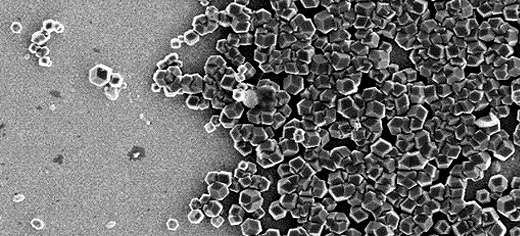
Forget computer viruses - magnet-making bacteria could be used to build tomorrow’s computers with larger hard drives and speedier connections.
Researchers at the University of Leeds have used a type of bacterium which 'eats' iron to create a surface of magnets, similar to those found in traditional hard drives, and wiring. As the bacterium ingests the iron it creates tiny magnets within itself.
The team has also begun to understand how the proteins inside these bacteria collect, shape and position these "nanomagnets" inside their cells and can now replicate this behaviour outside the bacteria.
Led by Dr Sarah Staniland from the University's School of Physics and Astronomy, in a longstanding collaboration with the Tokyo University of Agriculture and Technology, the team hope to develop a 'bottom-up' approach for creating cheaper, more environmentally-friendly electronics of the future.
Dr Staniland said: "We are quickly reaching the limits of traditional electronic manufacturing as computer components get smaller. The machines we've traditionally used to build them are clumsy at such small scales. Nature has provided us with the perfect tool to circumvent this problem."
The magnetic array was created by Leeds PhD student Johanna Galloway using a protein which creates perfect nanocrystals of magnetite inside the bacterium Magnetospirilllum magneticum. In a process akin to potato-printing on a much smaller scale, this protein is attached to a gold surface in a checkerboard pattern and placed in a solution containing iron.
At a temperature of 80°C, similarly-sized crystals of magnetite form on the sections of the surface covered by the protein. The team are now working to reduce the size of these islands of magnets, in order to make arrays of single nanomagnets. They also plan to vary the magnetic materials that this protein can control. These next steps would allow each of these nanomagnets to hold one bit of information allowing the construction of better hard drives.
"Using today's 'top-down' method - essentially sculpting tiny magnets out of a big magnet - it is increasingly difficult to produce the small magnets of the same size and shape which are needed to store data," said Johanna Galloway. "Using the method developed here at Leeds, the proteins do all the hard work; they gather the iron, create the most magnetic compound, and arrange it into regularly-sized cubes."
A different protein has been used to create tiny electrical wires by Dr Masayoshi Tanaka, during a secondment to Leeds from Tokyo University of Agriculture and Technology. These 'nanowires' are made of 'quantum dots' - particles of copper indium sulphide and zinc sulphide which glow and conduct electricity - and are encased by fat molecules, or lipids.
The magnetic bacteria contain a protein that moulds mini compartments for the nanomagnets to be formed in using the cell membrane lipids. Dr Tanaka used a similar protein to make tubes of fat containing quantum dots - biological-based wiring.
"It is possible to tune these biological wires to have a particular electrical resistance. In the future, they could be grown connected to other components as part of an entirely biological computer," said Dr Tanaka.
The research group and the team at Tokyo University of Agriculture and Technology, led by Prof. Tadashi Matsunaga, now plan to examine the biological processes behind the behaviour of these proteins. "Our aim is to develop a toolkit of proteins and chemicals which could be used to grow computer components from scratch," adds Dr Staniland.
The papers Biotemplated Magnetic Nanoparticle Arrays and Fabrication of Lipid Tubules with Embedded Quantum Dots by Membrane Tubulation Protein are published in the journal Small.
This research is funded by the Engineering and Physical Sciences Research Council (EPSRC), Biotechnology and Biological Sciences Research Council (BBSRC) and the Royal Society's Newton International Fellowships Scheme.
Source: University of Leeds
Additional Information:
May 9, 2012
Forget computer viruses - magnet-making bacteria could be used to build tomorrow’s computers with larger hard drives and speedier connections.
Researchers at the University of Leeds have used a type of bacterium which 'eats' iron to create a surface of magnets, similar to those found in traditional hard drives, and wiring. As the bacterium ingests the iron it creates tiny magnets within itself.
The team has also begun to understand how the proteins inside these bacteria collect, shape and position these "nanomagnets" inside their cells and can now replicate this behaviour outside the bacteria.
Led by Dr Sarah Staniland from the University's School of Physics and Astronomy, in a longstanding collaboration with the Tokyo University of Agriculture and Technology, the team hope to develop a 'bottom-up' approach for creating cheaper, more environmentally-friendly electronics of the future.
Dr Staniland said: "We are quickly reaching the limits of traditional electronic manufacturing as computer components get smaller. The machines we've traditionally used to build them are clumsy at such small scales. Nature has provided us with the perfect tool to circumvent this problem."
The magnetic array was created by Leeds PhD student Johanna Galloway using a protein which creates perfect nanocrystals of magnetite inside the bacterium Magnetospirilllum magneticum. In a process akin to potato-printing on a much smaller scale, this protein is attached to a gold surface in a checkerboard pattern and placed in a solution containing iron.
At a temperature of 80°C, similarly-sized crystals of magnetite form on the sections of the surface covered by the protein. The team are now working to reduce the size of these islands of magnets, in order to make arrays of single nanomagnets. They also plan to vary the magnetic materials that this protein can control. These next steps would allow each of these nanomagnets to hold one bit of information allowing the construction of better hard drives.
"Using today's 'top-down' method - essentially sculpting tiny magnets out of a big magnet - it is increasingly difficult to produce the small magnets of the same size and shape which are needed to store data," said Johanna Galloway. "Using the method developed here at Leeds, the proteins do all the hard work; they gather the iron, create the most magnetic compound, and arrange it into regularly-sized cubes."
A different protein has been used to create tiny electrical wires by Dr Masayoshi Tanaka, during a secondment to Leeds from Tokyo University of Agriculture and Technology. These 'nanowires' are made of 'quantum dots' - particles of copper indium sulphide and zinc sulphide which glow and conduct electricity - and are encased by fat molecules, or lipids.
The magnetic bacteria contain a protein that moulds mini compartments for the nanomagnets to be formed in using the cell membrane lipids. Dr Tanaka used a similar protein to make tubes of fat containing quantum dots - biological-based wiring.
"It is possible to tune these biological wires to have a particular electrical resistance. In the future, they could be grown connected to other components as part of an entirely biological computer," said Dr Tanaka.
The research group and the team at Tokyo University of Agriculture and Technology, led by Prof. Tadashi Matsunaga, now plan to examine the biological processes behind the behaviour of these proteins. "Our aim is to develop a toolkit of proteins and chemicals which could be used to grow computer components from scratch," adds Dr Staniland.
The papers Biotemplated Magnetic Nanoparticle Arrays and Fabrication of Lipid Tubules with Embedded Quantum Dots by Membrane Tubulation Protein are published in the journal Small.
This research is funded by the Engineering and Physical Sciences Research Council (EPSRC), Biotechnology and Biological Sciences Research Council (BBSRC) and the Royal Society's Newton International Fellowships Scheme.
Source: University of Leeds
Additional Information:
- Dr Sarah Staniland is available for interview. Accompanying pictures can be downloaded here:
- https://docs.google.com/open?id=0B691WmQZab8LZkptRTViSFE2UXc
- https://docs.google.com/open?id=0B691WmQZab8LUE4xOTl5cF9OX1E
- Galloway, J. M., Bramble, J. P., Rawlings, A. E., Burnell, G., Evans, S. D. and Staniland, S. S. (2012), Biotemplated Magnetic Nanoparticle Arrays. Small, 8: 204-208. (http://onlinelibrary.wiley.com/doi/10.1002/smll.201101627/abstract)
- Tanaka, M., Critchley, K., Matsunaga, T., Evans, S. D. and Staniland, S. S. (2012), Fabrication of Lipid Tubules with Embedded Quantum Dots by Membrane Tubulation Protein. Small. (http://onlinelibrary.wiley.com/doi/10.1002/smll.201102446/abstract)
Creating energy from light and air – new research on biofuel cells
Engineerblogger
May 8, 2012
Researchers from the University of Leeds are studying how to make electricity from electrodes coated in bacteria, and other living cells, using light or hydrogen as the fuel.
The aim of the research long-term is to develop more efficient biofuel cells, seen as the future of electronics. Because biofuel cells are powered by readily available biological materials, they have the potential to be used indefinitely when electricity is required at places where is it not possible to replace a battery or recharge them.
Most biofuel cells create electricity using enzymes that process glucose, but the Leeds research will focus on bacterial enzymes that can harness light or hydrogen gas to create energy. The work is funded by a £1.42m grant from the European Research Council.
Lead researcher, Dr Lars Jeuken, from the University's Faculty of Biological Sciences, says: "Technology that creates an electrical signal from a biochemical reaction is already in commercial use, for example in blood glucose biosensors. However, developing an efficient biofuel cell that can create sufficient electricity for general use has proved much more difficult. This is mainly because the systems developed to date have only limited control of how inorganic materials and biological molecules interact.
"Our research combines state of-the-art surface physics, colloid and organic chemistry, membrane biology and electrochemistry to develop electrodes with complete control of the biochemical interactions needed to create electricity. We now want to apply this to membrane proteins to generate energy from light and hydrogen."
In their simplest form, biofuel cells have two electrodes, one which removes electrons from a fuel - for instance glucose or hydrogen - whilst the other donates electrons to molecules of oxygen, making water. When these are connected by a wire, they form a circuit, resulting in an electrical current.
Dr Jeuken and his team have extensive experience in making electrodes that directly interact with enzymes located in the membranes that surround cells. This new project will begin by applying this technique to two specific groups of enzymes, one which harnesses light and the other, hydrogen. These are found in membranes of chloroplast - the parts of cells which conduct photosynthesis - or bacterial cells, both of which have promising applications in biofuel cells. The final part of the project will aim to connect electrodes to the membranes of living bacterial cells.
"Not only will this help scientists understand the role of different enzymes in making energy, but how best to capture and use this energy in electrical applications," says Dr Jeuken.
Dr Jeuken's research will also contribute to a new Interdisciplinary Centre for Microbial Fuel Cells (ICMFC), set up jointly between the Universities of Leeds, Sheffield and York. The Centre will bring together chemists from York, biophysicists such as Dr Jeuken from Leeds and engineers from Sheffield, to work together on improving the performance of microbial fuel cells, using a combination of synthetic biology and nanoengineering.
Source: University of Leeds
Additional Information:
May 8, 2012
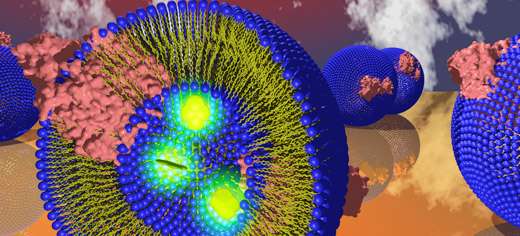 |
| An artistic representation of submicron lipid vesicles filled with fluorescent molecules. The vesicles contain enzymes which convert oxygen to water and transport protons outside the vesicles in the process. The proton transport changes the pH inside the vesicles, which is seen by a change in fluorescence. Credit: Image reproduced by permission of Lars J C Jeuken and The Royal Society of Chemistry. |
Researchers from the University of Leeds are studying how to make electricity from electrodes coated in bacteria, and other living cells, using light or hydrogen as the fuel.
The aim of the research long-term is to develop more efficient biofuel cells, seen as the future of electronics. Because biofuel cells are powered by readily available biological materials, they have the potential to be used indefinitely when electricity is required at places where is it not possible to replace a battery or recharge them.
Most biofuel cells create electricity using enzymes that process glucose, but the Leeds research will focus on bacterial enzymes that can harness light or hydrogen gas to create energy. The work is funded by a £1.42m grant from the European Research Council.
Lead researcher, Dr Lars Jeuken, from the University's Faculty of Biological Sciences, says: "Technology that creates an electrical signal from a biochemical reaction is already in commercial use, for example in blood glucose biosensors. However, developing an efficient biofuel cell that can create sufficient electricity for general use has proved much more difficult. This is mainly because the systems developed to date have only limited control of how inorganic materials and biological molecules interact.
"Our research combines state of-the-art surface physics, colloid and organic chemistry, membrane biology and electrochemistry to develop electrodes with complete control of the biochemical interactions needed to create electricity. We now want to apply this to membrane proteins to generate energy from light and hydrogen."
In their simplest form, biofuel cells have two electrodes, one which removes electrons from a fuel - for instance glucose or hydrogen - whilst the other donates electrons to molecules of oxygen, making water. When these are connected by a wire, they form a circuit, resulting in an electrical current.
Dr Jeuken and his team have extensive experience in making electrodes that directly interact with enzymes located in the membranes that surround cells. This new project will begin by applying this technique to two specific groups of enzymes, one which harnesses light and the other, hydrogen. These are found in membranes of chloroplast - the parts of cells which conduct photosynthesis - or bacterial cells, both of which have promising applications in biofuel cells. The final part of the project will aim to connect electrodes to the membranes of living bacterial cells.
"Not only will this help scientists understand the role of different enzymes in making energy, but how best to capture and use this energy in electrical applications," says Dr Jeuken.
Dr Jeuken's research will also contribute to a new Interdisciplinary Centre for Microbial Fuel Cells (ICMFC), set up jointly between the Universities of Leeds, Sheffield and York. The Centre will bring together chemists from York, biophysicists such as Dr Jeuken from Leeds and engineers from Sheffield, to work together on improving the performance of microbial fuel cells, using a combination of synthetic biology and nanoengineering.
Source: University of Leeds
Additional Information:
Tuesday, 8 May 2012
Manufacturing: Improved lubrication without oil
Engineerblogger
May 8, 2012
Running nicely – this applies even more to aqueous biopolymer solutions than to oil. These solutions are used as a cooling lubricant for machining hard metals and for tool-making machinery on which tools are manufactured.
Metalworking plays a key role in industry. Drilling, milling, turning and grinding operations all use lubricants to prevent work pieces and tools from overheating and from excess wear. Standard lubricants today are based on mineral oil. This has drawbacks: fossil mineral oils come from finite resources, transport relatively little heat away from the work piece, are harmful to health and are flammable. All of this calls for extreme technical efforts, for occupational safety, fire safety and disposal, for example. So there‘s a need for alternative lubricants.
Renewable raw materials as a lubricant additive
The idea hatched by Andreas Malberg, Dr. Peter Eisner and Dr. Michael Menner from the Fraunhofer Institute for Process Engineering and Packaging IVV in Freising sounds simple as well as surprising: lubricate with water, not oil. “At IVV here in Freising, we have been looking at the issue of cooling lubricants for some considerable time”, explains Michael Menner. “In two projects supported by the Federal Ministry of Education and Research, we have successfully replaced oil with water. One surprising thing we found was that water is no worse a lubricant than oil, the key to it all being the additives.” Adding natural polymers to water can dramatically improve its lubricating properties. The Freising-based researchers set about testing renewable raw materials such as celluloses, starches or bacterial polysaccharides and improving their use as lubricant additives. Their aim: to make water more viscous by adding biopolymers, so it lubricates better.
For the idea to become a marketable product, other partners were brought on board: the Institute for Machine Tool Engineering and Production Technology at the University of Braunschweig, and Carl Bechem GmbH - a lubricant manufacturer from Hagen, Germany. The basic fluid made by the IVV, the viscous water, was improved by adding water-soluble additives so it could be used as an anti-corrosion agent, for example. That‘s how it meets the requirements during processing: withstanding high temperatures and shearing stresses.
Benefits: Easy on the environment and on gentle to the skin, does not burn
In addition to the significantly lower impact on the environment and the high raw material efficiency, the new lubricant also offers technological benefits. It reduces wear and prolongs tool life, for example. The processed components are also easier to clean. This cuts costs and improves the cost-efficiency of the entire production process. Converting to the new lubricant is very easy for companies to carry out”, explains Peter Eisner. “In principle, once thoroughly cleaned, the same machine tool circulation systems can be used.” In addition, the use of the aqueous lubricant improves occupational health and safety and hygiene: no formation of oil mists, addition of fewer biocides, it smells better and is gentler on the skin.
For the mineral oil-free lubricant made of aqueous biopolymer solutions for use in metalworking applications, Dr. Peter Eisner, Dipl.-Ing. Andreas Malberg and Dr. Michael Menner will receive one of the 2012 Joseph-von-Fraunhofer awards. The newly developed lubricant is already being distributed by Carl Bechem GmbH under the product name of BERUFLUID and is in use in various metalworking companies in the manufacturing of tools, mechanical engineering, in the automotive and aviation industry and in medical technology.
Source: Fraunhofer-Gesellschaft
May 8, 2012
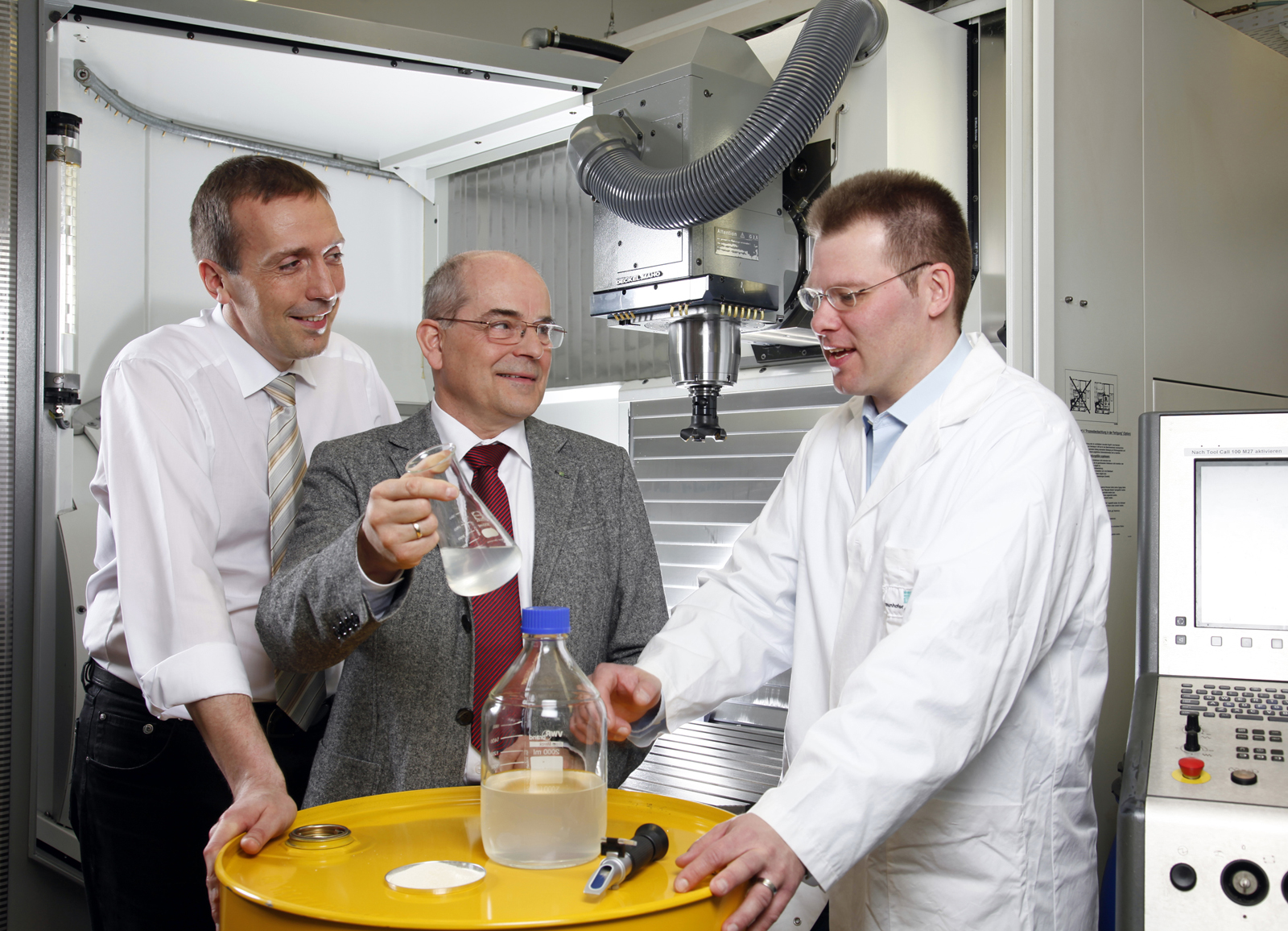 |
| Dr. Peter Eisner, Dr. Michael Menner and Andreas Malberg. Developed a cooling lubricant from aqueous biopolymers. Astonishing the lubricant industry by finding: “Water lubricates like oil”. © Dirk Mahler / Fraunhofer |
Running nicely – this applies even more to aqueous biopolymer solutions than to oil. These solutions are used as a cooling lubricant for machining hard metals and for tool-making machinery on which tools are manufactured.
Metalworking plays a key role in industry. Drilling, milling, turning and grinding operations all use lubricants to prevent work pieces and tools from overheating and from excess wear. Standard lubricants today are based on mineral oil. This has drawbacks: fossil mineral oils come from finite resources, transport relatively little heat away from the work piece, are harmful to health and are flammable. All of this calls for extreme technical efforts, for occupational safety, fire safety and disposal, for example. So there‘s a need for alternative lubricants.
Renewable raw materials as a lubricant additive
The idea hatched by Andreas Malberg, Dr. Peter Eisner and Dr. Michael Menner from the Fraunhofer Institute for Process Engineering and Packaging IVV in Freising sounds simple as well as surprising: lubricate with water, not oil. “At IVV here in Freising, we have been looking at the issue of cooling lubricants for some considerable time”, explains Michael Menner. “In two projects supported by the Federal Ministry of Education and Research, we have successfully replaced oil with water. One surprising thing we found was that water is no worse a lubricant than oil, the key to it all being the additives.” Adding natural polymers to water can dramatically improve its lubricating properties. The Freising-based researchers set about testing renewable raw materials such as celluloses, starches or bacterial polysaccharides and improving their use as lubricant additives. Their aim: to make water more viscous by adding biopolymers, so it lubricates better.
For the idea to become a marketable product, other partners were brought on board: the Institute for Machine Tool Engineering and Production Technology at the University of Braunschweig, and Carl Bechem GmbH - a lubricant manufacturer from Hagen, Germany. The basic fluid made by the IVV, the viscous water, was improved by adding water-soluble additives so it could be used as an anti-corrosion agent, for example. That‘s how it meets the requirements during processing: withstanding high temperatures and shearing stresses.
Benefits: Easy on the environment and on gentle to the skin, does not burn
In addition to the significantly lower impact on the environment and the high raw material efficiency, the new lubricant also offers technological benefits. It reduces wear and prolongs tool life, for example. The processed components are also easier to clean. This cuts costs and improves the cost-efficiency of the entire production process. Converting to the new lubricant is very easy for companies to carry out”, explains Peter Eisner. “In principle, once thoroughly cleaned, the same machine tool circulation systems can be used.” In addition, the use of the aqueous lubricant improves occupational health and safety and hygiene: no formation of oil mists, addition of fewer biocides, it smells better and is gentler on the skin.
For the mineral oil-free lubricant made of aqueous biopolymer solutions for use in metalworking applications, Dr. Peter Eisner, Dipl.-Ing. Andreas Malberg and Dr. Michael Menner will receive one of the 2012 Joseph-von-Fraunhofer awards. The newly developed lubricant is already being distributed by Carl Bechem GmbH under the product name of BERUFLUID and is in use in various metalworking companies in the manufacturing of tools, mechanical engineering, in the automotive and aviation industry and in medical technology.
Source: Fraunhofer-Gesellschaft
Engineers develop novel system for producing conductive films
Engineerblogger
May 8, 2012
Yale engineers have developed a novel automated system for generating strong, flexible, transparent coatings with promising uses in lithium-ion battery and fuel cell production, among other applications.
Until now, the slow through-put of some existing assembly methods has significantly restricted the practical application of these thin, multilayered conductive films.
Led by André Taylor, an assistant professor of chemical and environmental engineering, the Yale team developed a new assembly technique that cuts process time and produces films with both nanolevel precision and improved function. The system — called spin-spray layer-by-layer (SSLbL) — generates thin, multilayered films more rapidly than previously possible and with greater control over film characteristics.
The researchers describe their method in a forthcoming issue of the journal ACS Nano.
“There are many applications for the new technique in developing functional nanoscale coatings,” says Forrest Gittleson, a Yale graduate student and member of the research team. “There are [existing] spray-only systems that reduce the assembly time for layer-by-layer films. But our system improves the process time further while also enhancing the ability to tune film characteristics. It makes for a powerful level of control.”
In one example cited in the paper, a sample film was assembled in 54 minutes using the new method. By contrast, the traditional assembly method, known as dip-coating (layer-by-layer), took 76 hours to produce a film with equivalent conductance.
In addition to improving assembly time, the new system also offers superior control over the film’s final thickness and uniformity.
Films containing carbon nanotubes have long been acknowledged as potentially valuable in sensor and electrode applications. But it’s been difficult to achieve uniform conductivity throughout the film using traditional dip methods. The Yale team demonstrates that its method generates a more uniformly conductive film than the dip method, providing superior performance potential.
“Because layer-by-layer assembly can be used with a wide choice of polyelectrolytes and nanomaterials,” says Taylor, “this technique can be used for an extensive variety of applications ranging from ultra strong materials (stronger than steel) to transparent O2 diffusion barriers, to drug delivery. The next application is up to the imagination of the material designer.”
The researchers assembled ultrathin polymer and nanotube multilayer films, and evaluated them for use as lithium-ion battery electrodes. The technique shows promise in developing a better understanding and method for rapidly creating battery electrodes with nanometer level precision.
Source: Yale University
Additional Information:
May 8, 2012
 |
| Yale engineers have developed a novel system for producing thin, conductive films. Pictured here, a freestanding carbon nanotube treated with one of the films. |
Yale engineers have developed a novel automated system for generating strong, flexible, transparent coatings with promising uses in lithium-ion battery and fuel cell production, among other applications.
Until now, the slow through-put of some existing assembly methods has significantly restricted the practical application of these thin, multilayered conductive films.
Led by André Taylor, an assistant professor of chemical and environmental engineering, the Yale team developed a new assembly technique that cuts process time and produces films with both nanolevel precision and improved function. The system — called spin-spray layer-by-layer (SSLbL) — generates thin, multilayered films more rapidly than previously possible and with greater control over film characteristics.
The researchers describe their method in a forthcoming issue of the journal ACS Nano.
“There are many applications for the new technique in developing functional nanoscale coatings,” says Forrest Gittleson, a Yale graduate student and member of the research team. “There are [existing] spray-only systems that reduce the assembly time for layer-by-layer films. But our system improves the process time further while also enhancing the ability to tune film characteristics. It makes for a powerful level of control.”
In one example cited in the paper, a sample film was assembled in 54 minutes using the new method. By contrast, the traditional assembly method, known as dip-coating (layer-by-layer), took 76 hours to produce a film with equivalent conductance.
In addition to improving assembly time, the new system also offers superior control over the film’s final thickness and uniformity.
Films containing carbon nanotubes have long been acknowledged as potentially valuable in sensor and electrode applications. But it’s been difficult to achieve uniform conductivity throughout the film using traditional dip methods. The Yale team demonstrates that its method generates a more uniformly conductive film than the dip method, providing superior performance potential.
“Because layer-by-layer assembly can be used with a wide choice of polyelectrolytes and nanomaterials,” says Taylor, “this technique can be used for an extensive variety of applications ranging from ultra strong materials (stronger than steel) to transparent O2 diffusion barriers, to drug delivery. The next application is up to the imagination of the material designer.”
The researchers assembled ultrathin polymer and nanotube multilayer films, and evaluated them for use as lithium-ion battery electrodes. The technique shows promise in developing a better understanding and method for rapidly creating battery electrodes with nanometer level precision.
Source: Yale University
Additional Information:
Subscribe to:
Posts (Atom)