Blogger Themes

Showing posts with label Nissan. Show all posts

Friday, 14 October 2011

Nissan Launches New Eco Technology

Engineerblogger
Oct 14, 2011


Nissan Engine Picture Nissan expects to debut a new 2.5-liter hybrid system in the U.S. within two years. Nissan Motors Corporation, Inc.

  • Among the eco-friendly goodies Nissan debuted this week in Japan is a new 2.5-liter hybrid system for front-drive vehicles that will appear in the U.S. within two years, most likely on the Altima and Rogue.
  • Nissan confirmed that a "new hybrid vehicle" using its own 2.5-liter system will appear in North America in 2013.
  • It also showed off an improved Xtronic continuously variable transmission that's a key part of its front-drive hybrid.
  • Nissan also demonstrated a "smart" new wireless charging system for its all-electric Leaf.

Among the eco-friendly goodies Nissan debuted here this week is a new 2.5-liter hybrid system for front-drive vehicles that will appear in the U.S. within two years, most likely on the Altima and Rogue.

The system was developed in-house and was revealed at Nissan's Oppama technical center.

To create the new hybrid, Nissan reworked the rear-drive system from the Infiniti M35h hybrid. Underneath, the Infiniti's single electric motor and twin-clutch layout, plus compact lithium-ion battery, stays the same.

But the gas engine now switches to a more compact supercharged 2.5-liter four-cylinder engine. The new setup boosts low-end torque and improves fuel economy, Nissan said. The new hybrid delivers the power of a 3.5-liter but with much better city/highway fuel economy.

To get a start in the hybrid race, Nissan created the original Altima hybrid as a stop-gap using Toyota technology. Neither side was ecstatic about the deal. Now Nissan confirms that a "new hybrid vehicle" using its own 2.5-liter system will appear in North America in 2013, followed by global markets.

Nissan also revealed an improved Xtronic continuously variable transmission that's another key part of its new front-drive hybrid.

Nissan is claiming up to 10 percent fuel-economy gains with this new CVT that has been designed for 2.0-3.5-liter engines and will first launch in the US in 2012, ahead of the hybrid.

Automotive media tried the new CVT in an Altima development mule at Oppama. While high on efficiency, CVTs don't always match well to high engine rpm but on this showing, Nissan has gone a long way to closing that gap with this responsive new transmission.

Looking further ahead, Nissan continues to investigate the viability of fuel cell electric vehicles, and its latest fuel stack shows the rapid speed of development.

Dramatically downsized and 2.5 times more efficient than the previous Nissan stack seen in 2005, the stack also uses just a quarter of the parts and costs have been slashed to just one sixth, said an engineer. Nissan is still planning to have a fuel-cell car on the road after 2015.

Nissan also demonstrated a "smart" new wireless charging system for its all-electric Leaf. Conventional EVs are charged using a cable but here the car simply parks over a charging unit and battery replenishing automatically begins.

The system is still being tested but is due to appear "within a few years," said Nissan. While the wireless system doesn't make battery charging any quicker, it certainly makes the process a whole lot easier and more convenient.

Nissan also debuted some safety innovations, including an accelerator suppression system.

Source: Insideline.com

Friday, 30 September 2011

Nissan's Cars Will Read Your Mind

Engineerblogger
Sept 30, 2011


In the future--don't ask how distant--your car may be able to read your mind.

Nissan announced that it would be collaborating with the École Polytechnique Fédérale de Lausanne in Switzerland (EPFL) on a car that would be able to make an educated guess about what a driver's intentions are. The idea isn't quite to have a car be steered by the driver's mind alone--as in this German concept proposing that a car brake for you, based on brain signals. Rather, the car would read the driver's mind and prepare itself for a manually executed maneuver. Think about turning to the right, for instance, and the car will adopt the appropriate speed and road position.

How could a car know what you're thinking? For one thing, it would use brain-computer interface (BCI) technology developed at EPFL. The Swiss researchers, led by Professor José del R. Millán, are acknowledged leaders in this space, having created an interface that enables the steering of a wheelchair (first video)by thought alone, for instance.

But the car would read more than the driver's mind. The car's sensors could scan around the car itself, effectively cross-checking what the driver is thinking with what's actually out there. You may want to turn left--but if there's a Mack truck in your blind spot, your car will know better. By combining brain and environmental data, the car (and driver) makes smarter choices. "The idea is to blend driver and vehicle intelligence together in such a way that eliminates conflicts between them, leading to a safer motoring environment," José del R. Millán recently said.

EPFL isn't the first academic institution to dabble in hands-free driving. A German university-- Freie Universität Berlin--got there first.

But to the best of my knowledge, this is the first time a major car manufacturer has joined the effort, bringing the research into the realm of commercial, mass-market reality. The EPFL collaboration is part of a six-year plan Nissan calls "Power 88"; other technology projects include smart cruise control, distance control assist, and moving object detection--basically, more and more ways of automating the driving experience.

All of which raises the question: won't mind-reading cars be obsolete in an era of driverless cars (second video)?

Source: Technology Review

Thursday, 22 September 2011

Nissan, Mitsubishi strengthen cooperation

Engineerblogger
Sept 22, 2011

Japanese automakers Nissan and Mitsubishi are strengthening their cooperation by expanding the number of models they make for each other in Japan.

Nissan and its smaller rival Mitsubishi have had what is called an original equipment manufacturer, or OEM, deal since December 2010. They manufacture specific vehicle models for each other and sell them under their own brands.

Nissan Motor Co. said Thursday it will provide the Fuga luxury sedan to Mitsubishi Motors Corp., starting from summer next year.

They have also started talks on Mitsubishi providing the Minicab-MiEV commercial electric car to Nissan in the fiscal year that begins April 2012.

Such OEM deals are fairly common in the auto industry. They allow companies to cut costs by increasing production scale and to expand their lineup of types of cars they don't want to invest in the development or manufacturing of.

Under an earlier agreement, Nissan, which also makes the Leaf electric car and March subcompact, is providing the NV200 Vanette compact van to Mitsubishi Motors from next month.

They also set up a joint venture called NMKV Co., which began operating in June, to work together on minicars for the Japanese market, which may later include other nations.

Mitsubishi President Osamu Masuko has said he hopes the joint venture will fuse his company's design expertise with Nissan's purchasing power.

"These initiatives are intended to strengthen the competitiveness of both companies in Japan," both sides said in a statement.

Source: The Associated Press

Tuesday, 13 September 2011

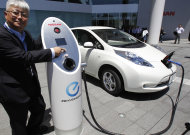
Nissan develops cheaper, smaller charger for EVs

Engineerblogger
Sept 12, 2011

Nissan has developed a charger for electric vehicles that's smaller, about half the price, and easier to install.

Nissan Motor Co., Japan's No. 2 automaker, said Monday the new charger will go on sale in November in Japan and is planned later for the U.S. and Europe, although dates are not set.

The basic model of the revamped charger will cost about half the price of the current model, which is stockier and has more parts, and costs 1.47 million yen ($19,000). The higher-grade model for outdoors will also be cheaper and cost under 1 million yen ($13,000), according to Nissan.

Yokohama-based Nissan, which makes the Leaf electric vehicle, is targeting sales of 5,000 of the new chargers in Japan by the end of March 2016.

Zero-emission electric vehicles are drawing attention amid concerns about global warming and the environment. The Leaf is among the pioneering models in the technology.

But electric vehicles still make up a niche market. They have to be recharged, and recharging stations aren't that plentiful. Owners generally have to go through the trouble of installing a recharger in their homes.

Right now, Leafs are being sold to mostly local governments rather than regular consumers.

The difficulty of installing chargers, which look like the filling machines at gas stations, is another reason.

Nissan is hoping to sell the new chargers to highways, airports, shopping centers, convenience stores and gas stations, it said.

Nissan has sold more than 13,600 Leaf cars around the world since they went on sale in December 2010. There are now 619 chargers throughout Japan, 32 percent, or 196, in the Nissan group, while the rest are with local governments, highways and other companies that promote EVs.

Competition in electric vehicles is likely to intensify in coming years as others, such as Japanese rival Toyota Motor Corp., enter the sector.

Toyota already offers plug-in hybrid cars, which run partly as EVs but switch to become regular hybrids with gas engines when they run out of the electric charge.

Source: The Associated Press

Tuesday, 26 July 2011

Nissan and China partner Dongfeng to invest $8 bln

Engineerblogger
July 26, 2011

Nissan and its Chinese partner Dongfeng Motor Co. will invest 50 billion yuan ($8 billion) and launch around 30 vehicle models in China over the next five years, the Japanese auto giant said Tuesday.

The two firms also plan to increase sales from nearly 1.3 million vehicles in 2010 to more than 2.3 million units by 2015 and launch a fully electric zero-emission car for the Chinese market, Nissan said in a statement.

"Nissan's strong partnership with Dongfeng Motor Corporation has been the primary driver of its robust growth over the past eight years in the Chinese market," Carlos Ghosn, Nissan Motor's chief executive, said in the statement.

"The new plan, with its investments in capacity, products and innovation, will ensure that China continues to be Nissan's largest global market."

China, which overtook the US to become the world's top auto market in 2009, has become increasingly important for global players. Auto sales in China rose more than 32 percent last year to a record 18.06 million units.

But the sector has since lost steam after Beijing phased out sales incentives such as tax breaks for small-engined vehicles, introduced to ward off the impact of the global financial crisis.

The government is considering new incentives to revive the sector. But an industry group still predicted earlier this month that auto sales growth was expected to slow, despite showing a slight rebound in June.

Nissan said its Chinese joint venture planned to achieve and maintain a 10 percent share of the Chinese market over the next five years.

Ghosn told reporters at a press conference that Nissan currently has a 6.2 percent share of the market.

The two firms will also build a new manufacturing facility in the eastern province of Jiangsu, which will reinforce existing plants in other parts of the country to achieve the 2015 sales target, it added.

Sales of the first passenger vehicle sporting the Dongfeng Nissan brand Venucia are scheduled for next year, and a total of five new models will be launched under that brand.

Copyright © 2011 AFP

Tuesday, 12 July 2011

Nissan works on recharging Leaf with solar power

AP
July 11, 2011
Japanese automaker Nissan is testing a super-green way to recharge its Leaf electric vehicle using solar power, part of a broader drive to improve electricity storage systems.

Nissan's Leaf went on sale late last year, but the automaker is looking ahead to about five years time when aging Leaf vehicles may offer alternative business opportunities in using their lithium-ion batteries as a storage place for electricity.

Nissan Motor Corp. acknowledges that, once the Leaf catches on, a flood of used batteries could result as the life span of a battery is longer than an electric vehicle's.

Electricity generation and storage are drawing attention in Japan after the March 11 earthquake and tsunami caused massive blackouts in the country's northeast. A nuclear power plant that went into meltdown, Fukushima Dai-ichi, after backup generators were destroyed by the tsunami, is also renewing fears about a power crunch.

In the new charging system, demonstrated to reporters Monday, electricity is generated through 488 solar cells installed on the roof of the Nissan headquarters building in Yokohama, southwest of Tokyo.
To read more click here...

Related Article:

Tuesday, 28 June 2011

Nissan sharpens focus on emerging markets

Financial Times
June 28, 2011

Nissan, which last year overtook Honda as Japan’s second-largest carmaker by sales, has unveiled ambitious plans to expand its global market share over the next six years by focusing on emerging markets.

Carlos Ghosn, who heads Nissan and its French alliance partner Renault, said on Monday that Nissan would seek to increase its market share from 5.8 per cent to 8 per cent by the financial year ending in March 2017.

Most of the hoped-for growth is to come from countries such as China, where Nissan is the most popular Japanese brand, outselling its larger rival Toyota.

Nissan aims to increase its share of the Chinese vehicle market – the world’s largest – from 6.2 per cent to 10 per cent.

“We are definitely on the offensive,” said Mr Ghosn.

In addition to its ambitions in China, Nissan is aiming to increase its share of the biggest south-east Asian markets from 6 per cent to 15 per cent over the next six years.
To read more click here...

Thursday, 23 June 2011

Major Automakers Race To Silicon Valley

Fast Company
June 22, 2011

Silicon Valley: home to Google, Intel, countless tech startups, and... Renault-Nissan? The automotive group announced this week that it is opening a research office directly across from Google's campus by the end of June--and it will focus on the company's most cutting-edge initiatives, including in-vehicle Internet connectivity, user-interface displays, and smart-grid research.

Nissan is one of a number of major automakers to tap Silicon Valley's technological prowess by setting up shop right where the action is. BMW has a technology office in Palo Alto, Mercedes-Benz has a Group and Advanced Engineering office in the area, and Volkswagen has an Electronics Research Laboratory in Belmont, CA.

What will Nissan work on at its new research center? The company says that it will work on devices like the "Carwings" telematics system--a seven-inch touchscreen featuring maps of EV charging stations and real-time energy consumption reports. The system is already found in all Nissan LEAFs. European carmaker Renault will also work on the research and advanced engineering aspects of its electric vehicles, which include the upcoming battery switch station-compatible Fluence ZE and the two-seater Twizy ZE (pictured).

It makes sense for these companies to focus on research in Silicon Valley; it's where the talent is, and the engineering starting wages in Detroit are low compared to California. And there are undeniable attractions to living in the Bay Area versus Detroit, meaning it's easier to lure prospective hotshot employees.

Land is still much cheaper in Detroit, however, so don't expect major automakers to pack up their factories and head for the Bay. But with the proliferation of hybrid, electric, and other advanced vehicle technologies, it only makes sense for car companies to focus on Silicon Valley. Renault-Nissan almost certainly won't be the last.