Blogger Themes

Showing posts with label USDA. Show all posts

Thursday, 19 April 2012

Nanotech Cotton Opens Up New Possibilities for the Fiber

Engineerblogger
April 19, 2012


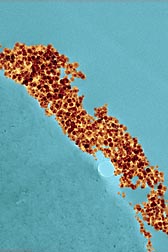
Closer view of a clay nanoparticle coating.  Photo courtesy of Jaime Grunlan, Texas A&M University, colorization by Stephen Ausmus.


Cotton is going high-tech in New Orleans, La., where a team of U.S. Department of Agriculture (USDA) scientists is continuing a long tradition of innovative research on the prized natural fiber.

Starting in the 1950s, chemist Ruth Benerito and her colleagues at the Agricultural Research Service (ARS) Southern Regional Research Center in New Orleans conducted groundbreaking studies that gave rise to easy-care, permanent-press clothing and other consumer-friendly improvements that helped cotton better compete with synthetic fibers, like polyester. Today, under the leadership of Brian Condon, the ARS cotton researchers in New Orleans are leveraging the latest developments in nanotechnology to bring cotton fully into the 21st century.

ARS is the chief intramural scientific research agency of USDA.

In one ongoing project, the researchers have teamed with Texas A&M University scientists to evaluate a first-of-its-kind, environmentally friendly flame-retardant for cotton apparel and durable goods. Halogenated flame retardants have been among the most widely used chemical treatments, but there's been a push to find alternatives that are more benign and that won't cause treated fabric to stiffen, according to Condon.

Made of water-soluble polymers, 50- to 100-nanometer clay particles and other "green" ingredients, the experimental fabric treatment reacts to open flame by rapidly forming a swollen charred surface layer. This stops the flame from reaching underlying or adjacent fibers in a process known as "intumescence," notes Condon, co-author of a May 2010 ACS Nano paper.

Early trials of the nanocoating using standard flame-resistance tests have been promising. In one case, 95 percent of treated cotton fabric remained intact after exposure to flame versus complete destruction of untreated fabric used for comparison.

In another project, the ARS scientists are generating ultrasonic fields of mechanical energy to improve enzyme-based processing of raw ("greige") cotton to strip away waxes and other fiber components that can hinder subsequent dying procedures and diminish product quality.


Additional Information:

Tuesday, 17 January 2012

Comparing Energy Conversion of Plants and Solar Cells

Engineerblogger
Jan 17, 2012


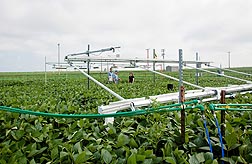
In studies at Urbana, Illinois, ARS scientists (left to right) Carl Bernacchi, Don Ort, and Lisa Ainsworth work in a facility where photosynthesis efficiency and yield can be measured in response to a simulated variable. Improving photosynthesis could lead to increased food production from soybeans, shown here. Photo courtesy of Institute for Genomic Biology/University of Illinois.

Scientists now have a way to more accurately compare how efficiently plants and photovoltaic, or solar, cells convert sunlight into energy, thanks to findings by a research consortium that included a U.S. Department of Agriculture (USDA) scientist.

The study, published in Science, could help researchers improve plant photosynthesis, a critical first link in the global supply chain for food, feed, fiber and bioenergy production.

Comparing plant and photovoltaic systems is a challenge. Although both processes harvest energy from sunlight, they use that energy in different ways. Plants convert the sun's energy into chemical energy, whereas solar cells produce electricity. The scientists, including Agricultural Research Service (ARS) research leader Donald Ort in the agency's Global Change and Photosynthesis Research Unit in Urbana, Ill., identified specific designs that hold excellent promise for improving efficiency.

ARS is the USDA's chief intramural scientific research agency.

The first step was to facilitate a direct comparison of the two systems. The researchers set a uniform basis for the comparison and examined the major factors that define the efficiencies of both processes, first considering current technology, then looking forward to possible strategies for improvements.

In all cases, the research team considered the efficiency of harvesting the entire solar spectrum as a basis for comparison. Additionally, the researchers compared plants to solar cell arrays that also store energy in chemical bonds. Calculations were applied to a solar cell array that was coupled to an electrolyzer that used electricity from the array to split water into hydrogen and oxygen. The free energy needed to split water is essentially the same as that needed for photosynthesis or a solar cell, so the comparison provided a level playing field.

Using this type of calculation, the annual averaged efficiency of solar-cell-driven electrolysis is about 10 percent. Solar energy conversion efficiencies for crop plants are about 1 percent, which illustrates the significant potential to improve the efficiency of the natural system, according to Ort. While, in the context of the team's efficiency analysis, solar cells have a clear advantage compared to photosynthesis, there is a need to apply both in the service of sustainable energy conversion for the future. This energy-efficiency analysis between plant photosynthesis and solar cells will lay the groundwork for improving the efficiency of plant photosynthesis in agriculture for improved yield.

Source: Agricultural Research Service