Blogger Themes

Showing posts with label UK. Show all posts

Tuesday, 12 February 2013

Stem cell breakthrough could lead to new bone repair therapies on nanoscale surfaces

Engineerblogger
Feb 12, 2013


Stem cell breakthrough could lead to new bone repair therapies


Scientists at the University of Southampton have created a new method to generate bone cells which could lead to revolutionary bone repair therapies for people with bone fractures or those who need hip replacement surgery due to osteoporosis and osteoarthritis.

The research, carried out by Dr Emmajayne Kingham at the University of Southampton in collaboration with the University of Glasgow and published in the journal Small, cultured human embryonic stem cells on to the surface of plastic materials and assessed their ability to change.

Scientists were able to use the nanotopographical patterns on the biomedical plastic to manipulate human embryonic stem cells towards bone cells. This was done without any chemical enhancement.

The materials, including the biomedical implantable material polycarbonate plastic, which is a versatile plastic used in things from bullet proof windows to CDs, offer an accessible and cheaper way of culturing human embryonic stem cells and presents new opportunities for future medical research in this area.

Professor Richard Oreffo, who led the University of Southampton team, explains: “To generate bone cells for regenerative medicine and further medical research remains a significant challenge. However we have found that by harnessing surface technologies that allow the generation and ultimately scale up of human embryonic stem cells to skeletal cells, we can aid the tissue engineering process. This is very exciting.

“Our research may offer a whole new approach to skeletal regenerative medicine. The use of nanotopographical patterns could enable new cell culture designs, new device designs, and could herald the development of new bone repair therapies as well as further human stem cell research,” Professor Oreffo adds.

The study was funded by the Biotechnology and Biological Sciences Research Council (BBSRC).

This latest discovery expands on the close collaborative work previously undertaken by the University of Southampton and the University of Glasgow. In 2011 the team successfully used plastic with embossed nanopatterns to grow and spread adult stem cells while keeping their stem cell characteristics; a process which is cheaper and easier to manufacture than previous ways of working.

Dr Nikolaj Gadegaard, Institute of Molecular, Cell and Systems Biology at the University of Glasgow, says: "Our previous collaborative research showed exciting new ways to control mesenchymal stem cell – stem cells from the bone marrow of adults – growth and differentiation on nanoscale patterns.

“This new Southampton-led discovery shows a totally different stem cell source, embryonic, also respond in a similar manner and this really starts to open this new field of discovery up. With more research impetus, it gives us the hope that we can go on to target a wider variety of degenerative conditions than we originally aspired to. This result is of fundamental significance."

Source: University of Southampton

Monday, 11 February 2013

Implants make light work of fixing broken bones

Engineerblogger
Feb 11, 2013

Richard Oreffo


Artificial bone, created using stem cells and a new lightweight plastic, could soon be used to heal shattered limbs.

The use of bone stem cells combined with a degradable rigid material that inserts into broken bones and encourages real bone to re-grow has been developed at the Universities of Edinburgh and Southampton.

Researchers have developed the material with a honeycomb scaffold structure that allows blood to flow through it, enabling stem cells from the patient’s bone marrow to attach to the material and grow new bone. Over time, the plastic slowly degrades as the implant is replaced by newly grown bone.

Scientists developed the material by blending three types of plastics. They used a pioneering technique to blend and test hundreds of combinations of plastics, to identify a blend that was robust, lightweight, and able to support bone stem cells. Successful results have been shown in the lab and in animal testing with the focus now moving towards human clinical evaluation.

The study, published in the journal Advanced Functional Materials, was funded by the Biotechnology and Biological Sciences Research Council.

This new discovery is the result of a seven-year partnership between the University of Southampton and the University of Edinburgh.

Richard Oreffo, Professor of Musculoskeletal Science at the University of Southampton, comments: "Fractures and bone loss due to trauma or disease are a significant clinical and socioeconomic problem. This collaboration between chemistry and medicine has identified unique candidate materials that support human bone stem cell growth and allow bone formation. Our collaborative strategy offers significant therapeutic implications."

Professor Mark Bradley, of the University of Edinburgh’s School of Chemistry, adds: “We were able to make and look at a hundreds of candidate materials and rapidly whittle these down to one which is strong enough to replace bone and is also a suitable surface upon which to grow new bone.

“We are confident that this material could soon be helping to improve the quality of life for patients with severe bone injuries, and will help maintain the health of an ageing population.”

Source:  University of Southampton

Saturday, 12 January 2013

Smarter infrastructure: Converting vibrations into electricity

Engineerblogger
Jan 12, 2013

Tunnel
Credit: stopthegears, via Flickr creative commons


A team from the Centre for Smart Infrastructure and Construction have developed a mechanical amplifier to convert ambient vibrations into electricity more effectively, which could be used to power wireless sensors for monitoring the structural health of roads, bridges and tunnels.

Undetected structural problems in aging infrastructure can be disastrous, such as the recent incident in the busy Sasago tunnel west of Tokyo. Nine people were killed when huge chunks of concrete began to fall from the roof of the tunnel, starting a fire and trapping people in their vehicles. Thankfully, such incidents are rare, but the ability to determine when structural problems may become a threat to public safety is a major priority for government and industry.

The Centre for Smart Infrastructure and Construction (CSIC) was established in 2011 to develop and commercialise new technologies designed to make smart infrastructure possible, primarily through the development of new sensor and data management technologies, which will enable continuous monitoring of our roads, tunnels and bridges.

A new device designed by researchers in the CSIC could allow this type of observations by converting the vibration experienced by structures into electricity, in order to power small remote monitoring devices in locations where access is limited, such as inside a tunnel or underneath a bridge.

“Wireless sensors are one way to better look after infrastructure, and it’s something that industry is interested in doing, but batteries are always the sticking point,” says Professor Kenichi Soga, who designed the device with Dr Ashwin Seshia and Yu Jia, a PhD student in Dr Seshia’s group. “It’s not the cost of the batteries that is the issue; it’s the cost of human power to replace the batteries.”

Since the devices are self-powered, there is no need to have individuals change the batteries on a regular basis, thereby decreasing cost to industry while enabling continuous remote monitoring in order to detect problems at an early stage.

Self-powered battery-less devices are not an entirely new concept: other energy harvesting principles are used to power digital wristwatches and handheld torches. Existing devices based on vibrational energy harvesting suffer from two key technical limitations, however: low output power density, and the mismatch between the narrow operational frequency bandwidth of conventional energy harvesters and the wideband nature of vibrations experienced by bridges, tunnels and roads.

The device developed by the CSIC team addresses these issues by basing their harvester on a phenomenon known as parametric resonance. The energy harvesting device can be realised as a micro-electromechanical system (MEMS) device, consisting of a micro-cantilever structure and a transducer. When force is applied to the cantilever perpendicular to the length instead of transversely, parametric resonance can be achieved, generating more energy from the same amount of vibration.

The MEMS device provides the added advantage of using batch manufacturing principles common to the semiconductor industry, potentially enabling low-cost battery replacement, large-scale volume production and co-integration with sensors and interface electronics to realise truly autonomous smart sensor nodes: a challenge that the CSIC team are seeking to address in the context of developing innovative monitoring technologies for large-scale built infrastructure.

Prototype versions of MEMS and macro-scale devices based on these principles have demonstrated a significantly improved power output and a wider operational bandwidth relative to current state-of-the-art devices. Preliminary results on a MEMS prototype were presented at the PowerMEMS conference in Atlanta in December. The device is being commercialised by Cambridge Enterprise, the University’s technology transfer office.

In addition to applications in the construction industry, the device also has potential applications such as powering wearable medical devices or extending the life of batteries in mobile phones.

CSIC was established in 2011, and brings together researchers from the Department of Engineering, along with colleagues from the Department of Architecture, the Computer Laboratory, the Judge Business School and Cambridge Enterprise.

Source: University of Cambridge

Saturday, 5 January 2013

How a computer game could radically alter manufacturing

Engineerblogger
Jan 4, 2013


Here at The Engineer we’re used to explaining difficult concepts, whether it’s nuclear fusion or spintronics (actually I’m still not sure about that one). It helps that we have a receptive and enthusiastic audience and are tackling subject material that is usually instantly exciting.

But what if you had to explain something with less obvious appeal to people who think you might be wasting their time, for example, a complex new manufacturing business model to a group of sceptical bean counters? It’s probably not a conversation you’d want to have at a dinner party.

The answer to this might be to make the explanation into a game, according to one research group at least. Make the process fun, entertaining and engaging, and the audience might be more likely to understand and remember the concept, and perhaps even become more enthusiastic about it.

A team led by Aston University Business School are about to do just this by starting a five-year research project on the gamification of explaining servitisation. Now comes the bit where I explain what this boring and complicated-sounding concept actually is.

A product service system (PSS) is a business model where a firm offers both products and services. Rolls-Royce, for example, is well known for earning around 50 per cent of its revenue through service and support contracts, providing things such as maintenance and advice to customers that also buy its goods. Simply put, servitisation is when a straightforward manufacturing company adopts this model.

Particularly in developed marketplaces and economies, servitisation offers companies a chance to make more money than they would simply by selling products and competing against other manufacturers. Described like this, it sounds rather simple and very attractive. But making it a reality is a far more complex procedure with many barriers, and so servitisation of manufacturing firms has been slow.

Prof Tim Baines of Aston University argues that one of the biggest barriers to adoption of PSS is just explaining how the process of servitisation works. ‘To try to get those ideas across to someone in a manufacturing company in five or 10 minutes in a way that makes sense to them is quite challenging,’ he says.

This is where he believes gamification could come in. This is another slightly off-putting piece of jargon that basically means turning a process into a game. It’s not a new concept but has found growing popularity in recent years thanks to the growth of the internet and smartphones. There are any number of websites and apps that encourage you to do something by making it a game and rewarding you in some for participation.

For example, if you want to get fit but struggle to find the motivation, an app on your phone can monitor your progress to give you encouragement, telling you how many calories you’ve burnt or giving you badges for completing certain levels. One app even asks you to image you’re being chased by zombies and the only way to escape them is to run to a certain place.

But how will this work for explaining servitisation? Baines is planning to work with the Serious Games Institute at Coventry University and Sheffield’s Advanced Manufacturing Research Centre to create a computer simulation of a business adopting PSS. Companies, including Ford and Xerox, will then be brought in to test the game. ‘One of the big barriers is understanding, getting across the basic ideas and the language used, an appreciation of what it can actually mean,’ says Baines.

‘We’ll create a demonstration first of all so that we can communicate to the gaming community what we’re trying to do. The big hurdle is translating between these two communities, explaining to the gaming community what it is that we’re trying to model and them explaining to us what makes an engaging game. We’ve got to try to find the middle ground and from that we’ll create the basics of the game.’

It would be easy to write this concept of gamification off as a fad or a buzzword. For one thing, it doesn’t sound like the most fun idea for a game but, then again, there have been whole series of popular computer games designed around simulating real-life industries (Sim City, for example). And this won’t be the first time games are used to explain manufacturing concepts. Team games have been used before to demonstrate and introduce Western manufacturers to the Japanese-originated ideas of lean manufacturing.

Perhaps it will take more than a computer game to persuade companies to adopt dramatically different business models, but Baines hopes the game will do more than just change individual’s minds. ‘I would like it to be something quite pervasive that people inside the organisation become aware of and have a go at it, and for the top managers to hear about it not just from academics but also from people within the organisation who get to know about this thing called servitisation from playing the game.’

The game will also serve as a way for academics to further study servitisation so they can better understand the barriers to adopting PSS when it is attempted by real companies.

With gamification spreading even into business management techniques, it’s interesting to consider how else it could be used in manufacturing or other parts of the economy. Perhaps games could become a more common sight at work, motivating people to complete tasks or reach certain levels of achievement. On the other hand, you could argue we already run such a reward system. It’s called getting paid.

Source: The Engineer

Friday, 26 October 2012

Electron 'sniper' targets graphene

Engineerblogger
Oct 26, 2012


Credit: Oxford University

Because of its intriguing properties graphene could be the ideal material for building new kinds of electronic devices such as sensors, screens, or even quantum computers.

One of the keys to exploiting graphene's potential is being able to create atomic-scale defects – where carbon atoms in its flat, honeycomb-like structure are rearranged or 'knocked out' – as these influence its electrical, chemical, magnetic, and mechanical properties.

A team led by Oxford University scientists report in Nature Communications a new approach to a new approach to engineering graphene's atomic structure with unprecedented precision.

'Current approaches for producing defects in graphene are either like a 'shotgun' where the entire sample is sprayed with high energy ions or electrons to cause widespread defects, or a chemistry approach where many regions of the graphene are chemically reacted,' said Jamie Warner from Oxford University's Department of Materials, a member of the team.

'Both methods lack any form of control in terms of spatial precision and also the defect type, but to date are the only reported methods known for defect creation.'

The new method replaces the 'shotgun' with something more like a sniper rifle: a minutely-controlled beam of electrons fired from an electron microscope.

'The shotgun approach is restricted to micron scale precision, which is roughly an area of 10,000,000 square nanometres, we demonstrated a precision to within 100 square nanometres, which is about four orders of magnitude better,' explains Alex Robertson of Oxford University's Department of Materials, another member of the team.

Yet it isn’t just about the accuracy of a single 'shot'; the researchers also show that by controlling the length of time graphene is exposed to their focused beam of electrons they can control the size and type of defect created.

'Our study reveals for the first time that only a few types of defects are actually stable in graphene, with several defects being quenched by surface atoms or relaxing back to pristine by bond rotations,' Jamie tells me.

The ability to create just the right kind of stable defects in graphene's crystal structure is going to be vital if its properties are to be harnessed for applications such as mobile phones and flexible displays.

'Defect sites in graphene are much more chemically reactive, so we can use defects as a site for chemical functionalisation of the graphene. So we can attach certain molecules, such as biomolecules, to the graphene to act as a sensor,' Alex tells me.

'Defects in graphene can also give rise to localized electron spin, an attribute that has important future use in quantum nanotechnology and quantum computers.'

At the moment scaling up the team's technique into a manufacturing process to create graphene-based technologies is still a way off. Currently electron microscopes are the only systems that can achieve the necessary exquisite control of an electron beam.

But, Alex says, it is always possible that a scalable electron beam lithography type technique may be developed in the future that could allow for defect patterning in graphene.And it's worth remembering that it wasn't so long ago that the technology needed to etch millions of transistors onto a tiny slice of silicon seemed like an impossible dream.

Source: Oxford University

Additional Information:

Tuesday, 10 July 2012

Graphene Repairs Holes By Knitting Itself Back Together, Say Physicists

Engineerblogger
July 10, 2012


The graphene revolution is upon us. If the visionaries are to be believed, the next generation of more or less everything is going to be based on this wonder material--sensors, actuators, transistors and information processors and so on. There seems little that graphene can't do.

But there's one fly in the ointment. Nobody has yet worked out how to make graphene in large, reliable quantities or how to carve and grow it into the shapes necessary for the next generation of devices.

That's largely because it's tricky growing anything into a layer only a single atom thick. But for carbon, it's all the more difficult because of this element's affinity to other atoms, including itself. A carbon sheet will happily curl up and form a tube or a ball or some more exotic shape. It will also react with other atoms nearby, which prevents growth and can even tear graphene apart.

So a better understanding of the way a graphene sheet interacts with itself and its environment is crucial if physicists are ever going to tame this stuff.

Enter Konstantin Novoselov at the University of Manchester and a few pals who have spent more than a few hours staring at graphene sheets through an electron microscope to see how it behaves.

Today, these guys say they've discovered why graphene appears so unpredictable. It turns out that if you make a hole in graphene, the material automatically knits itself back together again.

Novoselov and co made their discovery by etching tiny holes into a graphene sheet using an electron beam and watching what happens next using an electron microscope. They also added a few atoms of palladium or nickel, which catalyse the dissociation of carbon bonds and bind to the edges of the holes making them stable.

They found that the size of the holes depended on the number of metal atoms they added--more metal atoms can stabilise bigger holes.

But here's the curious thing. If they also added extra carbon atoms to the mix, these displaced the the metal atoms and reknitted the holes back together again.

Novoselov and co say the structure of the repaired area depends on the form in which the carbon is available. So when available as a hydrocarbon, the repairs tend to contain non-hexagonal defects where foreign atoms have entered the structure.

But when the carbon is available in pure form, the repairs are perfect and form pristine graphene.

That's important because it immediately suggests a way to grow graphene into almost any shape using the careful injection of metal and carbon atoms.

But there are significant challenges ahead. One important question is how quickly these processes occur and whether they can be controlled with the precision and reliability necessary for device manufacture.

Novoselov is a world leader in this area and the joint recipient of the Nobel Prize for physics in 2010 for his early work on graphene. He and his team are well set up to solve this and various related questions.

But with the future of computing (and almost everything else) at stake, there's bound to be plenty of competitors snapping at their heels.

Source: Technology Review


Additional Information:

Nanodevice builds electricity from tiny pieces

Engineerblogger
July 10, 2012

Scanning electron microscope image of the electron pump.
The arrow shows the direction of electron pumping. The hole
in the middle of the electrical control gates where the
electrons are trapped is ~0.0001 mm across
.

A team of scientists at the National Physical Laboratory (NPL) and University of Cambridge has made a significant advance in using nano-devices to create accurate electrical currents. Electrical current is composed of billions and billions of tiny particles called electrons. They have developed an electron pump - a nano-device - which picks these electrons up one at a time and moves them across a barrier, creating a very well-defined electrical current.

The device drives electrical current by manipulating individual electrons, one-by-one at very high speed. This technique could replace the traditional definition of electrical current, the ampere, which relies on measurements of mechanical forces on current-carrying wires.

The key breakthrough came when scientists experimented with the exact shape of the voltage pulses that control the trapping and ejection of electrons. By changing the voltage slowly while trapping electrons, and then much more rapidly when ejecting them, it was possible to massively speed up the overall rate of pumping without compromising the accuracy.

By employing this technique, the team were able to pump almost a billion electrons per second, 300 times faster than the previous record for an accurate electron pump set at the National Institute of Standards and Technology (NIST) in the USA in 1996.

Although the resulting current of 150 picoamperes is small (ten billion times smaller than the current used when boiling a kettle), the team were able to measure the current with an accuracy of one part-per-million, confirming that the electron pump was accurate at this level. This result is a milestone in the precise, fast, manipulation of single electrons and an important step towards a re-definition of the unit ampere.

As reported in Nature Communications, the team used a nano-scale semiconductor device called a 'quantum dot' to pump electrons through a circuit. The quantum dot is a tiny electrostatic trap less than 0.0001 mm wide. The shape of the quantum dot is controlled by voltages applied to nearby electrodes.

The dot can be filled with electrons and then raised in energy. By a process known as 'back-tunneling', all but one of the electrons fall out of the quantum dot back into the source lead. Ideally, just one electron remains trapped in the dot, which is ejected into the output lead by tilting the trap. When this is repeated rapidly this gives a current determined solely by the repetition rate and the charge on each electron - a universal constant of nature and the same for all electrons.

The research makes significant steps towards redefining the ampere by developing the application of an electron pump which improves accuracy rates in primary electrical measurement.

Masaya Kataoka of the Quantum Detection Group at NPL explains:

"Our device is like a water pump in that it produces a flow by a cyclical action. The tricky part is making sure that exactly the same number of electronic charge is transported in each cycle.

The way that the electrons in our device behave is quite similar to water; if you try and scoop up a fixed volume of water, say in a cup or spoon, you have to move slowly otherwise you'll spill some. This is exactly what used to happen to our electrons if we went too fast."

Stephen Giblin also part of the Quantum Detection Group, added:

"For the last few years, we have worked on optimising the design of our device, but we made a huge leap forward when we fine-tuned the timing sequence. We've basically smashed the record for the largest accurate single-electron current by a factor of 300.

Although moving electrons one at a time is not new, we can do it much faster, and with very high reliability - a billion electrons per second, with an accuracy of less than one error in a million operations.

Using mechanical forces to define the ampere has made a lot of sense for the last 60 or so years, but now that we have the nanotechnology to control single electrons we can move on.

The technology might seem more complicated, but actually a quantum system of measurement is more elegant, because you are basing your system on fundamental constants of nature, rather than things which we know aren't really constant, like the mass of the standard kilogram."

Source:  National Physical Laboratory

Additional Information:

University to play key role in European solar energy technology project

Engineerblogger
July 10, 2012


Professor Kwang-Leong Choy


The University of Nottingham has joined a 10 million euro project to develop cost effective, solar generated electricity.

Photovoltaic (PV) electricity generation, converts solar radiation into electricity using solar cell panels. At the moment, producing silicon solar cells involves the use of complicated equipment such as vacuum processes, high temperatures and clean rooms, which makes the cost of energy generated in this way expensive.

Establishing a way to fabricate cost-effective high efficiency solar cells has long been of interest to both academics and industry. The Novel Nanostructured Thin/Thick Film Processing Group, which is based at the University, will be working on the project, entitled “SCALENANO” to develop cost-effective photovoltaic devices and modules based on advanced thin film technologies.

SCALENANO, which is part of the European FP-7 project, runs until 2015, and involves 13 European partners from research institutes, universities and companies, who all have an interest in the development of PV technologies.

Speaking about the project, Professor Kwang-Leong Choy, who is leading the research group at The University of Nottingham, said: “As the global supply of fossil fuels declines, the ability to generate sustainable energy will become absolutely vital. Generating electricity by converting solar radiation into electricity, potentially provides us with an unlimited source of energy.

“At the moment, the production of silicon solar cells involves complicated equipment, vacuum processes and clean rooms which makes the cost of PV cells very expensive. By working together with academic and industrial partners across Europe, we are confident that we will be able to find a way of fabricating cost-effective, high efficiency solar cells, which will benefit businesses and households across the world.”
Groundbreaking achievements There are issues with the thin film solar cells currently commercialised at the moment, due to challenges with depositing the materials on the cells over a large area, and also the limited supply of Indium, which is used in the production process.

Professor Choy and her group at The University of Nottingham will build on groundbreaking achievements they have already made in the area of thin film solar cell technologies, and will focus both on solving the problem of uniformity and the application of alternatives to Indium to develop high performance and sustainable solar cells.

Speaking about the SCALENANO project, Mike Carr, The University of Nottingham’s Director of Business Engagement, said: “The work that Professor Choy and her team are doing in photovoltaic technology is a great example of how innovations developed by researchers at The University of Nottingham can have potentially enormous benefits in industry. We always welcome the opportunity to meet with businesses who are interested in exploring ways in which we can work together to commercialise ideas and launch new products onto the market.”

Source: University of Nottingham

Tuesday, 3 July 2012

Lightening the load: new materials for automotive

The Engineer
July 2, 2012
In the automotive sector, mineral fillers such as glass fibre are being replaced by materials such as hemp

Steel could one day be replaced as the material of choice for high-volume auto manufacture, but installed plant and entrenched manufacturing processes make the transition difficult

We’re in a brave new world of engineering innovation, with new inventions and developments enriching our lives every day. Yet some aspects of the devices we depend on have changed little from their inception. It might seem like a contradiction, but sometimes even the most innovative sectors find there are barriers to innovation.

Take, for example, the most visible example of the way technology changed our lives in the last century: the motor car. In many ways, the cars on the roads today are unrecognisable from the contraptions and the early fruits of mass production that trundled down the roads of the 1910s and 1920s. But in others, they have changed very little.

‘People have the perception that cars are basically steel boxes with glass windows, and there’s a good reason for that perception,’ said Prof Richard Dashwood, head of materials and sustainability at the Warwick Manufacturing Group (WMG) and chief technology officer of the new High Value Manufacturing Catapult centre. ‘It is because, largely, they are. Something like 99.9 per cent of all cars on the road are steel-intensive vehicles.’

But the issue of ‘lightweighting’ — reducing the mass of the vehicle — is very much on the minds of automotive manufacturers at the moment. ‘It’s driven by European legislation on CO2 emissions,’ Dashwood said. ‘While you can improve your powertrain and aerodynamics, it’s lightweighting that will give you the biggest CO2 improvement.’

So why, considering the many advances in materials that have taken place over the last century and which have been adopted so enthusiastically by, for example, the aerospace sector, is the automotive industry still so wedded to its original materials?

There are exceptions to this rule. Among the most notable is Jaguar Land Rover, which switched to all-aluminium bodies in 2009, after Jaguar led the way with aluminium construction with the XJ and XK models. Aluminium is, of course, lighter than steel with comparable strength. ‘We didn’t decide to use aluminium because it was new or different,’ said Jaguar’s chief technical specialist for body engineering, Mark White. ‘It is because aluminium delivers significant benefits for drivers.’

Research targets next-generation electric motors for luxury automobiles

Engineerblogger
July 2, 2012


Cobham, Jaguar Land Rover and Ricardo will carry out research into the design of economic electric motors that avoid expensive magnet materials.

Next-generation electric motors for low carbon emission vehicles are the target of a new collaborative research programme to be led by Cobham Technical Services. The project, ‘Rapid Design and Development of a Switched Reluctance Traction Motor’, will also involve partners Jaguar Land-Rover and engineering consultancy Ricardo UK, and is co-funded by the Technology Strategy Board.

As part of its work in the project, Cobham will develop multi-physics software and capture the other partners’ methodology in order to design, simulate and analyze the performance of high efficiency, lightweight electric traction motors that eliminate the use of expensive magnetic materials. Using these new software tools JLR and Ricardo will design and manufacture a prototype switched reluctance motor that addresses the requirements of luxury hybrid vehicles.

The project is one of 16 collaborative R&D programmes to have won funding from the UK government-backed Technology Strategy Board and the Department for Business, Innovation and Skills (BIS), which have agreed to invest £10 million aimed at achieving significant cuts in CO2 emissions for vehicle-centric technologies. The total value of this particular motor project is £1.5 million, with half the amount funded by the Technology Strategy Board/BIS, and the rest by the project partners.

According to Kevin Ward, Director of Cobham Technical Services - Vector Fields Software, “Design software for switched reluctance motors is at about the same level as diesel engine design software when it was first introduced. Cobham will develop its existing SRM capabilities to provide the consortium with enhanced tools based on the widely used Opera suite for design, finite element simulation and analysis. In addition to expanding various facets of Opera’s electromagnetic capabilities, we will investigate advanced integration with our other multi-physics software, to obtain more accurate evaluation of model related performance parameters such as vibration. Design throughput will also be enhanced via more extensive parallelization of code and developing an environment which captures the workflow of the design process.”

Tony Harper, Jaguar Land Rover Head of Research: “It is important to understand the capability of switched reluctance motors in the context of the vehicle as a whole so that we can set component targets that will deliver the overall vehicle experience. Jaguar Land Rover will apply its expertise in designing and producing world class vehicles to this project, with the aim of developing the tools and technology for the next generation of electric motors.”

Dr Andrew Atkins, chief engineer – innovation, at Ricardo UK, said: “The development of technologies enabling the design of electric vehicle motors that avoid the use of expensive and potentially carbon-intensive rare-earth metals, is a major focus for the auto industry. Ricardo is pleased to be involved in this innovative programme and we look forward to working with Cobham and Jaguar Land Rover to develop this important new technology. This will further build upon our growth plans for electric drives capability and capacity.”

The project has a three year timetable, at the end of which improved design tools and processes will be in place to support rapid design, helping to accelerate the uptake of this technology into production. Aside from the need to further reduce CO2 emissions from hybrid vehicles by moving to more efficient and lower weight electric motors, there is an urgent requirement to eliminate the use of rare earth elements, which are in increasingly short supply and have risen ten-fold in cost in recent years. Virtually all electric traction motors currently used in such applications employ permanent magnets made from materials such as neodymium-iron-boron and samarium-cobalt. Since switched reluctance motors do not use permanent magnets, they are likely to provide the ideal replacement technology. However, one of the main challenges of the project will be to produce a torque-dense motor that is also quiet enough for use in luxury vehicles.

Source: Ricardo

Additional Information:

Sustainable energy solution developed by rubbish collection

Engineerblogger
July 3, 2012


The Pyroformer overcomes many of the problems other renewable energy solutions have generated

As fuel prices continue to increase, researchers from the European Bioenergy Research Institute (EBRI) at Aston University, have developed an innovative bioenergy solution that uses waste products to generate cost-effective heat and power and that could reduce the world’s reliance on fossil fuels.

The market opportunities of the equipment – a Pyroformer, developed by Professor Andreas Hornung, of EBRI – also offer business benefits to the West Midlands region. It is anticipated that 35 jobs will be directly safeguarded or created and over 1,000 indirect jobs created in the West Midlands by 2022 as a result. This would see an increase in the turnover of the West Midlands’ regional bioenergy industry and will result in an increase in Net Regional GVA of £105 million by the same date.

The Pyroformer overcomes many of the problems other renewable energy solutions have generated. Tests have shown that unlike other bioenergy plants, the Pyroformer has no negative environmental or food security impacts. It can use multiple waste sources and therefore does not require the destruction of rainforests or the use of agricultural land for the growth of specialist bioenergy crops. In fact biochar - one of its by-products - can even be used as a fertiliser to increase crop yields.

As well as generating heat and power, the Pyroformer also dramatically reduces the amount of material sent to landfill.

Professor Andreas Hornung, Head of the European Bioenergy Research Institute at Aston University, said: “This Pyroformer is the first of its kind in the UK and the first industrial scale plant is now up and running at Harper Adams University College before it is permanently installed on the Aston campus later this year. We are delighted with the tests taking place at Harper Adams which are demonstrating that this really is a low carbon, renewable and sustainable energy source.

“However, this is about more than just energy provision. We believe this bioenergy technology could be a key stimulator of growth and jobs in the region and the reaction of the business community so far has been very enthusiastic. If you are looking for a clean energy source that ensures energy security without damaging people or planet, we already have the solution.”

The Pyroformer is capable of processing up to 100 kg/h of biomass feed and when coupled with a gasifier it will have an output of 400 kWeI – this is the equivalent to providing power for 800 homes[1]. It is currently being tested at Harper Adams University College in Shropshire before moving to its permanent home at EBRI’s new £16.5m ERDF funded laboratories later this year. This facility will showcase the Pyroformer to industry and demonstrate how real-life solutions for tackling biomass based residues and waste can be achieved, with both environmental and financial benefits for households, businesses and local authorities.

Source: Aston University (European Bioenergy Research Institute (EBRI))

Additional Information: 
  • [1] 800 homes based on a consumption of approximately 3000 kwH per home.

The world’s largest offshore wind farm: The Big Project London Array

The Engineer
June 25, 2012


Providing power: electricity is taken from the turbines and transferred to the shore
Of all the components that will make up the UK’s new energy landscape in the coming decades, wind is perhaps the most contentious. Supporters and opponents are seemingly entrenched in their positions, with the intermittency of wind being the biggest stumbling block to the acceptance of wind turbines and farms.

For the supporters of wind energy, the potential of offshore wind is the trump card; stronger, more sustained in magnitude and direction, and much less intermittent than onshore wind, the wind out to sea is said to offer real possibilities for the reliable generation of renewable power.

But it’s far more difficult to build off shore than on shore, and, as yet, there are no really large offshore wind farms. The current largest is Walney Island, off the coast of Cumbria, whose 102 turbines have a combined capacity of 367.2MW and power some 320,000 homes in the north west. Even that is a newcomer to the UK’s energy mix, coming on stream less than a fortnight before The Engineer went to press.

But Walney is fairly modest in size. A far larger installation, billed by its developers as the world’s first truly industrial-scale wind farm, is currently under construction. The London Array, sited in the outer Thames Estuary between the Kent and Essex coasts, will have a generating capacity of 1,000MW, making it the first wind farm to have a capacity comparable to a land-based power station; for comparison, the Sizewell B nuclear power station has a capacity of almost 1,200MW.

The site for the London Array is between two bastions of the British seaside resort, Margate and Clacton, around seven miles off the shore and in water up to 25m deep. Covering an area of about 230km2 (90 square miles), the array will, when complete, consist of 341 separate turbines, each with a capacity of 3.6MW.

The story of the London Array began in 2001, when a survey of the estuary identified the area as being suitable for a large wind farm, having high wind speeds; a range of water depths suitable for turbine installation; nearby ports for construction, operation and maintenance; suitable ground conditions; an accessible high-voltage network connection; and, not least, a ready demand for electricity. When complete and fully online, the array will generate enough electricity for 750,000 homes, its developers claim, which is about a quarter of Greater London’s population.
To read more click here...

Saturday, 23 June 2012

Mold-making technology could speed up product development

Engineerblogger
June 23, 2012

3D solid model for a vacuum form tool created in Mechanical Desktop. Credit porenstein.com

 A new way of rapidly producing prototype molds for vacuum-forming processes could help make product development quicker and cheaper.

The system uses a grid of adjustable pins to quickly create different shapes that function as molds for plastic vacuum forming, rather than the now-conventional method of rapid prototyping that involves building molds layer by layer (additive manufacturing).

The inventor of the prototype technology, Brunel University student Patrick Bion, said the system would enable product developers to make changes to prototypes much more quickly than with additive manufacturing.

‘Many companies now use additive manufacturing for making molds, but rather than having four hours of making a mould to then vacuum form onto and then needing to change something and repeat that process we’re looking for instantaneous molding,’ he said.

‘You can update the CAD data and have the pins reconfigured in a matter of 18 minutes. We’re trying to redefine “rapid” in rapid prototyping while making the technology attainable to industry.’

Once commercialized, the system should be much cheaper than existing technology that functions in a similar way but positions the pins hydraulically rather than electrically, Bion added.

‘That system weighs about 20 tonnes and costs millions of pounds. The whole objective was to develop a system architecture that would bridge the gap between reconfigurable tooling technology and commerce.

‘So we’re trying to develop a low-cost, compact system that can compete financially with additive manufacturing systems.’

The 2mm pins are adjusted using a linear actuator running CAD data and held in place using polyethylene foam, then clamped into place for the vacuum forming before being covered by neoprene or silicon interpolation material to smooth the surface of the mold.

Bion hopes to develop the scalable system to produce larger and more detailed molds using smaller pins.

‘The next step is finding a more technically advanced foam that will enable us to position those pins with higher accuracy,’ he said. ‘At the moment, it can position them within 0.5mm.’

Source: The Engineer

Monday, 18 June 2012

Vehicle suspension improves handling and maintains comfort

Engnineerblogger
June 19, 2012


MIRA has developed new vehicle suspension that is claimed to offer improved handling without compromising comfort.

The suspension has been developed by vehicle dynamicists at MIRA over the past two years and builds on the existing double-wishbone suspension (DWS).

The DWS is most commonly seen in high-performance sports cars — including those made by Lamborghini and Aston Martin — thanks to its ability to provide a low bonnet line and improved handling. However, it has always struggled to achieve the comfort offered by softer suspensions, such as the MacPherson strut suspension.

Ian Willows, a MIRA consultant, told The Engineer: ‘The problem with the existing DWS is that there’s an inherent compromise with its design.’

He explained that there is a trade-off between the longitudinal compliance and the castor compliance of the suspension. The longitudinal compliance allows the wheel to be displaced rearwards if a force is applied in that direction. Meanwhile, the castor compliance relates to the rotational displacement of the wheel when braking is applied while cornering.

‘The reason we’d like some longitudinal compliance is because it gives the ability to absorb the longitudinal force input to a pothole or a ridge in the tarmac,’ said Willows. ‘But we don’t want the associated castor compliance because that reduces the stability of the steering as the steering axis rotates backwards.’

The interlinked DWS overcomes the compromise by effectively decoupling the castor and the longitudinal compliances of the traditional suspension — creating a solution that delivers the cornering, handling and steering performance of a double-wishbone design but with the longitudinal isolation associated with a more comfortable suspension design.

‘When you apply a braking force, there is no loss in castor angle for the new suspension,’ said Willows. ‘This will maintain the stability of the steering axis and eliminate any variation in steering through the wheel when you’re cornering and braking.’

He explained that one of the problems suspensions now have to address is the fact that less isolation is being offered from tyres on new vehicles as the trend towards reducing tyre profiles continues.

The concept is ready to go but the suspension would have to be customised for each individual vehicle model.

‘We’re aiming to advertise the concept advantages and then get some manufacturers or OEM suppliers to develop it for their next model,’ said Willows.

The Society of Motor Manufacturers and Traders (SMMT) told The Engineer: ‘MIRA’s suspension development is another clear example of the high level of innovation and R&D capability within UK industry.’

Source: The Engineer

Additional Information:

Monday, 11 June 2012

Solar-Powered Laser Spacecraft Could Prevent Apophis Hitting Earth in 2036

Engineerblogger
June 11, 2012


In 2004, the Earth crossing asteroid Apophis generated much interest when astronomers announced that there was a 2.7 per cent chance that it would hit the Earth in 2029.

The excitement died down when more detailed observations showed that Apophis would actually miss Earth in 2029. And yet, Apophis might still hit in 2036 or 2037--we simply cannot know until nearer the time.

An important question, then, is what to do if astronomers spot Apophis coming our way--what can we do to push this 46 million tonne object away?

Last year, we looked at a Chinese plan to deflect the asteroid by smashing a spacecraft into it using a solar sail.

Today, Massimiliano Vasile and Christie Maddock at the University of Strathclyde in Scotland reveal a plan to blast the asteroid with solar powered lasers, ablating its surface and steering it away from us. "[Our] paper demonstrates how significant deflections can be obtained with relatively small sized, easy-to-control spacecraft," they say.

Laser ablation is not a new idea. The basic idea is that the material vapourised from the asteroid's surface, pushes it like rocket exhaust, generating thrust. Until now, space scientists had always thought that a job this size required a megawatt class laser, which would need to be powered by a nuclear reactor.

That introduces a host of challenges, not least of which is launching such a device safely and then dealing with the huge amount of heat it produces.

But Vasile and Maddock say that instead of a single large laser, a better option is to use lots of small ones--kilowatt-class lasers, which could each be powered by the Sun.

The advantages are many, they say. First, the problem of dissipating heat in space is a serious one and does not scale linearly with mass. Small spacecraft are easier and cheaper to cool because a smaller percentage of their mass needs to be devoted to radiators and related equipment.

Next, solar powered lasers have the obvious advantage of requiring no fuel and being far simpler and safer to launch than nuclear devices.

And finally, having many small spacecraft ablating the asteroid gives greater scope for redundancy. If one goes wrong, there are several others to plug the gap.

That's not to say that such a mission would be easy to mount. A significant problem for all ablation schemes is that the vaporised rock from the asteroid can end up coating the spacecraft optics and ruining their efficiency.

That's particularly acute for spacecraft that must orbit close the asteroid, such as those that might use mirrors to focus the Sun's rays onto the surface, as some astronomers have suggested.

But laser beams can be collimated and so aimed from much further away. That vastly reduces the risk from ablated material.

Then there is the problem of asteroids with highly eccentric orbits, which are too far from the Sun for much of their orbit for solar power to be much use. In this case, Vasile and Maddock say that solar power spacecraft could still deliver a large enough kick to steer such an asteroid away from us, given enough lead time.

Vasile and Maddock make no attempt to calculate the cost of such a mission or compare it to the cost of other plans. However, there's no question that the price of preventing an Apophis-sized asteroid hitting Earth pales into insignificance compared to the cost of dealing with the consequences of the impact itself.

These ideas might sound like science fiction today but the only question is not whether we will ever need to put such a plan into action but when. If Apophis turns out to be heading our way in 2036, it will turn out to be extremely useful to have sketched out the details already.

Ref: arxiv.org/abs/1206.1336: Design of a Formation of Solar Pumped Lasers for Asteroid Deflection

Source: Technology Review

Tuesday, 29 May 2012

Study takes novel 'back-casting' approach to transform cities for healthier lives

Engineerblogger
May 30, 2012


Researchers at four of the country’s leading universities, led by the University of Birmingham, are embarking on a low carbon engineering project that could transform the way cities are built, as well as the way we live in them, by taking a novel ‘back-casting’ approach to their study.

The study will create visions of an alternative urban future with drastically reduced CO2 emissions then develop realistic and radical engineering solutions to achieve them in a socially acceptable way. Research will closely link people’s social aspirations and wellbeing with the engineering of cities.

The UK government is committed to meeting its 2050 climate change target to reduce greenhouse gas emissions by 80 per cent from 1990 levels.

Professor Chris Rogers at the University of Birmingham’s School of Civil Engineering, said: ‘Engineering of our cities has traditionally been a ‘top-down’ exercise, mainly because it’s so very difficult to create a ‘bottom-up’ approach: solutions are created and society must either learn to work and live with them or choose to resist them.

‘Our research is novel in that we start by imagining the future that we want for our cities, for example, what does a city like Birmingham look like with an 80 per cent carbon reduction? We then work backwards to find out what combinations of engineering solutions, behavioural changes and technological developments are needed to make these alternative futures possible, while at the same time ensuring that the planet can still provide us with the resources we need. The ambition of our research programme is necessary to deal with the global challenges that we face.’

Professor Rogers’ research experience encompasses the Mapping the Underworld project to create a prototype multi-sensor device to detect and map the pipes that lie beneath our cities’ streets without the need for excavation. Such technical advances will make utility service provision and streetworks more sustainable.

As the world undergoes the largest wave of urban growth in history, research that can provide visions of an alternative economically viable future for low carbon, sustainable development is crucial.

In 2008, for the first time in history, more than half the world’s population was living in towns and cities. The UK was the first country in the world in which this happened. By the time of the 2001 census almost 80 per cent of the UK population was living in cities, today this figure has risen to 90 per cent.

By using focus groups, case studies, a city analysis methodology and other approaches in pioneering futures research, the researchers will create a roadmap that aims to drive future engineering thinking for decades to come. Its goal is to influence policy and be used by urban designers in the UK with the potential to be applied anywhere in the world.

The study has been made possible by a £6 million programme grant from the Engineering and Physical Sciences Research Council (EPSRC). Programme grants are flexible grants made available to world-leading research teams aiming to address major research challenges.

Lancaster University, University College London and the University of Southampton are part of the five-year multidisciplinary research team. Commercial partners include power and gas company E-ON, global engineering consultancy Halcrow, international engineering and construction company Costain, and the UK’s rail operator Network Rail.

Source:  Birmingham University


Additional Information:

Saturday, 19 May 2012

Bright future for solar power in space

Engineerblogger
May 19, 2012


Dr Massimiliano Vasile

Solar power gathered in space could be set to provide the renewable energy of the future thanks to innovative research being carried out by engineers at the University of Strathclyde, Glasgow.


Researchers at the University have already tested equipment in space that would provide a platform for solar panels to collect the energy and allow it to be transferred back to earth through microwaves or lasers.

This unique development would provide a reliable source of power and could allow valuable energy to be sent to remote areas in the world, providing power to disaster areas or outlying areas that are difficult to reach by traditional means.

Dr Massimiliano Vasile, of the University of Strathclyde’s Department of Mechanical and Aerospace Engineering, who is leading the space based solar power research, said: “Space provides a fantastic source for collecting solar power and we have the advantage of being able to gather it regardless of the time of the day or indeed the weather conditions.

“In areas like the Sahara desert where quality solar power can be captured, it becomes very difficult to transport this energy to areas where it can be used. However, our research is focusing on how we can remove this obstacle and use space based solar power to target difficult to reach areas.

“By using either microwaves or lasers we would be able to beam the energy back down to earth, directly to specific areas. This would provide a reliable, quality source of energy and would remove the need for storing energy coming from renewable sources on ground as it would provide a constant delivery of solar energy.

“Initially, smaller satellites will be able to generate enough energy for a small village but we have the aim, and indeed the technology available, to one day put a large enough structure in space that could gather energy that would be capable of powering a large city.”

Last month, a team of science and engineering students at Strathclyde developed an innovative ‘space web’ experiment which was carried on a rocket from the Arctic Circle to the edge of space.

The experiment, known as Suaineadh – or ‘twisting’ in Scots Gaelic, was an important step forward in space construction design and demonstrated that larger structures could be built on top of a light-weight spinning web, paving the way for the next stage in the solar power project.

Dr Vasile added: “The success of Suaineadh allows us to move forward with the next stage of our project which involves looking at the reflectors needed to collect the solar power.

“The current project, called SAM (Self-inflating Adaptable Membrane) will test the deployment of an ultra light cellular structure that can change shape once deployed. The structure is made of cells that are self-inflating in vacuum and can change their volume independently through nanopumps.

“The structure replicates the natural cellular structure that exists in all living things. The independent control of the cells would allow us to morph the structure into a solar concentrator to collect the sunlight and project it on solar arrays. The same structure can be used to build large space systems by assembling thousands of small individual units.”

The project is part of a NASA Institute for Advanced Concepts (NIAC) study led by Dr John Mankins of Artemis Innovation. The University of Strathclyde represents the European section of an international consortium involving American researchers, and a Japanese team, led by Professor Nobuyuki Kaya of the University of Kobe, a world leader in wireless power transmission.

The NIAC study is demonstrating a new conceptual design for large scale solar power satellites. The role of the team at the University of Strathclyde is to develop innovative solutions for the structural elements and new solutions for orbit and orbit control.

Source: University of Strathclyde

Additional Information:

Prosthetic retina offers simple solution to restoring sight

Engineerblogger
May 19, 2012

Credit: University of Strathclyde

A device which could restore sight to patients with one of the most common causes of blindness in the developed world is being developed in an international partnership.

Researchers from the University of Strathclyde and Stanford University in California are creating a prosthetic retina for patients of age related macular degeneration (AMD), which affects one in 500 patients aged between 55 and 64 and one in eight aged over 85.

The device would be simpler in design and operation than existing models. It acts by electrically stimulating neurons in the retina, which are left relatively unscathed by the effects of AMD while other ‘image capturing’ cells, known as photoreceptors, are lost.

It would use video goggles to deliver energy and images directly to the eye and be operated remotely via pulsed near infra-red light- unlike most prosthetic retinas, which are powered through coils that require complex surgery to be implanted.

The prosthetic retina is a thin silicon device that converts pulsed near infra-red light to electrical current that stimulates the retina and elicits visual perception. It requires no wires and would make surgical implantation simpler.

The device has been shown to produce encouraging responses in initial lab tests and is reported in an article published in Nature Photonics. The technology is now being developed further.

Credit: University of Strathclyde

Dr Keith Mathieson, now a Reader in the Institute of Photonics at the University of Strathclyde in Glasgow, was one of the lead researchers and first author of the paper. He said: “AMD is a huge medical challenge and, with an aging population, is continuing to grow. This means that innovative, practical solutions are essential if sight is to be restored to people around the world with the condition.

“The prosthetic retina we are developing has been partly inspired by cochlear implants for the ear but with a camera instead of a microphone and, where many cochlear implants have a few channels, we are designing the retina to deal with millions of light sensitive nerve cells and sensory outputs.

“The implant is thin and wireless and so is easier to implant. Since it receives information on the visual scene through an infra-red beam projected through the eye, the device can take advantage of natural eye movements that play a crucial role in visual processing.”

The research was co-authored by Dr. Jim Loudin of Stanford and led by Professor Daniel Palanker, also of Stanford, and Professor Alexander Sher, of the University of California, Santa Cruz.

Professor Palanker said: "The current implants are very bulky, and the surgery to place the intraocular wiring for receiving, processing and power is difficult. With our device, the surgeon needs only to create a small pocket beneath the retina and then slip the photovoltaic cells inside it."

Dr Mathieson was supported through a fellowship from SU2P, a venture between academic institutions in Scotland and California aimed at extracting economic impact from their joint research portfolio in photonics and related technologies.

Strathclyde leads the collaboration, which also includes Stanford, the Universities of St Andrews, Heriot-Watt and Glasgow and the California Institute of Technology. SU2P was established through funding from Research Councils UK- as part of its Science Bridges awards- the Scottish Funding Council and Scottish Enterprise.

The research links to Photonics and Health Technologies at Strathclyde- two of the principal themes of the University’s Technology and Innovation Centre (TIC), a world-leading research and technology centre transforming the way universities, business, and industry collaborate.

Through Health Technologies at Strathclyde, academics work with industry and the health sector to find technologies for earlier, more accurate disease detection and better treatments, as well as life-long disease prevention.

Source: University of Strathclyde 

Additional Information:

Thursday, 10 May 2012

Robots of the future: £16 million boost for UK robotics

Engineerblogger
May 10, 2012


UK research to develop smart machines that think for themselves will receive a £16 million boost today thanks to a major partnership between the government and industry. This research includes two University of Bristol EPSRC-funded projects.

Speaking at the official opening of the Bristol Robotics Laboratory at the University of the West of England, Minister for Universities and Science, David Willetts, will announce today [Thursday 10 May] funding for 22 exciting university-based research projects in the UK.

Led by the Engineering and Physical Sciences Research Council (EPSRC) and an eight-strong group of partners, the investment has over £4 million in support from industry. This will include access to specialist laboratories, equipment, expertise and advice on commercialisation and industrialisation. The partners are BAE Systems, Schlumberger, National Nuclear Laboratory (NNL), Sellafield Ltd, Network Rail, SCISYS, DSTL and the UK Space Agency.

The two University of Bristol projects to be funded are:

Building vehicles with legs will look at how visual information is used to adapt to changing terrain and environment by studying how humans behave via head-mounted cameras. This could speed up the development of vision control for land-based vehicles with wheels or legs.

RIVERAS: Robust Integrated Verification of Autonomous Systems will develop techniques and methodologies that can be used to design autonomous intelligent systems that are verifiably trustworthy.

Robotics research and the development of intelligent autonomous systems, such as unmanned aircraft, are vital to many major UK companies, emerging industries, and SMEs, from advanced manufacturing to oil and gas exploration, nuclear energy to railways and automotive, healthcare to defence.

Autonomous and intelligent systems are capable of independent action in dynamic, unpredictable environments. They interact with each other and humans, using sensors to learn from their environment, adapting their behaviour and making choices based on their immediate and stored knowledge and experiences.

Mr Willetts said: “Robotics and autonomous intelligent systems are areas of science in which the UK has world class expertise, but to reap the full benefits for the economy and society we need to get better at applying the technology to industry. This £16 million investment will bring together leaders from the research base and business to develop systems for a range of important sectors, from transport to aerospace. In addition, I have asked EPSRC, the Royal Academy of Engineering and the Technology Strategy Board to organise a roundtable to discuss the future of UK research in this area.”

Professor David Delpy, Chief Executive of the Engineering and Physical Sciences Research Council (EPSRC) which is funding the projects, said: “These technologies can help us in many practical ways, for instance, using unmanned air or land vehicles to monitor emergency situations like disasters or to carry out maintenance inspections. But the research will also look at how people and systems interact and help develop further our understanding of how knowledge can be acquired and used independently by machines that learn.”

Commenting on behalf of the six industry partners, James Baker, Managing Director of BAE Systems’ Advanced Technology Centre, said: “It is vital for the universities to work with industry to drive these technologies forward as autonomous and intelligent systems are going to be an integral part of our infrastructure and society in the near future. As partners we hold a shared goal to improve the generic technology in the field so that it can transfer and benefit many industries and sectors.

Source: Bristol University

Wednesday, 9 May 2012

Bacterial builders on site for computer construction

Engineerblogger
May 9, 2012


Forget computer viruses - magnet-making bacteria could be used to build tomorrow’s computers with larger hard drives and speedier connections.

Researchers at the University of Leeds have used a type of bacterium which 'eats' iron to create a surface of magnets, similar to those found in traditional hard drives, and wiring. As the bacterium ingests the iron it creates tiny magnets within itself.

The team has also begun to understand how the proteins inside these bacteria collect, shape and position these "nanomagnets" inside their cells and can now replicate this behaviour outside the bacteria.

Led by Dr Sarah Staniland from the University's School of Physics and Astronomy, in a longstanding collaboration with the Tokyo University of Agriculture and Technology, the team hope to develop a 'bottom-up' approach for creating cheaper, more environmentally-friendly electronics of the future.

Dr Staniland said: "We are quickly reaching the limits of traditional electronic manufacturing as computer components get smaller. The machines we've traditionally used to build them are clumsy at such small scales. Nature has provided us with the perfect tool to circumvent this problem."

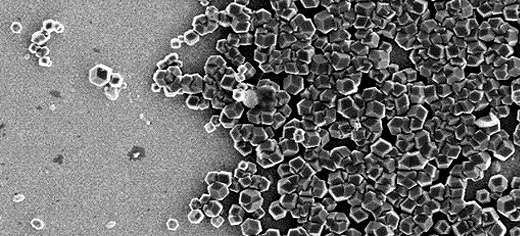
The magnetic array was created by Leeds PhD student Johanna Galloway using a protein which creates perfect nanocrystals of magnetite inside the bacterium Magnetospirilllum magneticum. In a process akin to potato-printing on a much smaller scale, this protein is attached to a gold surface in a checkerboard pattern and placed in a solution containing iron.

At a temperature of 80°C, similarly-sized crystals of magnetite form on the sections of the surface covered by the protein. The team are now working to reduce the size of these islands of magnets, in order to make arrays of single nanomagnets. They also plan to vary the magnetic materials that this protein can control. These next steps would allow each of these nanomagnets to hold one bit of information allowing the construction of better hard drives.

"Using today's 'top-down' method - essentially sculpting tiny magnets out of a big magnet - it is increasingly difficult to produce the small magnets of the same size and shape which are needed to store data," said Johanna Galloway. "Using the method developed here at Leeds, the proteins do all the hard work; they gather the iron, create the most magnetic compound, and arrange it into regularly-sized cubes."

A different protein has been used to create tiny electrical wires by Dr Masayoshi Tanaka, during a secondment to Leeds from Tokyo University of Agriculture and Technology. These 'nanowires' are made of 'quantum dots' - particles of copper indium sulphide and zinc sulphide which glow and conduct electricity - and are encased by fat molecules, or lipids.

The magnetic bacteria contain a protein that moulds mini compartments for the nanomagnets to be formed in using the cell membrane lipids. Dr Tanaka used a similar protein to make tubes of fat containing quantum dots - biological-based wiring.

"It is possible to tune these biological wires to have a particular electrical resistance. In the future, they could be grown connected to other components as part of an entirely biological computer," said Dr Tanaka.

The research group and the team at Tokyo University of Agriculture and Technology, led by Prof. Tadashi Matsunaga, now plan to examine the biological processes behind the behaviour of these proteins. "Our aim is to develop a toolkit of proteins and chemicals which could be used to grow computer components from scratch," adds Dr Staniland.

The papers Biotemplated Magnetic Nanoparticle Arrays and Fabrication of Lipid Tubules with Embedded Quantum Dots by Membrane Tubulation Protein are published in the journal Small.

This research is funded by the Engineering and Physical Sciences Research Council (EPSRC), Biotechnology and Biological Sciences Research Council (BBSRC) and the Royal Society's Newton International Fellowships Scheme.

Source: University of Leeds

Additional Information: