Blogger Themes

Showing posts with label Lockheed Martin. Show all posts

Thursday, 26 April 2012

3D Printing Technology: Manufacturing technologies present new opportunities for R&D prototypes and high-end manufacturing facilities

R&D Magazine
April 26, 2012


Flight Testing 3D Printing


For years, aerospace engineers have been inspired by the natural world, and many have built and flown biologically inspired vehicles. Engineers at Lockheed Martin Advanced Technology Laboratories (ATL), Cherry Hill, N.J., are designing, flying, and 3D printing Samarai, a family of unmanned aerial vehicles (UAVs) that mimic the shape of winged maple seeds—samaras—that float to the ground each spring. The vehicles are structurally simple, and inherently stable in flight.

Shahrukh Tarapore, senior research scientist at Lockheed Martin Advanced Technology Laboratories, examines the 3D-printed Samarai as he pulls it from the Stratasys Dimension 3D printer. Image: Lockheed Martin Advanced Technology Laboratories
Since 2009, Lockheed Martin ATL engineers have been producing and flying Samarai using traditional materials and manual manufacturing. However, the team is now investigating 3D printing to produce the vehicles.

The research project has two goals. The team will explore whether or not 3D printing can drastically reduce the time and costs required to design and manufacture the small UAV. Also, the team plans to develop a tool that takes specific mission objectives—such as flight duration—as input and automatically produce a customized vehicle design that meets these objectives. This research could go far beyond the Samarai platform, as the technology could be extended to support other complex systems.

3D printing also helps gain insight into how the Samarai wing design affects flight characteristics. Single wing, or monowing, flight is not well understood, and the rapid manufacturing of different designs through 3D printing, combined with testing the different variants and measuring resulting performance, enables rapid exploration of the flight design space.  To read more click here...


New Life for 3D Printing


The additive manufacturing industry is populated by a broad family of technologies and some high-end systems can achieve impressive results with metals and polymers. Developments in ceramics may soon make a big impact. The low end of the market has recently been shaken up by the entry of some very low-cost systems that are causing a lot of excitement in the hobbyist market. 
The first 3D-printed full jaw replacement was made in laser-sintered titanium by the Belgian company LayerWise. Image: LayerWise

Metal parts made by laser sintering of powders top the list in performance. A wide range of stainless and tool steels, titanium and nickel alloys, and cobalt-chrome, as well as copper, aluminum, and precious metals can all be formed in machines built by companies such as EOS (Munich), Concept Laser (Lichtenfels, Germany), Renishaw Inc. (Wotton-under-Edge, U.K.), and Phenix Systems (Riom, France). Metal parts are fully dense, with a uniform microstructure due to the localized melting of a static powder bed. Titanium parts meet American Society for Testing and Materials (ASTM) standards for wrought titanium and exceed the strength and toughness of cast materials.

Laser cladding systems, such as those built by Optomec (Albuquerque, N.M.) and POM Group Inc. (Auburn Hills, Mich.), operate by jetting metal powders through a nozzle directed at a focused laser spot. These systems are able to build up parts from different metals in different locations, and are also able to effect repairs on damaged parts.

Medical implants are a very lively market for additive manufacturing metal parts. Recently, a complete lower jaw was fabricated in titanium by the Belgian company LayerWise on an EOS machine, and subsequently coated with a bioceramic by plasma spraying. Smaller custom-fit cranial implants, as well as dental implants and copings, are becoming more and more common.

More than 30 different systems make plastic parts of some type. Unlike laser-sintered metals, polymeric parts generally don't meet the same standards as conventionally processed materials. This shortcoming has relegated most processes to design prototyping and display models.

The additive manufacturing industry was founded in the mid-1980s by 3D Systems, Rock Hill, S.C., with a technology called stereolithography, which is still one of the most widely used and profitable methods. It is moderately fast, accurate, and very reliable. It is also laser-based, but rather than directing the laser onto a bed of powder, the laser is focused on the surface of a bath of photopolymer that is selectively cured in layers. The resulting parts—mostly epoxies and acrylics—are transparent and relatively tough. Stereolithography parts are useful for displaying the internal components of assemblies.  To read more click here...

Source: R&D Magazine

Tuesday, 3 January 2012

K-MAX unmanned helicopter makes first cargo delivery

Engineerblogger
Jan 3, 2012


K-MAX is the Marine's first unmanned helicopter.  Photo courtesy of Lockheed Martin

A new era in unmanned aviation began earlier this month when Marine Unmanned Aerial Vehicle Squadron 1 operated a K-MAX unmanned helicopter during its historic 90-minute flight, Dec. 17. K-MAX is the Marine's first unmanned helicopter designed for resupplying troops in remote locations. During its maiden flight, K-MAX successfully delivered about 3,500 pounds of food and supplies to troops at a forward operating base in Afghanistan without risk to a pilot.

Source: NAVAIR


Related Information:

Thursday, 15 September 2011

Lockheed, Ball chosen for solar propulsion concept

Engineerblogger
Sept 15, 2011


Two Colorado-based aerospace operations are among five companies chosen by NASA to develop concepts for demonstrating solar electric propulsion in space.

NASA said this week that Lockheed Martin Space Systems of Littleton and Ball Aerospace & Technologies of Boulder were chosen for the project.

NASA says contracts still have to be negotiated. They would be worth up to $600,000 each.

Each company would provide a report on how to demonstrate solar electric propulsion technologies, capabilities and infrastructure for human space travel.

Also chosen for the project were Analytical Mechanics Associates in Hampton, Va., Boeing in Huntington Beach, Calif., and Northrop Grumman Systems in Redondo Beach, Calif.

Source: The AP

Monday, 22 August 2011

Lockheed Martin Unveils Samarai Flyer at Unmanned Vehicle Conference

Engineerblogger
Aug 22, 2011

Inspired by a maple seed, Lockheed Martin's Samarai handheld vehicle flew publically for the first time today at the Association for Unmanned Vehicle Systems International conference.

Weighing less than half a pound, Samarai demonstrated vertical takeoff and landing, stable hover, and on-board video streaming. While the aircraft flew a series of flights in the roughly 40 foot test area, it streamed live video from a camera that rotated around its center providing a 360 degree view without a gimbal.


"Our team has taken the basic shape and design of the naturally aerodynamic maple seed and harnessed it with flight controls and avionics," said Kingsley Fregene, principal investigator for Samarai at Lockheed Martin's Advanced Technology Laboratories. "We've learned a great deal about biologically inspired vehicles that we can apply across the laboratory, including a better understanding of micro-robots and the devices that control their movement."

Samarai is mechanically simple with only two moving parts. Because its 16 inches long and weighs less than half a pound, an operator can easily carry the vehicle in a backpack and launch it from the ground or like a boomerang. The design is scalable to meet different missions, including surveillance and reconnaissance and payload delivery.

Lockheed Martin tested the first 3-D printed Samarai last week. The vehicle was produced by "printing" successive small layers of plastic to create a single form. The printer eliminates expensive production costs, allowing engineers to quickly and affordably produce Samarai tailored to specific missions.

Source: Lockheed Martin

Friday, 1 July 2011

Lockheed Martin's HULC™ Robotic Exoskeleton Enters Biomechanical Testing at U.S. Army Natick Soldier Systems Center

Orlando FL (SPX)
July 01, 2011
Biomechanical testing of the Lockheed Martin ruggedized HULC exoskeleton is now underway at the U.S. Army Natick Soldier Research, Development and Engineering Center in Natick, Mass. The testing is expected to help shape future requirements for the HULC based on feedback from soldiers.

For seven weeks, U.S. Army warfighters will be evaluated to assess the effects of load carriage with and without use of the HULC exoskeleton. Biomechanical testing will measure changes in energy expended by users, assessing how quickly individuals acclimate to the system and whether there is a reduction in metabolic cost.

Testing will also determine if there is an improvement in metabolic efficiency as measured by oxygen consumption per unit total mass, when wearing the ruggedized HULC as compared to not wearing the device under identical load, speed, grade and duration conditions.
To read more click here...

Tuesday, 22 March 2011

LockMart Makes Strides In Human Space Exploration

Denver CO (SPX) 
March 22, 2011
 
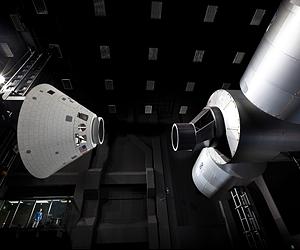
Forging a new path forward to ensure safe, affordable and sustainable human exploration beyond low Earth orbit, Lockheed Martin has unveiled the first Orion spacecraft and a spacious state-of-the-art Space Operations Simulation Center (SOSC). These two major projects, located at Lockheed Martin's Waterton Facility near Denver, Colo., showcase the NASA-industry teams' progress for human space flight, the Orion Project and NASA's Multi-Purpose Crew Vehicle.
To read more click here...

Friday, 18 March 2011

Lockheed Martin Team Fuel Cell Milestone Validates Potential In-Theater Use

Lockheed Martin
March 16, 2011
Lockheed Martin and Technology Management Inc. for the first time have operated a fuel-cell generator for 1,000 hours using the military’s standard fuel, JP-8. This milestone paves the way to field fuel-cell generators in theater to create a more efficient, safe and affordable method to convert expensive fuel into electricity.
To read more click here...