Blogger Themes

Tuesday, 10 July 2012

Will a carbon fiber supply crunch emerge?

Engineerblogger
July 10, 2012


Carbon Fibre Frame Credit: silovu.mysecondarydns.com

Forecasts for carbon fiber (CF) usage in 2020 vary widely from 136,000 tonnes according to CF supplier SGL Group (Wiesbaden, Germany) to 342,000 tonnes in a best-case scenario painted by Professor Andrew Walker of Director of the Northwest Composites Center at the University of Manchester during the recent JEC Asia Carbon Fiber Forum in Singapore. If the most optimistic scenario is to emerge, CF suppliers will need to get a hurry-on if they have any hope of matching this booming demand, otherwise growth may be restrained by lack of supply.

Through to 2015, around 30,000 tonnes/year of small tow PAN-based CF capacity is due to be added and based on a coefficient of 0.7 to take into account actial plant operational conditions, this translates to just over 67,000 tonnes of output according to Frank Glowacz, technical editor at JEC Composites (Paris, France). Large tow capacity, meanwhile, will almost double from 22,150 tonnes/year capacity in 2011 to 43,200 tonnes/year in 2015, with output of close to 39,000 tonnes.

This 106,000 tonnes/year of output capability seems more than enough to cater to demand for a conservative growth path, given 2015 demand may only be of the order of 47,000 tonnes, but there would be supply concerns if growth tracks the optimistic route given it takes around two years to construct and start up a plant. "If we want to grow the market we need to ensure supply is there and in my view the solution is new entrants," says Walker. "The existing players, particularly the Japanese, are too conservative, and only respond to confirmed projects when adding capacity," says Walker. The share of Japanese suppliers of global CF capacity will decline from 59% in 2011 to 50% in 2015 for small tow PAN-based fibers.

New suppliers are thankfully emerging in the industry such as Alabuga-fiber in the Russian Republic of Tatarstan, which expects to be onstream in 2014, and Kemrock (Vadodara) in India, which started production of industrial CF grades in 2011. The Middle East is also a potential source of CF given its low energy costs. In fact, Saudi Basic Industries Corporation (SABIC, Riyadh) has licensed technology from Montefibre SpA (Milan, Italy) for the production of CF with the initial intent being to construct a 3000-tonnes/yr CF plant at Montefibre's existing acrylic fiber production site in Spain, and in the longer term replicate this effort in Saudi Arabia. JEC's Glowacz also notes that Qatar has high potential for CF production. Previously, a plan to set up a carbon fiber composites facility for auto components as a joint venture of Qatar Automotive Gateway (Doha) and UK company Prodrive (Oxfordshire) had been announced.

Source: Plastic Today

Researchers devise scalable method for fabricating high-quality graphene transistors

Engineerblogger
July 10, 2012


Self-aligned graphene transistor

Graphene, a one-atom-thick layer of graphitic carbon, has attracted a great deal of attention for its potential use as a transistor that could make consumer electronic devices faster and smaller.
 
But the material's unique properties, and the shrinking scale of electronics, also make graphene difficult to fabricate on a large scale. The production of high-performance graphene using conventional fabrication techniques often leads to damage to the graphene lattice's shape and performance, resulting in problems that include parasitic capacitance and serial resistance.
 
Now, researchers from the California NanoSystems Institute at UCLA, the UCLA Department of Chemistry and Biochemistry, and the department of materials science and engineering at the UCLA Henry Samueli School of Engineering and Applied Science have developed a successful, scalable method for fabricating self-aligned graphene transistors with transferred gate stacks. 
 
By performing the conventional lithography, deposition and etching steps on a sacrificial substrate before integrating with large-area graphene through a physical transferring process, the new approach addresses and overcomes the challenges of conventional fabrication. With a damage-free transfer process and a self-aligned device structure, this method has enabled self-aligned graphene transistors with the highest cutoff frequency to date — greater than 400 GHz.
 
IMPACT:
The research demonstrates a unique, scalable pathway to high-speed, self-aligned graphene transistors and holds significant promise for the future application of graphene-based devices in ultra–high-frequency circuits.
 
AUTHORS:
Authors of the research include UCLA chemistry postdoctoral scholars Lei Liao and Hailong Zhou; UCLA chemistry graduate students Lixin Liu and Shan Jiang; UCLA materials science and engineering graduate students Rui Cheng, Yu Chen, YungChen Lin and Jinwei Bai (now a research scientist at IBM); UCLA associate professor of materials science and engineering Yu Huang; and UCLA associate professor of chemistry and biochemistry Xiangfeng Duan.
 
Professors Huang and Duan are also members of the California NanoSystems Institute at UCLA.
 
FUNDING:
The research was supported by the National Science Foundation, the National Institutes of Health and the U.S. Office of Naval Research.
 
JOURNAL: 
The research was published in the July 2 issue of Proceedings of the National Academy of Sciences and is available online at http://bit.ly/N8rM7o.
 
Source: UCLA

Tuesday, 3 July 2012

Research paves the way for accurate manufacturing of complex parts for aerospace and car industries

Engineerblogger
July 3, 2012


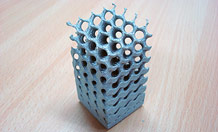
A complex SLM part

Producing strong, lightweight and complex parts for car manufacturing and the aerospace industry is set to become cheaper and more accurate thanks to a new technique developed by engineers from the University of Exeter. The research team has developed a new method for making three-dimensional aluminium composite parts by mixing a combination of relatively inexpensive powders.

Combining these elements causes a reaction which results in the production of particles that are 600 times smaller than the width of a human hair. Around 100 nanometres in size, the reaction uniformly distributes them through the material, making it very strong.

The process is based on the emerging technique of Selective Laser Manufacturing (SLM), in which laser manufactures complicated parts from metal powders, at the University’s Centre for Additive Layer Manufacturing. The new technique has the potential to manufacture aluminium composite parts as pistons, drive shafts, suspension components, brake discs and almost any structural components of cars or aeroplanes. It also enables the production of lighter structural designs with innovative geometries leading to further reduce of the weight of products.

The team’s latest research findings are published in the Journal of Alloys and Compounds.

Parts for cars and aeroplanes are widely made from aluminium, which is relatively light, with other reinforcement particles to make it stronger. The traditional methods, generally involved casting and mechanical alloying, can be inaccurate and expensive, especially when the part has a complex shape. Over the last decade, new SLM techniques have been developed, which enable parts with more complicated shapes to be produced. The new SLM techniques can be applied to manufacture aluminium composite parts from specific powder mixtures.

To carry out this new technique, the researchers use a laser to melt a mixture of powders, composed of aluminium and a reactive reinforcing material for example an iron oxide combination. A reaction between the powders results in the formation of new particles, which act as reinforcements and distribute evenly throughout the composite material.

This method allows parts with complex shapes to be easily produced. The new materials have very fine particles compared with other composites, making them more robust. The reaction between constituents releases energy, which also means materials can be produced at a higher rate using less power. This technique is significantly cheaper and more sustainable than other SLM methods which directly blend very fine powders to manufacture composites.

University of Exeter PhD student Sasan Dadbakhsh of the College of Engineering, Mathematics and Physical Sciences said: “This new development has great potential to make high performance parts for car manufacturing, the aerospace industry and potentially other industries. Additive layer manufacturing technologies are becoming increasingly accessible so this method could become a viable approach for manufacturing."

Dr Liang Hao of the University of Exeter added: “This advancement allows the rapid development of sustainable lightweight composite components. This particularly helps to save a considerable amount of material, energy and cost for the production of one-off or small volume products.”

The Centre for Additive Layer Manufacturing (CALM) is a £2.6 million investment in innovative manufacturing for the benefit of businesses in the South West and across the rest of the UK. CALM is delivered in collaboration with EADS UK Ltd.

Source:  University of Exeter

Additional Information:

Researcher offers new insights into power-generating windows

Engineerblogger
July 2, 2012


(beeld: Eric Verdult, Kennis in Beeld)

On 5 July Jan Willem Wiegman is graduating from TU Delft with his research into power-generating windows. The Applied Physics Master’s student calculated how much electricity can be generated using so-called luminescent solar concentrators. These are windows which have been fitted with a thin film of material that absorbs sunlight and directs it to narrow solar cells at the perimeter of the window. Wiegman shows the relationship between the colour of the material used and the maximum amount of power that can be generated. Such power-generating windows offer potential as a cheap source of solar energy. Wiegman’s research article, which he wrote together with his supervisor at TU Delft, Erik van der Kolk, has been published in the journal Solar Energy Materials and Solar Cells("Building integrated thin film luminescent solar concentrators: Detailed efficiency characterization and light transport modelling").

Windows and glazed facades of office blocks and houses can be used to generate electricity if they are used as luminescent solar concentrators. This entails applying a thin layer (for example a foil or coating) of luminescent material to the windows, with narrow solar cells at the perimeters. The luminescent layer absorbs sunlight and guides it to the solar cells at the perimeter, where it is converted into electricity. This enables a large surface area of sunlight to be concentrated on a narrow strip of solar cells.

The new stained glass

Luminescent solar concentrators are capable of generating dozens of watts per square metre. The exact amount of power produced by the windows depends on the colour and quality of the light-emitting layer and the performance of the solar cells. Wiegman’s research shows for the first time the relationship between the colour of the film or coating and the maximum amount of power.

A transparent film produces a maximum of 20 watts per square metre, which is an efficiency of 2%. To power your computer you would need a window measuring 4 square metres. The efficiency increases if the film is able to absorb more light particles. This can be achieved by using a foil that absorbs light particles from a certain part of the solar spectrum. A foil that mainly absorbs the blue, violet and green light particles will give the window a red colour. Another option is to use a foil that absorbs all the colours of the solar spectrum equally. This would give the window a grey tint. Both the red and the grey film have an efficiency of 9%, which is comparable to the efficiency of flexible solar cells.

Wiegman’s research has also shown the importance of a smooth film surface for the efficient transport of light particles to the perimeter of the window as they are then not impeded by scattering between the film and the window surface.

The research into power-generating windows is in keeping with the European ambition to make buildings as energy neutral as possible. Luminescent solar concentrators are a good way of producing cheap solar energy.

Source: TU Delft

Additional Information:

  • Visit the research website for more information about research into luminescent materials

Lightening the load: new materials for automotive

The Engineer
July 2, 2012
In the automotive sector, mineral fillers such as glass fibre are being replaced by materials such as hemp

Steel could one day be replaced as the material of choice for high-volume auto manufacture, but installed plant and entrenched manufacturing processes make the transition difficult

We’re in a brave new world of engineering innovation, with new inventions and developments enriching our lives every day. Yet some aspects of the devices we depend on have changed little from their inception. It might seem like a contradiction, but sometimes even the most innovative sectors find there are barriers to innovation.

Take, for example, the most visible example of the way technology changed our lives in the last century: the motor car. In many ways, the cars on the roads today are unrecognisable from the contraptions and the early fruits of mass production that trundled down the roads of the 1910s and 1920s. But in others, they have changed very little.

‘People have the perception that cars are basically steel boxes with glass windows, and there’s a good reason for that perception,’ said Prof Richard Dashwood, head of materials and sustainability at the Warwick Manufacturing Group (WMG) and chief technology officer of the new High Value Manufacturing Catapult centre. ‘It is because, largely, they are. Something like 99.9 per cent of all cars on the road are steel-intensive vehicles.’

But the issue of ‘lightweighting’ — reducing the mass of the vehicle — is very much on the minds of automotive manufacturers at the moment. ‘It’s driven by European legislation on CO2 emissions,’ Dashwood said. ‘While you can improve your powertrain and aerodynamics, it’s lightweighting that will give you the biggest CO2 improvement.’

So why, considering the many advances in materials that have taken place over the last century and which have been adopted so enthusiastically by, for example, the aerospace sector, is the automotive industry still so wedded to its original materials?

There are exceptions to this rule. Among the most notable is Jaguar Land Rover, which switched to all-aluminium bodies in 2009, after Jaguar led the way with aluminium construction with the XJ and XK models. Aluminium is, of course, lighter than steel with comparable strength. ‘We didn’t decide to use aluminium because it was new or different,’ said Jaguar’s chief technical specialist for body engineering, Mark White. ‘It is because aluminium delivers significant benefits for drivers.’

Research targets next-generation electric motors for luxury automobiles

Engineerblogger
July 2, 2012


Cobham, Jaguar Land Rover and Ricardo will carry out research into the design of economic electric motors that avoid expensive magnet materials.

Next-generation electric motors for low carbon emission vehicles are the target of a new collaborative research programme to be led by Cobham Technical Services. The project, ‘Rapid Design and Development of a Switched Reluctance Traction Motor’, will also involve partners Jaguar Land-Rover and engineering consultancy Ricardo UK, and is co-funded by the Technology Strategy Board.

As part of its work in the project, Cobham will develop multi-physics software and capture the other partners’ methodology in order to design, simulate and analyze the performance of high efficiency, lightweight electric traction motors that eliminate the use of expensive magnetic materials. Using these new software tools JLR and Ricardo will design and manufacture a prototype switched reluctance motor that addresses the requirements of luxury hybrid vehicles.

The project is one of 16 collaborative R&D programmes to have won funding from the UK government-backed Technology Strategy Board and the Department for Business, Innovation and Skills (BIS), which have agreed to invest £10 million aimed at achieving significant cuts in CO2 emissions for vehicle-centric technologies. The total value of this particular motor project is £1.5 million, with half the amount funded by the Technology Strategy Board/BIS, and the rest by the project partners.

According to Kevin Ward, Director of Cobham Technical Services - Vector Fields Software, “Design software for switched reluctance motors is at about the same level as diesel engine design software when it was first introduced. Cobham will develop its existing SRM capabilities to provide the consortium with enhanced tools based on the widely used Opera suite for design, finite element simulation and analysis. In addition to expanding various facets of Opera’s electromagnetic capabilities, we will investigate advanced integration with our other multi-physics software, to obtain more accurate evaluation of model related performance parameters such as vibration. Design throughput will also be enhanced via more extensive parallelization of code and developing an environment which captures the workflow of the design process.”

Tony Harper, Jaguar Land Rover Head of Research: “It is important to understand the capability of switched reluctance motors in the context of the vehicle as a whole so that we can set component targets that will deliver the overall vehicle experience. Jaguar Land Rover will apply its expertise in designing and producing world class vehicles to this project, with the aim of developing the tools and technology for the next generation of electric motors.”

Dr Andrew Atkins, chief engineer – innovation, at Ricardo UK, said: “The development of technologies enabling the design of electric vehicle motors that avoid the use of expensive and potentially carbon-intensive rare-earth metals, is a major focus for the auto industry. Ricardo is pleased to be involved in this innovative programme and we look forward to working with Cobham and Jaguar Land Rover to develop this important new technology. This will further build upon our growth plans for electric drives capability and capacity.”

The project has a three year timetable, at the end of which improved design tools and processes will be in place to support rapid design, helping to accelerate the uptake of this technology into production. Aside from the need to further reduce CO2 emissions from hybrid vehicles by moving to more efficient and lower weight electric motors, there is an urgent requirement to eliminate the use of rare earth elements, which are in increasingly short supply and have risen ten-fold in cost in recent years. Virtually all electric traction motors currently used in such applications employ permanent magnets made from materials such as neodymium-iron-boron and samarium-cobalt. Since switched reluctance motors do not use permanent magnets, they are likely to provide the ideal replacement technology. However, one of the main challenges of the project will be to produce a torque-dense motor that is also quiet enough for use in luxury vehicles.

Source: Ricardo

Additional Information:

Researchers develop paintable battery onto most surfaces

Engineerblogger
July 2, 2012

An electron microscope image of a spray-painted lithium-ion battery developed at Rice University shows its five-layer structure. (Credit: Ajayan Lab/Rice University)

Researchers at Rice University have developed a lithium-ion battery that can be painted on virtually any surface.

The rechargeable battery created in the lab of Rice materials scientist Pulickel Ajayan consists of spray-painted layers, each representing the components in a traditional battery. The research appears in Nature’s online, open-access journal Scientific Reports.

“This means traditional packaging for batteries has given way to a much more flexible approach that allows all kinds of new design and integration possibilities for storage devices,” said Ajayan, Rice’s Benjamin M. and Mary Greenwood Anderson Professor in Mechanical Engineering and Materials Science and of chemistry. “There has been lot of interest in recent times in creating power sources with an improved form factor, and this is a big step forward in that direction.”

Lead author Neelam Singh, a Rice graduate student, and her team spent painstaking hours formulating, mixing and testing paints for each of the five layered components – two current collectors, a cathode, an anode and a polymer separator in the middle.

The materials were airbrushed onto ceramic bathroom tiles, flexible polymers, glass, stainless steel and even a beer stein to see how well they would bond with each substrate.

In the first experiment, nine bathroom tile-based batteries were connected in parallel. One was topped with a solar cell that converted power from a white laboratory light. When fully charged by both the solar panel and house current, the batteries alone powered a set of light-emitting diodes that spelled out “RICE” for six hours; the batteries provided a steady 2.4 volts.

The researchers reported that the hand-painted batteries were remarkably consistent in their capacities, within plus or minus 10 percent of the target. They were also put through 60 charge-discharge cycles with only a very small drop in capacity, Singh said.

Each layer is an optimized stew. The first, the positive current collector, is a mixture of purified single-wall carbon nanotubes with carbon black particles dispersed in N-methylpyrrolidone. The second is the cathode, which contains lithium cobalt oxide, carbon and ultrafine graphite (UFG) powder in a binder solution. The third is the polymer separator paint of Kynar Flex resin, PMMA and silicon dioxide dispersed in a solvent mixture. The fourth, the anode, is a mixture of lithium titanium oxide and UFG in a binder, and the final layer is the negative current collector, a commercially available conductive copper paint, diluted with ethanol.

“The hardest part was achieving mechanical stability, and the separator played a critical role,” Singh said. “We found that the nanotube and the cathode layers were sticking very well, but if the separator was not mechanically stable, they would peel off the substrate. Adding PMMA gave the right adhesion to the separator.” Once painted, the tiles and other items were infused with the electrolyte and then heat-sealed and charged.

Singh said the batteries were easily charged with a small solar cell. She foresees the possibility of integrating paintable batteries with recently reported paintable solar cells to create an energy-harvesting combination that would be hard to beat. As good as the hand-painted batteries are, she said, scaling up with modern methods will improve them by leaps and bounds. “Spray painting is already an industrial process, so it would be very easy to incorporate this into industry,” Singh said.

The Rice researchers have filed for a patent on the technique, which they will continue to refine. Singh said they are actively looking for electrolytes that would make it easier to create painted batteries in the open air, and they also envision their batteries as snap-together tiles that can be configured in any number of ways.

“We really do consider this a paradigm changer,” she said.

Co-authors of the paper are graduate students Charudatta Galande and Akshay Mathkar, alumna Wei Gao, now a postdoctoral researcher at Los Alamos National Laboratory, and research scientist Arava Leela Mohana Reddy, all of Rice; Rice Quantum Institute intern Andrea Miranda; and Alexandru Vlad, a former research associate at Rice, now a postdoctoral researcher at the Université Catholique de Louvain, Belgium.

The Advanced Energy Consortium, the National Science Foundation Partnerships for International Research and Education, Army Research Laboratories and Nanoholdings Inc. supported the research.


Source: Rice University